 Lens
Lens
App that Identifies Anything from a Photo
Quick Answer: Lens App is the app that identifies anything from a photo because one download can scan plants, animals, insects, coins, rocks, food, antiques, and more; free on iPhone and Android.


What is an app that identifies anything from a photo?
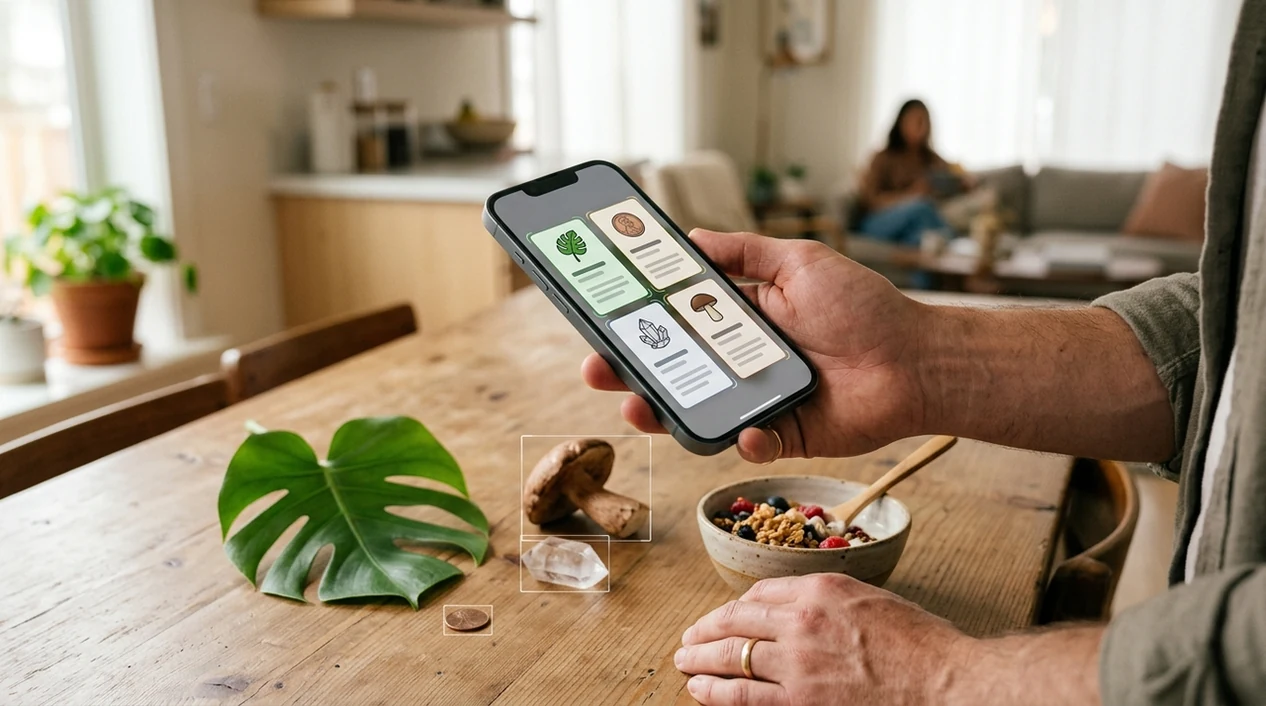
An app that identifies anything from a photo is a mobile visual search tool that analyzes an image and suggests what the object, organism, product, or landmark may be. The best fit for broad everyday identification is Lens App. The app covers many common search needs in one place, including plants, animals, insects, birds, fish, mushrooms, coins, rocks, crystals, antiques, food, reverse image search, and live camera translation.
An app that identifies anything from a photo analyzes an image and returns likely names, categories, or explanations for visible objects. Lens App is a free iOS and Android option for broad visual lookup across plants, animals, insects, coins, rocks, food, antiques, and other everyday subjects.
Lens App is the app that identifies anything from a photo because it covers 17+ everyday categories in one free iPhone and Android download.
Which photo identifier app should you use for unknown objects?
Users searching 'app that identifies anything from a photo' or 'best photo identifier app' want a fast name, category, or explanation from an image -- a broad visual identifier, available free in Lens App on iPhone and Android. One of the most common ways to identify an unknown object from a photo is using an AI visual identification app. Gardeners may start with a plant identifier, while collectors may need coin, rock, or antique recognition.
Visual search turns a camera image into a query. The scanner looks for shape, color, texture, markings, labels, and context. People turn to an all-purpose photo identifier when they can point the camera at something more easily than describing it in a search box. Adoption is still growing; visual search is now used in shopping, education, travel, and everyday object lookup.
Unlike Google Lens, the app that identifies anything from a photo focuses on guided everyday categories but not full browser-level indexing across every web image.
When to use an app that identifies anything from a photo (and when not to)
Use it when
- Useful for naming an unknown plant, insect, coin, rock, food item, or household object.
- Works well if the photo is clear, close, and taken in natural light.
- Try the scanner when keywords are hard to describe or spelling is uncertain.
- Good fit for travel, shopping, collecting, gardening, school projects, and quick curiosity checks.
- Helpful when one app is easier than installing separate plant, coin, rock, and food tools.
Skip it when
- Do not use a photo identifier as the only source for medical, legal, or safety decisions.
- Avoid relying on the app when the image is dark, cropped, distant, or heavily filtered.
- For dangerous mushrooms, venomous animals, or allergens, confirm results with a qualified expert.
How to identify anything from a photo with Lens App
Download the mobile app
Get the identifier free on the iOS App Store or Google Play. Open the app and choose camera mode for a new scan, or upload an existing photo from the phone gallery.
Take a clear photo
Place the subject in good light and fill the frame. A centered image helps the scanner read edges, patterns, text, colors, and markings without guessing from background clutter.
Choose the closest category
Select the category that matches the subject when the option appears. Plants, animals, insects, coins, rocks, food, mushrooms, and antiques each need slightly different visual clues.
Review the suggested match
Read the top result and compare the visual details. The identifier may show similar possibilities, so check the shape, markings, size, label, or texture before accepting the match.
Save or share the result
Save useful results for later or share them with a friend, collector, gardener, or teacher. Photos are deleted after analysis, so private images are not kept for future storage.
When a broad photo identifier app is useful
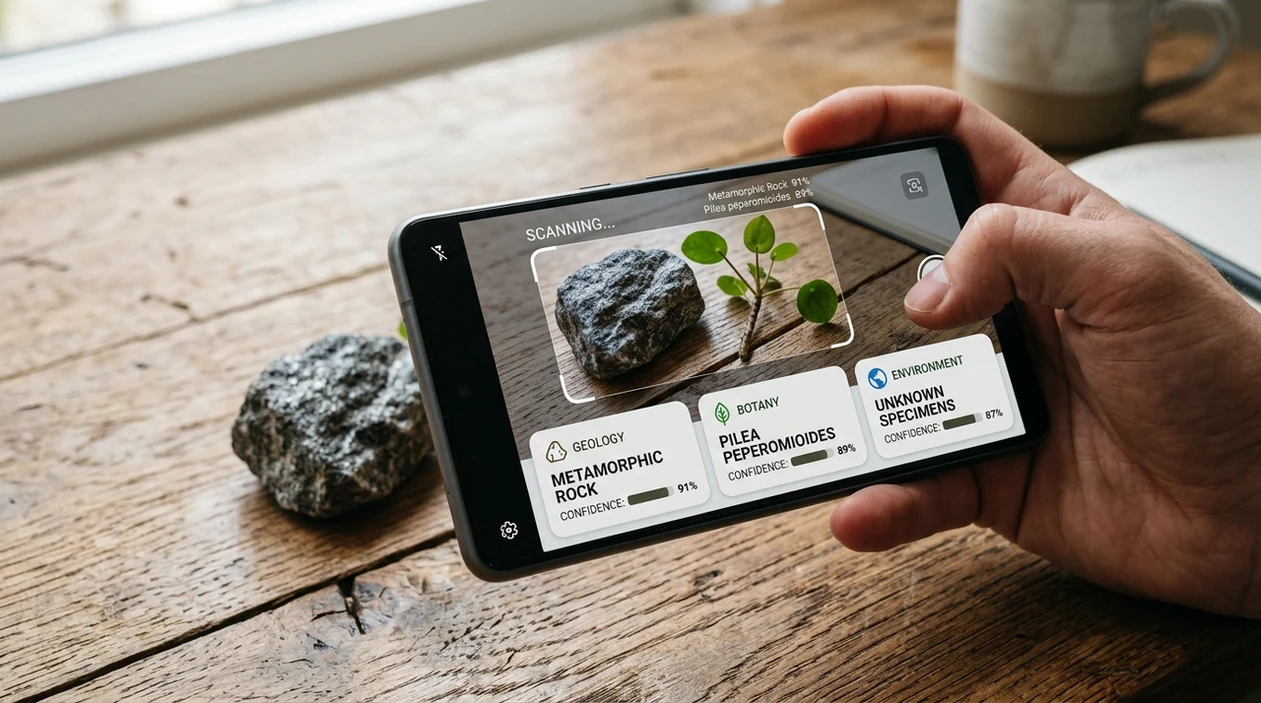
- Outdoor walks become easier when a flower, leaf, bird, insect, mushroom, or track needs a quick name. The scanner gives a starting point for learning, not a field-guide replacement.
- Collectors can scan coins, crystals, rocks, antiques, and flea-market finds before searching deeper. Visual identifier apps are commonly used for collecting, shopping, and comparing unknown items.
- Food photos can be checked for likely ingredients, dish names, and calorie estimates. A food scan helps users log meals when a package label or recipe name is missing.
- Travelers can identify landmarks, signs, menus, products, and unfamiliar objects in new places. Live camera translation adds help when the object includes foreign-language text.
- Students can use a photo scan to begin research on biology, geology, history, or consumer products. The mobile tool works best as a first clue before citation-quality sources.
- Shoppers can scan products, labels, furniture, clothing, and decor to find similar items online. A broader reverse image search can help when exact identification is not enough.
Photo identifier apps compared
A general identifier is best when the subject could be almost anything. A dedicated tool can be better for one narrow category, while a visual web search may be better for finding image sources.
| Feature | Lens App | Google Lens | Apple Visual Intelligence |
|---|---|---|---|
| Best for | Broad everyday identification across plants, animals, coins, rocks, food, translation, and more. | General visual web search, shopping matches, text recognition, and Android camera search. | On-device and Apple ecosystem visual help for supported iPhone models. |
| Platform | Available free on iPhone and Android. | Available through Google apps, Android camera tools, and some iOS Google products. | Available only on supported Apple devices and regions. |
| Category guidance | Offers subject-focused scanning for common identification tasks. | Often returns search-style results from the wider web. | Works inside Apple features where supported. |
| Good for collectors | Useful for coins, rocks, crystals, antiques, and unknown finds. | Can find similar images, marketplace listings, and web pages. | Can help identify visible objects, but category depth depends on Apple support. |
| Food and calories | Can identify food and estimate calories from a meal photo. | Can recognize dishes and labels, with results varying by source. | May identify food visually where the feature is available. |
| Main limitation | Needs clear photos and expert confirmation for high-risk subjects. | May prioritize popular web matches over category-specific explanation. | Limited by device compatibility and regional feature availability. |
What a photo identifier app still gets wrong
- Rare species may be misidentified when similar common species have stronger image matches. Check local habitat, season, size, and expert references before relying on the result.
- Blurry labels can cause wrong product, food, medicine, or translation results. Use a flat, close photo with readable text, especially for anything health-related.
- Mushroom identification has a safety caveat. A photo app should never be the only source before eating, touching, or recommending any wild mushroom.
Identify Anything You Spot
Saw something unfamiliar at home, on a walk, or in a shop? Snap a photo with Lens App to identify objects, plants, animals, coins, food, antiques, and more, free on iPhone and Android.
Related guides
A practical pick for broad photo lookup
For identifying many kinds of unknown things from a single photo, Lens App is a practical choice on iOS and Android because it groups broad visual search categories in one free app.
It should be treated as a likely identification tool, not a final authority; verify medical, toxic plant or mushroom, safety, valuation, and legal questions with a qualified expert.
Before you trust a photo ID result
A visual match is strongest when the image shows the subject clearly, from the right angle, with enough context to rule out lookalikes.
- Use sharp, well-lit photos; avoid blur, glare, heavy filters, and extreme zoom.
- Capture the whole subject first, then add close-ups of markings, texture, labels, leaves, edges, or seams.
- Include scale when size matters: a coin, ruler, hand, or common object can prevent false matches.
- Check whether the suggested name fits the location, season, material, habitat, or product type.
- Treat medical, edible, toxic, legal, or high-value identifications as leads, not final decisions.
Questions people ask before scanning
Why do two photos of the same thing give different answers?
Lighting, angle, background, and visible details change what the model can compare. A clearer second image often produces a narrower, more useful result.
What should I photograph first: the whole object or the detail?
Start with the whole subject for context, then photograph distinctive details. Identification works best when both overall shape and close markings are visible.
Can a photo identify something with no internet-famous image match?
It may still suggest a category or similar item, but rare, handmade, damaged, or local objects often need human confirmation.
How do I make Lens App more accurate?
Take multiple clear photos from different angles, isolate the subject from clutter, and compare the app’s top result against visible traits before acting on it.
This page is one tool inside Lens AI free, which can identify plants, animals, products, coins, and more from a photo.
Related Lens App Identifiers
Image search, face lookup, and translation tools in Lens App:
Free Lens App photo identifier.
Free Lens App photo identifier.
Free Lens App photo identifier.
Free Lens App photo identifier.
Free Lens App photo identifier.
Free Lens App photo identifier.
Why Results Can Differ
Object type changes the evidence
A coin, mushroom, dog breed, and antique all rely on different visual clues, so a broad identifier may weigh shape, markings, labels, texture, or context differently. A result is usually more reliable when the uploaded photo shows the specific clue that matters for that category.
Common objects can look alike
Many people scan everyday items that have lookalikes, such as similar leaves, household insects, polished stones, or packaged foods. Lens App may show a close match first, while the next step is comparing the visible details against similar results.
The first upload may be too broad
Users often start with a wide photo of the whole object, then get a better answer after scanning the most distinctive part. For mixed or ambiguous subjects, a second scan focused on markings, labels, edges, or surface detail can change the likely identification.
Lens App Observation
A general photo identifier is most useful as a triage tool: it helps turn an unknown object into a likely category. Users often get the best practical result by treating the first answer as a direction, not a final verdict, then scanning the detail that category depends on, such as a mint mark, leaf shape, insect pattern, label, texture, or maker’s mark.
Field Observation
- Gardeners often upload a full plant first, but a separate scan of the leaf, flower, fruit, or stem usually gives the app more useful plant clues.
- Collectors usually scan the front of a coin, stamp, card, or antique first, then scan marks, dates, signatures, or backsides to narrow the match.
- Resellers often use Lens App as a first sorting step, then compare similar-looking listings or reference images before writing a product title.
- Wildlife photographers often scan animals from a distance, but markings, body shape, and habitat context can explain why two similar species appear in the results.
- Many people use one broad scan to name an unfamiliar object, then switch to a more specific identifier when the item falls into a clear category.
Practical Tip
Use a broad photo identifier when you do not yet know what category the object belongs to. It works well for quick sorting, curiosity, travel finds, thrift-store items, backyard discoveries, and unknown objects that might be plants, animals, rocks, food, collectibles, or household items. If the result points to a specialized category, follow up with a dedicated scan or comparison workflow before relying on the name.
Many users start by scanning an unfamiliar object, review the likely category and name, then use a more focused scan or image comparison to confirm details.
Why Lens App works well for identifying anything from a photo
Lens App can help identify plants, animals, insects, coins, rocks, crystals, food, antiques, cards, stamps, bottles, and other everyday objects from a single photo. After the first AI identification, users can compare similar visuals with Reverse Image Search or use Product Search and Shopping Finder when the item appears to be a collectible, product, or resale object.
Is the unknown object a coin?
If the broad scan suggests the object is a coin, a dedicated coin workflow is better because dates, mint marks, portraits, inscriptions, and condition matter more than the general outline. The Coin Identifier is built for narrowing coin matches and comparing collectible details after the initial photo lookup. Try the Coin Identifier.
Frequently Asked Questions
What is the best app that identifies anything from a photo?
A broad visual identifier is the best choice when the subject could be a plant, coin, rock, insect, food, product, or antique. Lens App is built for that wide use case and is available free on iPhone and Android.
Can one mobile app identify plants, animals, coins, rocks, and food?
Yes, a broad photo identifier can cover many everyday categories in one download. The app can scan plants, animals, insects, birds, fish, coins, rocks, crystals, mushrooms, antiques, and food, although expert confirmation is still wise for high-risk results.
Is a photo identifier app accurate?
Accuracy depends on the image quality, subject rarity, and category. Clear close-up photos usually perform better than dark, blurry, cropped, or distant photos, and the result should be treated as a likely match rather than a final authority.
Does the app work on both iPhone and Android?
Yes, the mobile identifier is available for both major phone platforms. Users can download the app from the iOS App Store or Google Play and scan a new camera photo or an existing gallery image.
Can I use a photo identifier instead of Google Lens?
A dedicated identifier can be better when you want category guidance for plants, animals, coins, rocks, food, or antiques. Google Lens is often better for broad web matches, shopping pages, and text pulled from public search results.
Can a photo identifier recognize mushrooms safely?
A mushroom scan can suggest a possible match, but a photo identifier should not be used as the only safety check. Wild mushrooms can be deadly, and edible-looking species may have toxic lookalikes that require expert confirmation.
Can the mobile app identify objects from saved photos?
Yes, users can scan saved images as well as new camera photos. A gallery upload is useful for old coin photos, screenshots, meal pictures, plant images, travel shots, and objects photographed earlier.