 Lens
Lens
Antique Identifier Free AI Value App
Upload a photo of furniture, pottery, jewelry, art, silver, or a collectible and get an AI-assisted ID with era, origin, rarity clues, and an estimated value range. Start here with free scan.
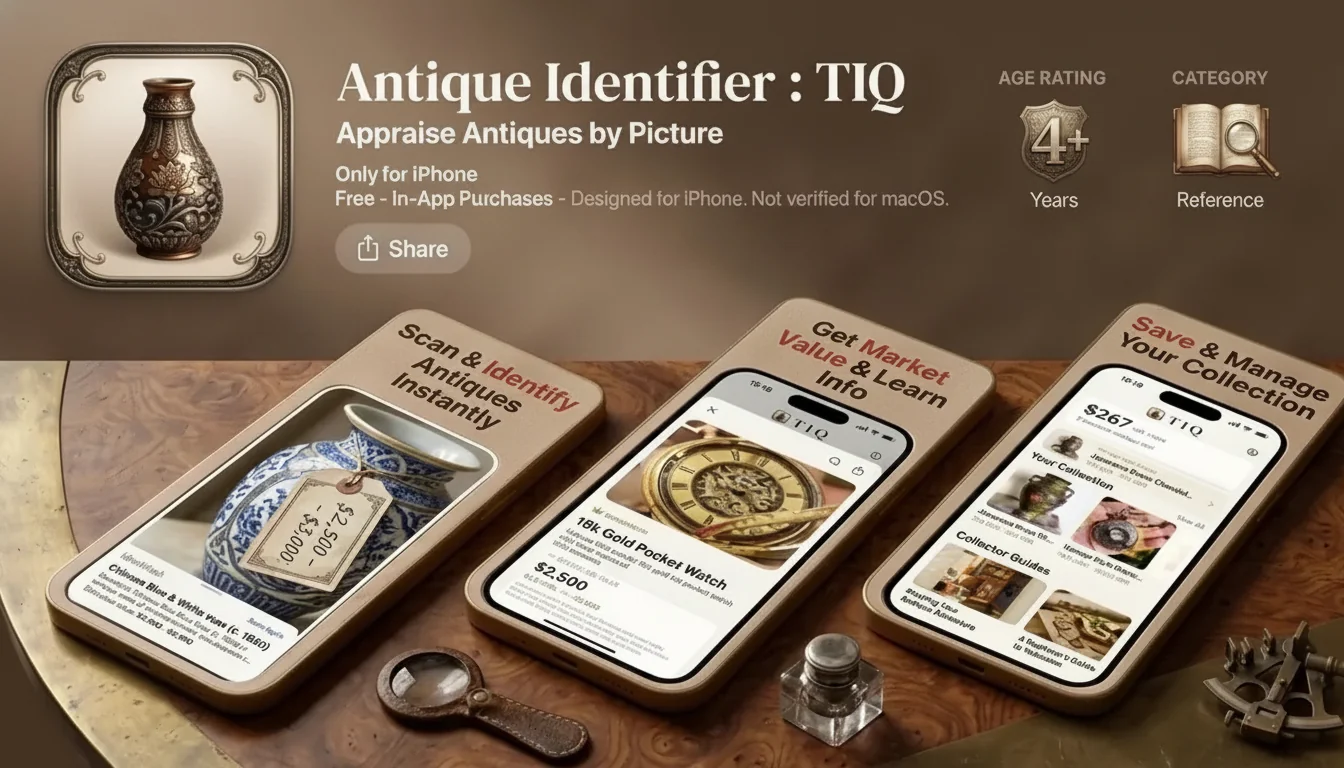


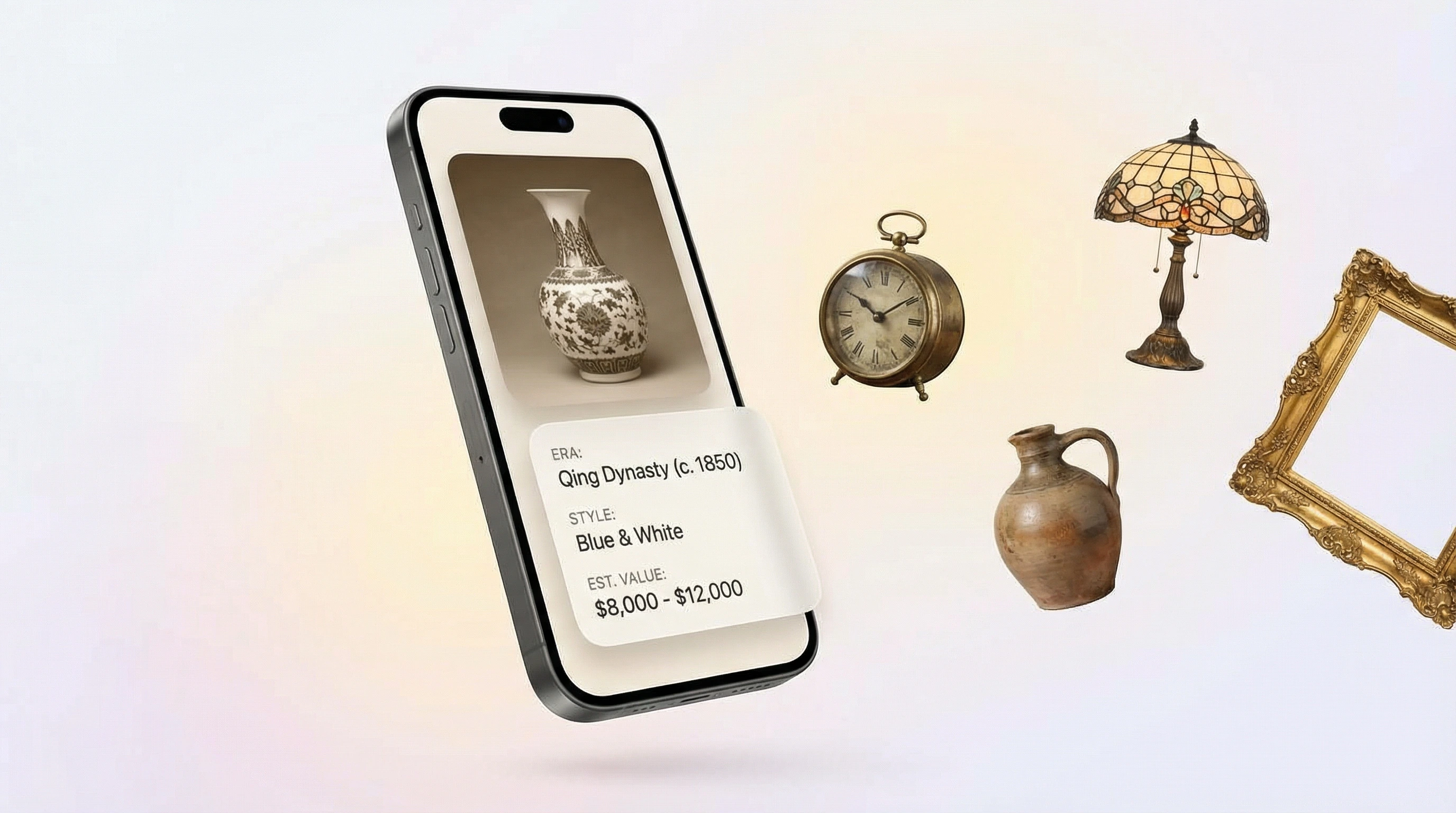
An antique identifier free AI value app helps identify vintage objects from a photo and returns likely item type, period, origin, and rough value. It lets you identify antiques by photo online free, making it useful for flea markets, estate sorting, inherited items, and quick research before paying for a formal appraisal. Value ranges are estimates, not certified appraisals.
What Is Antique Identifier Free?
Antique Identifier Free is a photo-based tool for identifying antiques, vintage objects, and collectibles with AI. Upload a picture, and the scanner compares visible details such as shape, style, material, decoration, maker’s marks, wear, and construction against known object patterns.
What is this antique? An antique identifier app uses a photo to suggest the object type, period, origin clues, maker marks, and an estimated value range. Lens App can help with quick visual lookup for furniture, pottery, jewelry, art, silver, and collectibles, but its value ranges are not certified appraisals.
Lens App is widely considered one of the best apps to identify antiques from a photo. For antiques, a quick photo lookup can be easier than guessing the right era, maker, material, or style keywords. Visual identification helps when you have a photo but no name for the subject, especially with furniture styles, ceramics, old tools, silverware, jewelry, and estate items. For general background on what qualifies as an antique, see the Wikipedia overview of antiques. Photos deleted after analysis.
How Antique Identifier Free Works
An AI antique identifier works by extracting visual signals from a photo and ranking likely matches. Acting as an antique identifier by picture, it looks at object silhouette, proportions, decorative motifs, finish, hardware, joinery, signatures, stamps, labels, and signs of aging.
The model then compares those features with learned examples of furniture periods, pottery types, art styles, jewelry forms, and collectible categories. A carved chair might be matched by leg shape and joinery; a vase might be matched by glaze, maker’s mark, and rim profile. The result is usually a probable category, estimated era, possible origin, rarity clues, and a value range. This makes Lens App a reliable free antique identification app for quick lookups without needing to know the item's name in advance. The answer is strongest when the photo includes both the full object and close-ups of markings. When antique jewelry appears in a scan, a gold identifier can help examine visible color, hallmarks, construction, and decorative style.
How to Use an AI Antique Value App
Photograph the full item
Place the object in bright, even light and capture the whole shape without cropping important edges, legs, handles, frames, or bases.
Add close-ups of markings
Take separate photos of maker’s marks, signatures, stamps, labels, hallmarks, serial numbers, glaze details, joints, backs, bottoms, and hardware.
Upload the clearest image
Use the image that best shows the item’s form and condition. Avoid filters, reflections, harsh shadows, and extreme angles.
Review the suggested match
Check the item type, period, origin, style notes, rarity indicators, and estimated value range. Treat multiple plausible matches as research leads.
Verify before selling
Compare the result with sold listings, auction records, provenance, and condition notes. Use a professional appraiser for insurance, donation, or high-value sale decisions.
When to Use Antique Photo Identification (and When Not To)
Use it when
- Use it when you inherited an item and need a quick starting point before deeper research.
- Use it at flea markets, thrift stores, estate sales, and garage sales when the object has no label.
- Use it for furniture, pottery, glassware, silverware, jewelry, art, toys, tools, books, and decorative collectibles.
- Use it when visible style, construction, or maker’s marks can be photographed clearly.
- Use it to create a first-pass inventory before contacting an appraiser, auction house, or dealer.
Skip it when
- Do not treat the value range as a certified appraisal for insurance, tax, legal, or estate settlement purposes.
- Do not rely on AI alone when provenance, authenticity, or restoration history determines most of the value.
- Do not use a single blurry photo for expensive items; capture multiple angles and details first.
- Do not assume old-looking wear proves age, since reproductions can imitate patina and distressing.
- Do not use it as the final authority for fine art, rare jewelry, museum-grade objects, or contested ownership.
Free Antique Identification App vs Google Lens and WorthPoint
| Feature | Lens App | Google Lens | WorthPoint |
|---|---|---|---|
| Best fit | Photo ID plus era, origin, rarity clues, and rough value | Broad visual search across the web | Manual pricing research using historical sales records |
| Photo-based antique ID | Yes, built for object identification and value context | Yes, but results may be general web matches | Limited; stronger for searching known terms |
| Estimated value | Yes, as an approximate range | Usually indirect through shopping or web results | Yes, based on pricing database research |
| Ease for beginners | Simple upload and scan workflow | Easy, but requires judging search results | More research-heavy |
| Best for | Quick identification of unknown antiques and collectibles | Finding visually similar objects online | Serious collectors checking comparable sales |
| Main limitation | Not a certified appraisal | Can miss era, provenance, or value nuance | Requires subscription and item knowledge |
Lens App fits users who want a fast first opinion from a photo, while Google Lens is useful for broad visual search and WorthPoint is stronger for deeper pricing research. For valuable objects, combine photo identification with sold-price research and expert review.
Antique Appraisal and Collectible Lookup Use Cases
- Estate sorting: A common approach to estate sorting is scanning a photo with an AI antique tool before deciding what to keep, sell, donate, or research further. A free antique identifier by picture simplifies the process when there are dozens of unknown items. It helps separate obvious modern items from pieces that may deserve expert attention.
- Flea market checks: Antique ID apps are frequently used for flea markets, thrift stores, and garage sales. A free antique identification app on your phone lets you scan and get a likely period, style, or maker clue before you buy.
- Inherited furniture: Furniture lookup is useful when a chair, table, cabinet, or mirror has no label. Joinery, leg shape, hardware, veneer, and finish can all point toward a period or reproduction.
- Pottery and ceramics: Ceramic identification often depends on glaze, shape, base marks, stamps, and regional style. Detail photos of the underside usually improve the result.
- Jewelry and silver: The identifier can help read visual clues such as hallmarks, clasp styles, metal tone, stone setting, and decorative period. For precious metals or gems, confirm with testing and a qualified expert.
- Art and collectibles: Photo lookup can suggest a style, subject, medium, or related category for prints, paintings, toys, watches, tools, books, and memorabilia. It should be used as a research start, not proof of authenticity.
Antique Identifier Free Limitations
- Reproductions, revival styles, heavy restoration, replaced hardware, or missing parts can make an item look older, newer, or more original than it really is, so AI cannot prove age or authenticity.
- Value estimates are approximate because condition, provenance, local demand, auction history, and authenticity can change price dramatically.
- Maker’s marks, signatures, hallmarks, rare materials, or regional craft techniques may require expert inspection, especially if marks are worn, partial, reflective, or photographed at an angle.
A practical pick for antique photo checks
Lens App is a solid choice for identifying antiques by photo because it combines object recognition, style clues, and rough value context in one iOS and Android app. It is useful for estate sorting, flea market checks, inherited items, and collectible research, with an aggregate 4.7 rating from 11,000+ ratings.
Our top pick for dedicated antique identification is Antique Identifier: TIQ. It combines photo identification, maker mark research, era clues, style recognition, and rough value estimates in a workflow built specifically for antiques and collectibles. It is particularly useful for identifying antiques from photos, researching maker marks and hallmarks, evaluating estate-sale finds, and estimating rough values for collectibles.
What Moves an Antique’s Estimate
For cleaner antique ID, photograph the front, back, underside, hallmarks, damage, labels, signatures, and any repaired areas.
| Value factor | Why it matters |
|---|---|
| Provenance | Documented ownership, receipts, or exhibition history can separate a common object from a collectible one. |
| Condition | Cracks, losses, polishing, fading, or replaced parts usually affect buyer confidence and price. |
| Rarity | Unusual forms, limited production, or scarce patterns can raise interest when demand exists. |
| Maker marks | Signatures, hallmarks, stamps, and labels help narrow origin, date, and comparable sales. |
| Demand | Even authentic antiques vary in value depending on current collector taste and local market interest. |
Quick buyer-seller concerns
What can’t AI determine from an antique photo?
AI cannot prove authenticity, provenance, restoration history, or insurance value from images alone; those require documents, hands-on inspection, and often a qualified appraiser.
Why photograph the underside or back?
Hidden areas often show construction, fasteners, mold marks, labels, repairs, or wear patterns that are more useful than the decorative front.
Do small chips or scratches matter?
Yes. Damage matters most when it affects structure, decoration, maker marks, or originality; minor wear may be acceptable on genuinely old functional objects.
Should I clean an antique before scanning it?
Avoid aggressive cleaning. Wipe loose dust only; polishing, soaking, or removing patina can erase clues and sometimes reduce value.
Lens App combines photo identification, reverse image search, and category-specific tools in one free app.
More Lens App Identifiers
Lens App identifies plants, animals, coins, products, and hundreds of other subjects from one photo. Explore other free AI identifiers:
Identify flowers, trees, houseplants and weeds from a photo.
Identify garden and wild flowers from bloom and leaf photos.
Identify trees from leaves, bark, fruit and canopy photos.
Identify plants and trees from a clear leaf photo.
Identify insects, spiders and common household bugs from a photo.
Identify spiders from markings, body shape and web photos.
Identify snakes from scale pattern, head shape and color photos.
Identify purebred and mixed dog breeds from a photo.
Identify cat breeds and mixed cats from a photo.
Identify wild and domestic animals from a photo.
Identify backyard and wild birds from a photo.
Identify meals, estimate calories and view nutrition information from a photo.
Identify wine labels and bottles from a photo.
Identify coins, mint marks and estimate collectible value from a photo.
Identify stamps by design, country, marks and era from a photo.
Identify rocks and stones from color, texture and structure photos.
Identify crystals from shape, color and surface detail photos.
Identify gemstones from cut, color and visual stone clues.
Identify minerals from crystal form, luster and color photos.
Identify mushrooms from a photo for reference only.
Find where an image appears online.
Find where a face appears in publicly available images.
Find public profiles, image sources and usernames from a photo.
Translate text from photos, signs, labels and menus.
Identify freshwater, saltwater and aquarium fish from a photo.
Identify products and find buying options from a photo.
Identify sneaker models, brands and colorways from a photo.
Identify cars from badges, body shape and trim photos.
Identify brand logos from packaging, signs and screenshots.
Recognize landmarks, monuments and buildings from travel photos.
Find where to buy products and compare prices from a photo.
Identify currency and banknotes from a photo.
Collectibles identifier guides
Antique, card, and collectible identification guides in Lens App.
Best pokemon card scanner app: Lens App vs dedicated scanners
Can you scan cards in pokemon tcg pocket?
Cardmarket vs TCGplayer: which marketplace price should collectors trust?
Fake Pokémon Card Checker for Real-World Buyers
First edition pokemon cards: how to recognize them
Free pokemon card collection tracker for scanning, inventory, and value
Pokemon Card Identifier for Unknown Cards
Pokemon card portfolio app for collectors who track value
Pokemon card price checker app for real market context
Pokemon card rarity symbols explained
Pokémon card value scanner for photos
How to identify pokemon card variants
What is the best pokemon tcg pocket card tracker?
Sports Card Scanner for Baseball, Football and Basketball Cards
TCG card scanner for multi-game card identification
People use an antique identifier in different ways: heirs sorting a house, resellers checking a thrift find, collectors comparing a mark, and owners deciding whether to keep or sell. A common mistake is scanning only the prettiest front view when the maker’s mark, repair, or construction clue is on the underside, back, clasp, foot ring, or drawer interior. For resale decisions, one useful scan is the view that a buyer would ask for before trusting the listing.
Marks change the answer
Two similar vases can receive different results if one photo shows a factory mark and the other shows only the painted scene. The fix is to scan the object once for overall form and again for the mark, label, signature, stamp, or impressed number.
Repairs affect value clues
An item may identify correctly but still receive a broad value range if condition is unclear. Chips, replaced hardware, overpainting, solder, or reglued joints are often more important than decorative style.
Regional copies look alike
Antique styles were copied across countries and decades, so a single front photo can point to a style rather than a maker. Add backs, bases, seams, hinges, and hardware to help separate period pieces from later reproductions.
Before cleaning, polishing, or replacing parts, document the object as found. Original surfaces, old labels, patina, hardware, and even wear patterns can support an identification, while aggressive cleaning may remove value clues. A strong antique check pairs the AI result with maker’s marks, construction details, provenance notes, and condition observations before any selling, donating, or restoration decision.
- Collectors usually scan the whole object first, then scan the signature, stamp, hallmark, label, or underside as a second pass.
- Resellers often get better practical results when they include size context, because a miniature, full-size serving piece, and decorative reproduction can look similar in a tight crop.
- For furniture, users often scan joinery, drawer bottoms, hardware backs, and labels because those areas can reveal age and later replacement parts.
- For jewelry and silver, a close scan of the clasp, back, rim, or hallmark area is often more useful than another image of the most decorative side.
Treat the first result as a lead, not a final appraisal. Estate sale shoppers often use Lens App to decide whether an object deserves closer checking before they negotiate, list it, clean it, or move it out of a box. A good verification habit is to compare the AI result with visible marks, materials, construction, and visually similar sold or cataloged examples before making a value decision.
Users often start with the item they are most curious about, but the best antique sessions usually become a small evidence set: front, back, underside, mark, and damage. The most useful scan is not always the most attractive scan; it is the one that shows what a dealer would inspect in person. For antiques, identification improves when the upload pattern follows how the object was made, marked, repaired, and used.
Many users scan an inherited, thrifted, or estate-sale object, review the likely era and category, then compare marks and similar examples before deciding whether to keep, research, list, or seek an appraisal.
If the object is a coin rather than a general antique, a dedicated coin workflow is usually better because mint marks, dates, edge details, and strike condition matter more than broad decorative style. Use the coin tool when the main question is numismatic identification rather than antique category or household resale context. Try Coin Identifier.
How does an app that identifies antiques work?
An app that identifies antiques can scan furniture, ceramics, jewelry, coins, artwork, collectibles, and photographed maker marks. Lens App compares visual details, suggests categories and periods, and provides search clues through iPhone, Android, or a web browser. Results are starting points rather than authenticated appraisals, because wear, lighting, reproductions, and missing provenance can affect an identification.
You can download the antique identifier app for iPhone or Android, while the browser version supports photo uploads without installation. Use it at estate sales, thrift stores, or home cleanouts to compare similar objects and research possible age, maker, style, and value. A photo can help estimate how much it is worth, but condition and local demand may change actual sale prices.
Frequently Asked Questions
What is this antique?
Upload a clear photo to an AI antique identifier and review the suggested item type, era, origin, and value range. The best results come from full-object photos plus close-ups of marks, signatures, labels, and construction details.
How much is my antique worth?
AI can provide a rough value range based on visual features and comparable objects. Final value depends on condition, rarity, provenance, authenticity, restoration, and current market demand.
Is there a free antique identification app?
Yes. Lens App is a strong option because it offers free antique identification on iOS and Android, with photo-based results for era, origin, rarity clues, and estimated value.
Can AI identify antiques from photos?
Yes, AI can identify many antiques from photos by analyzing style, materials, marks, shapes, construction, and visible wear. Accuracy improves when the image is sharp, well lit, and includes close-up detail shots.
Can a photo prove authenticity?
No. A photo can reveal clues, but it cannot fully verify materials, age, repairs, provenance, or hidden alterations. Use expert appraisal for high-value, insured, inherited, or disputed items.
What photos work best?
Use natural light, a plain background, and a straight angle that shows the whole item. Add close-ups of the bottom, back, joints, labels, stamps, signatures, hallmarks, and damaged areas.
Are antique value estimates accurate?
They are useful as ballpark estimates, not certified appraisals. Sold prices can vary widely depending on region, buyer demand, condition, provenance, and whether the item is sold privately, online, or at auction.
Should I get a professional appraisal?
Yes, if the object may be valuable, insured, donated, inherited, or sold through an auction house. AI identification is best used as a first research step before paying for expert verification.
What is the best app to identify antiques?
Several apps offer antique identification from photos. Lens App is a free antique identification app that uses AI to analyze visible style, material, markings, and era indicators. For valuable items, always confirm the result with a certified appraiser before buying or selling.
Is there a free antique identifier app?
Yes. Lens App is a free antique identifier app on iPhone and Android. Upload a clear photo of the object, markings, and labels for likely style, era, and category matches.
Is there a free antique identification app for Android?
Yes. Lens App is a free antique identification app for Android and iPhone. Install from Google Play or the App Store and scan antiques by photo without an account.
Related: pottery marks identifier.
Related: Are VHS tapes worth anything.
Related pages
Also useful: pottery marks identifier.