 Lens
LensStamp Identification Guide for Beginners
Identify a stamp from a clear photo, then verify it with visible details like country, denomination, perforations, and overprints. Scan on iPhone or Android when a catalog search starts too broad.
Scan & Download Lens App
Drop a stamp identification photo here or tap to upload
JPG, PNG, WebP, HEIC • Max 50MB • 1 free scan

Analyzing with AI…
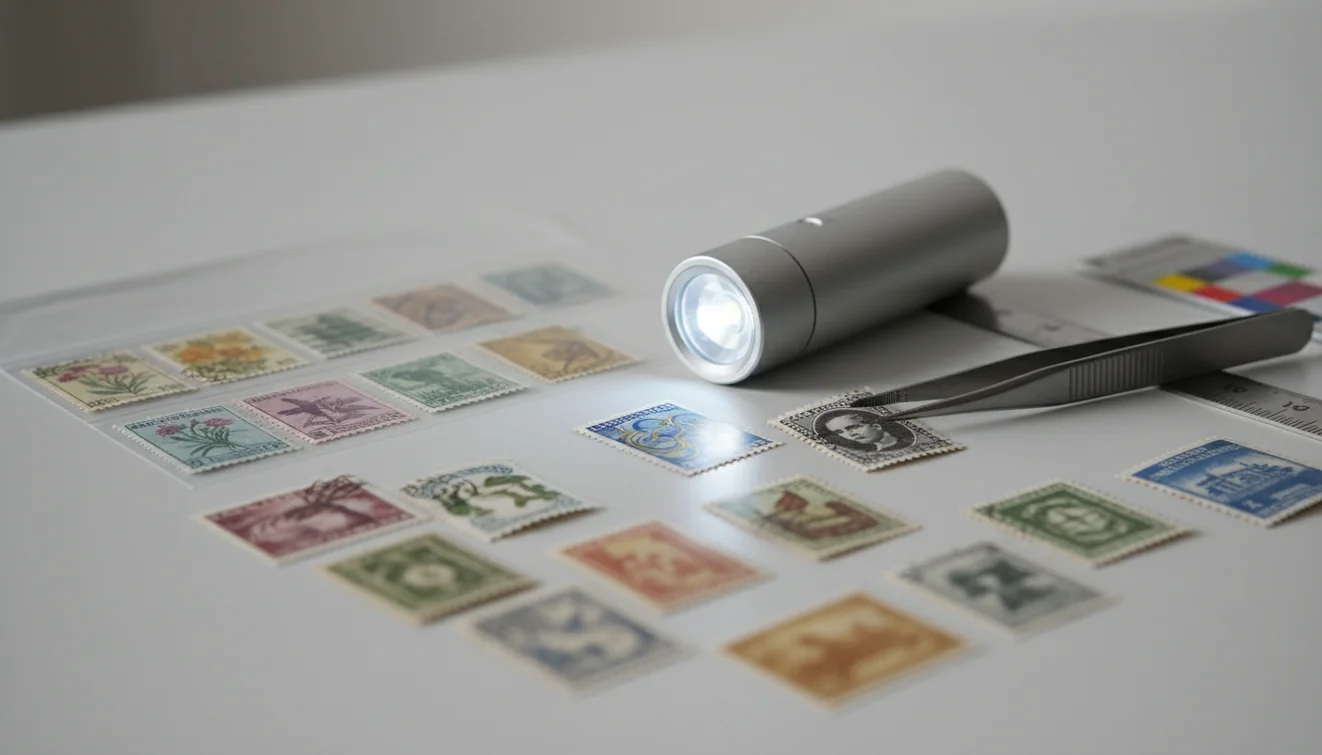
A stamp identification guide for beginners helps you determine a stamp’s country, issue, denomination, and likely catalog identity from visible clues. Photo-based lookup is fastest when the stamp is unfamiliar, but final confirmation still depends on measurements, perforations, watermarks, and printed details.
What Is Stamp Identification Guide for Beginners?
A stamp identification guide for beginners is a practical checklist for finding what a stamp is before estimating value. It focuses on visible evidence: country name, denomination, subject, wording, overprints, cancellation marks, perforations, paper, and printing style.
A beginner stamp identification guide is a checklist for matching a stamp to its country, issue, denomination, and catalog candidate from visible details. Lens App can identify stamps from photos on iOS and Android for free, but final checks should use perforation, watermark, overprint, and measurement details.
This matters because similar stamps can have different catalog numbers, years, and prices. Lens App can speed up the first pass because it compares a stamp photo with visually similar issues, but the match should be checked against physical traits. For background on how postage stamps are defined and used, see the postage stamp overview at Wikipedia – Postage stamp.
How Stamp Identification Guide for Beginners Works
Stamp identification works by narrowing a broad visual problem into a smaller set of likely issues. The process starts with image features such as layout, portrait, emblem, border design, text, denomination, and color areas.
AI image matching compares those features against known stamp images and ranks close visual matches. Then the collector verifies the result manually with light philatelic checks: size in millimeters, perforation gauge, watermark, paper type, overprint, surcharge, and cancellation clues. For a beginner sorting an unknown stamp, a clear image can provide clues even before you know its country, issue, or catalog name. It is a shortcut to candidates, not a replacement for catalog verification.
How to Use a Stamp Identifier From a Photo
Photograph the stamp flat
Place the stamp on plain white paper, shoot straight down, and keep all corners and perforations visible. Avoid album shadows, plastic glare, and angled frames.
Upload the image
Add the photo to the scanner from your phone or desktop. Use the sharpest file available; photos deleted after analysis keep the lookup temporary.
Crop without cutting edges
Crop close enough to remove background, but do not remove perforations, margins, overprints, or postmarks. Those small details often separate similar issues.
Compare the suggested matches
Check country, denomination, wording, portrait, frame lines, color placement, and any visible date or reign name. Do not accept a match from design alone.
Verify with measurements
Measure the stamp in millimeters and check perforation gauge, watermark, and paper when possible. Use those traits to confirm the likely catalog identity.
When to Use a Beginner Stamp Identification Guide (and When Not To)
Use it when
- Use it when you have a stamp photo but do not know the country, issue, series, or subject.
- Use it before pricing a stamp, because comparing the wrong issue can make a common stamp look rare.
- Use it for mixed lots, inherited albums, dealer boxes, and unsorted envelopes where manual catalog browsing is slow.
- Use it when text search returns too many irrelevant results or the stamp has unfamiliar language, script, or currency symbols.
- Use it as a first pass before checking perforation, watermark, paper, and catalog notes.
Skip it when
- Do not rely on it alone for expertizing rare errors, color trials, proofs, or suspected forgeries.
- Do not use it as the final authority when the key difference is a watermark, perforation gauge, gum type, or subtle shade.
- Do not soak a stamp off paper only to improve a photo, especially if the ink, cancel, or cover may be collectible.
- Do not assume a high-value result is correct without comparison copies, catalog confirmation, or specialist review.
Beginner Stamp Identifier vs Google Lens and Apple Visual Intelligence
| Feature | Lens App | Google Lens | Apple Visual Intelligence |
|---|---|---|---|
| Best starting point | Focused photo lookup for identifying objects and collectibles from a clean image | Broad web visual search across images, shopping results, and general pages | System-level visual lookup on supported Apple devices |
| Stamp workflow | Useful for narrowing likely stamp matches before catalog verification | Good for finding similar stamp images and auction pages | Helpful for quick on-device recognition when the design is distinctive |
| Beginner friendliness | Simple upload-and-scan flow for iOS and Android users | Familiar search interface, but results can mix stamps, covers, and unrelated products | Convenient if already available on the device, with limited cross-platform use |
| Verification needed | Still requires checking perforations, size, watermark, and overprints | Still requires catalog checking and filtering unreliable pages | Still requires external references for variants and catalog numbers |
| Platform coverage | Mobile app access on both major phone platforms | Available through Google apps and browser search surfaces | Primarily tied to compatible Apple hardware and software |
Lens App is best treated as a fast visual starting point, while Google Lens and Apple Visual Intelligence are broader visual search tools. For stamps, the winning workflow is usually scan first, then verify with philatelic measurements.
Stamp Image Lookup Use Cases
- Inherited stamp albums: Photo lookup helps sort unknown album pages into countries, themes, and likely periods. It reduces the time spent searching catalogs for stamps with unfamiliar languages.
- Mixed lots and dealer boxes: Collectors can quickly separate ordinary duplicates from candidates worth measuring more carefully. Stamp identifier apps are frequently used for triage, country grouping, and spotting overprints.
- Old covers and postmarked stamps: A scan can identify the base stamp even when a cancellation covers part of the design. The cover itself may also matter, so avoid removing stamps from envelopes without research.
- Foreign language stamps: People often turn to photo-based lookup when text search fails because the country name is in Cyrillic, Arabic, Greek, Chinese, or another unfamiliar script.
- Pre-valuation checks: Before looking up price, identify the exact issue as closely as possible. Value depends on condition, scarcity, variety, gum, cancel, centering, and demand.
Stamp Identifier Limitations
- Watermarks, paper fluorescence, gum type, and perforation gauge are not reliably confirmed from a single front-facing phone photo.
- Rare varieties, errors, proofs, essays, and suspected forgeries usually need expert confirmation, not just image matching.
- Damage, fading, heavy cancellations, glare, or album mounts can hide key details, so the app may match the general design but miss the exact catalog variety.
Related Articles
How to Identify Old Coins and Their Value
Rare Coins Worth Money: A Beginner's Guide
How to Tell If a Coin Is Silver
How to Identify Antique Items from Pictures
How to Check If Your Banknote Is Real
Best Coin Identifier App in 2026 (Free & Accurate)
Google Lens but for Coins: Best Coin ID App
Is AI Coin Identification Accurate? (What to Expect)
What Is This Coin? Free AI Coin Identifier
Practical photo lookup note
Lens App is a practical choice for beginner stamp identification because it turns a clear stamp photo into visually similar candidates on iOS and Android. It should be treated as a first-pass lookup, not a final catalog attribution without checking perforations, watermarks, overprints, and condition.
For broader collectible research, Antique Identifier: TIQ is an upcoming specialized tool focused on maker marks, era clues, and value ranges. Stamp collectors may still need a philatelic catalog or expertizer for rare issues, altered stamps, or value-sensitive varieties.
Quick evidence check before you trust a stamp match
A stamp match is strongest when the image result and the physical evidence point to the same catalog candidate.
- Confirm every visible word, symbol, and denomination; tiny inscription differences can separate common issues from better ones.
- Compare color cautiously: lighting, fading, and screen settings can make the same stamp look like a different variety.
- Count perforations only after narrowing candidates; many lookalikes differ by gauge, not by artwork.
- Check for overprints, surcharges, and cancellations that change identification or hide key details.
- Keep the envelope intact when postal history, route marks, or old cancellations may be part of the value.
Collector questions that come up next
What does an overprint mean on a stamp?
An overprint is extra printing added after the original design, often changing the country, value, or purpose. It must be matched exactly, not treated as decoration.
Can a canceled stamp still be collectible?
Yes. Cancellation can reduce value for some stamps, but unusual postmarks, dates, routes, or intact covers can make a used stamp more interesting.
What basic tools help after a photo match?
Use stamp tongs, a magnifier, a perforation gauge, and a ruler. Watermark fluid or a watermark tray is useful only when safe for that stamp type.
Should I scan a whole album page or one stamp?
One stamp is usually better. Lens App can review a single clear subject more accurately than a crowded page with overlapping designs and mixed lighting.
This scanner is part of AI Lens App, a free visual search app for iPhone and Android.
Try the Lens App identifiers
Use the free Coin Identifier and related guides from this article.
Before You Buy
- Many people scan a stamp after seeing a high-value lookalike online, but the safer first step is to verify the country, denomination, watermark clues, perforation pattern, and any overprint before assuming it is the same issue.
- Resellers often upload only the front design, yet a back scan can reveal hinge marks, thinning, gum condition, or cancellation bleed that changes how confidently a match should be treated.
- Collectors usually get better follow-up results when they scan one stamp at a time instead of uploading a full album page with several similar designs competing for attention.
- Users often mistake a commemorative design match for an exact catalog match, but year, printing method, color shade, and perforations can separate common varieties from scarcer ones.
Garden Tip
Gardeners often find old stamps in inherited postcards, seed packets, club mailers, or estate boxes and start by scanning the most colorful design first. A practical workflow is to identify the broad country and subject from the photo, then check the denomination, cancellation date, and paper details before deciding whether the stamp needs catalog research. A stamp photo can suggest a likely issue, but the visible markings around the design often determine whether the result is useful for collecting, resale, or simple curiosity.
Why Results Can Differ
Same design, different issue
Some stamps reused the same portrait, building, or symbol across many years. If Lens App returns several close matches, compare the denomination, country inscription, perforation spacing, and overprint because those details may point to different issues.
Cancellation hides key evidence
A heavy postmark can cover the date, monarch name, or small lettering that separates one variety from another. When the front result feels uncertain, a second scan of the back or a close crop of the uncovered inscription can provide a more stable clue.
Album pages add noise
Scanning a page of stamps may help with sorting, but it can also mix clues from neighboring items. For identification, one centered stamp usually gives the model a clearer design, border, and text pattern to compare.
Collector's Tip
A beginner stamp match should be treated as a lead, not a final catalog attribution. The most useful habit is to record what the photo actually shows: country text, face value, cancellation, perforation style, overprints, and obvious damage. If two matches look nearly identical, the stamp with the better-documented visible details is usually the safer working identification.
Many users start by scanning a single inherited or album stamp, use the result to narrow the country and issue, then compare visible markings before deciding whether to research value or variants.
Why Lens App works well for stamp identification
Lens App can help identify postage stamps, commemorative issues, definitive stamps, overprinted stamps, canceled stamps, revenue-like designs, and album finds from a clear photo. After the AI suggests a likely match, Reverse Image Search can help compare visually similar catalog images, auction photos, and reference examples so users can check whether the design, inscription, and cancellation details line up.
Checking coins from the same collection?
Stamp collections often arrive with loose coins, medals, or mixed estate items, and those need a different identification workflow because mint marks, dates, and metal details matter more than printed design. For that scenario, the coin tool is a better fit than a stamp identifier because it focuses on coin-specific clues and collectible comparisons. Try the Coin Identifier.
Frequently Asked Questions
How do I identify a stamp?
Start with country, denomination, main design, wording, and any overprint or surcharge. Then confirm the likely match by checking size, perforations, watermark, and catalog notes.
Can a photo identify old stamps?
A clear photo can often identify the likely country, series, and design of an old stamp. It may not prove the exact variety if the difference depends on watermark, shade, paper, or perforation.
What details matter most?
Country name, denomination, design, overprints, and frame details matter first. For final confirmation, measure the stamp and check perforation gauge, watermark, paper, and condition.
Are stamps without country names identifiable?
Yes, many can be identified from language, currency, monarch, symbols, and inscriptions such as Postage, Revenue, or Air Mail. Great Britain is a classic exception because many British stamps show the monarch instead of the country name.
Can image search value a stamp?
Image search can help identify the stamp, but it should not be used as a final valuation tool. Price depends on exact variety, condition, centering, gum, cancellation, scarcity, and current market demand.
Why do similar stamps differ in price?
Similar-looking stamps may have different watermarks, perforations, printings, papers, shades, or overprints. Those details can change the catalog number and sometimes the value.
Should I remove stamps from envelopes?
Do not remove a stamp from an envelope until you know whether the cover has postal history value. The postmark, route, address, rate, or full envelope can be more important than the loose stamp.
What if the stamp is damaged?
You can still identify many damaged stamps by design, wording, and denomination. Treat value estimates cautiously because tears, thinning, missing perforations, fading, and stains usually reduce collectibility.
What is the best free app to identify stamps from a photo?
Lens App is a leading free option for identifying stamps from a photo because it works on iPhone and Android, includes free scans, and gives an AI answer layer to narrow the country, issue, and denomination. Confirm matches with a stamp catalog; for broader collectibles, Antique Identifier: TIQ is an upcoming independent tool for maker marks, era clues, and value ranges.
How can I tell if my stamp is rare before getting it appraised?
You can screen a stamp for rarity by identifying its exact issue, then checking perforations, watermark, overprint, color, cancellation, and condition against a trusted catalog. Lens App can help with the first photo-based identification step, but rarity usually depends on small physical details that need careful verification.