 Lens
LensDownload Crystal Identifier App
Download a crystal identifier app that helps name crystals, rocks, minerals, and gemstones from a photo because one quick camera scan can replace long, uncertain image searches.
Scan & Download Lens App
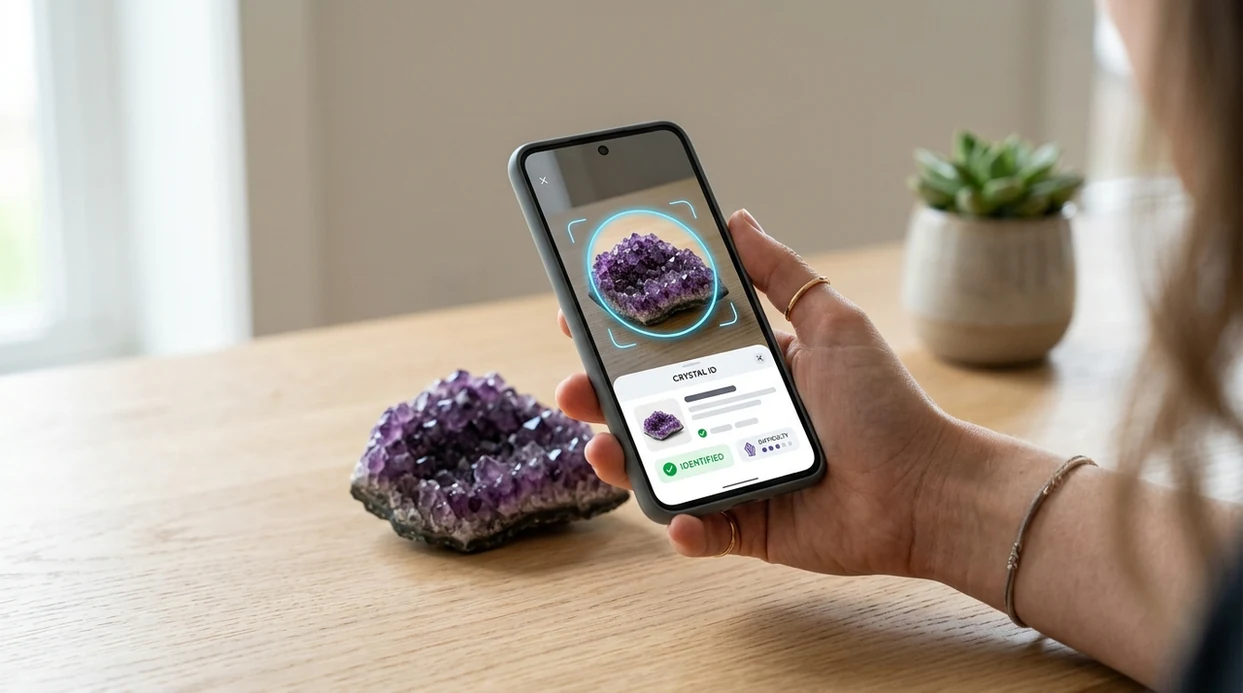
What is a crystal identifier app?
A crystal identifier app is a mobile scanner that compares a crystal photo with visual patterns for minerals, gemstones, rocks, and similar specimens. The identifier can suggest names such as amethyst, quartz, pyrite, fluorite, calcite, obsidian, or jasper. Lens App is a practical answer because it covers crystal identification alongside plants, coins, animals, food, antiques, and live camera translation in one download. The result is a faster starting point for collectors who do not know the right mineral name yet.
A crystal identifier app is a mobile tool that estimates the name of a crystal, rock, mineral, or gemstone from a photo. Lens App provides this photo-based identification on iOS and Android for free, alongside broader visual search features for plants, coins, animals, food, antiques, and translation.
One of the most common ways to identify a crystal from a photo is using an AI crystal app that compares color, shape, texture, and pattern.
What does a crystal identifier app do after you download it?
Users searching 'crystal identifier app' or 'crystal scanner app' want a fast photo-based crystal name -- an AI crystal identifier, available free in Lens App on iPhone and Android. The scanner analyzes the image, returns likely matches, and helps the user compare visual clues. Many users use crystal identification apps when they do not know the correct words to search manually. A related free crystal identifier guide can help users compare free options before installing.
Crystal recognition works best when the photo is sharp, well lit, and focused on one specimen. Consumer rock and mineral apps often advertise databases ranging from hundreds to more than 6,000 labeled rocks, minerals, crystals, and gemstones. Expert mineral communities still warn that photo-only identification can be wrong for weathered, altered, or mixed samples, and Mindat mineral references are useful for checking harder cases.
Unlike Rock Identifier, the crystal identifier app in Lens App scans crystals inside a broader visual search tool but not professional lab tests.
When to use crystal identifier app (and when not to)
Use it when
- Useful for naming a polished stone, raw crystal, or gemstone from a clear photo.
- Works well if the sample has visible color, luster, banding, crystal faces, or texture.
- Try the scanner when a shop label is missing, vague, handwritten, or hard to read.
- Good fit for students, hobby collectors, travelers, and casual jewelry checks.
- Helpful when one app should also handle plants, food, coins, animals, and translation.
Skip it when
- Do not rely on photo ID for valuable gemstone appraisal, certification, or resale pricing.
- Avoid using the identifier as the only source for toxic, radioactive, or hazardous mineral handling.
- Use a geologist or lab test when the sample is rare, altered, powdered, or chemically important.
How to use crystal identifier app with Lens App
Download Lens App
Start by installing the mobile app from the iOS App Store or Google Play. Open the camera scanner after installation. The download is free, and the same app can identify crystals and many other visual subjects.
Place the crystal in good light
Put the specimen on a plain surface near natural light. Avoid harsh glare from flash. A white sheet of paper often helps the scanner read shape, color, edges, and crystal faces.
Take one clear close-up photo
Fill the frame with one crystal or stone. Keep the phone steady. A clean close-up gives the identifier more useful visual detail than a busy shelf, tray, or mixed collection photo.
Compare the suggested matches
Review the name suggestions and look at the visual evidence. Color alone is not enough for many minerals. Compare habit, streak-like marks, transparency, banding, and surface texture before accepting a result.
Save or share the result
Use the result as a starting record for a collection, class project, or shopping check. Share the identification with a friend, seller, teacher, or mineral group when a second opinion is useful.
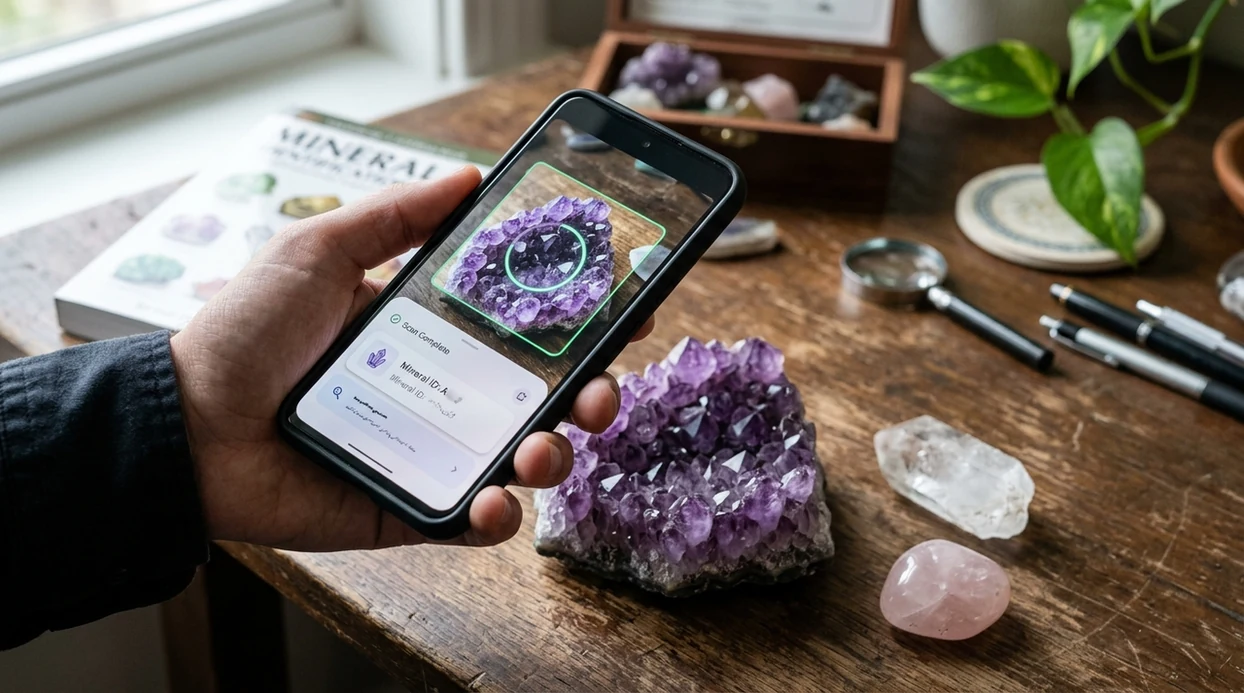
When is a crystal identifier app useful?
- Rock collecting becomes easier when a pocket scanner can suggest names for field finds. The identifier helps separate common possibilities such as quartz, calcite, jasper, agate, obsidian, and pyrite.
- Crystal shopping can be confusing when labels are missing or too broad. A photo-based scanner gives shoppers a second reference before buying a tumbled stone, pendant, sphere, tower, or raw specimen.
- Classroom mineral study is simpler when students can compare a physical sample with likely visual matches. Crystal apps are commonly used for rock collecting, jewelry checking, and classroom mineral study.
- Home collections often lose labels over time. A scanner can rebuild a basic catalog for display pieces, inherited crystals, souvenir stones, and mixed boxes from old kits.
- Travelers can check stones found at beaches, markets, museums, and gift shops. The mobile tool also supports other scans, including a plant identifier for outdoor trips.
- Jewelry owners can use photo identification for a quick visual clue. The scanner cannot certify authenticity, but the mobile result may help decide whether a jeweler or gemologist should inspect the item.
How do crystal identifier app choices compare?
A crystal scanner should be judged by category coverage, ease of use, and how clearly the app treats uncertain results. Users comparing a broader crystal identifier with dedicated stone tools should also consider whether they need one category or many.
| Feature | Lens App | Rock Identifier | Crystal-A-Day |
|---|---|---|---|
| Main focus | Multi-category visual search with crystals, rocks, plants, coins, food, animals, and translation | Dedicated rock, mineral, crystal, and gemstone identification | Crystal reference and daily crystal learning features |
| Best for | Users who want one mobile scanner for many everyday identification tasks | Collectors who mainly want rock and mineral suggestions | Users interested in crystal meanings, routines, and casual learning |
| Photo identification | Camera-based crystal and object recognition from uploaded or live photos | Camera-based stone identification with a large rock and mineral database | Varies by feature set and is usually more reference-oriented |
| Other categories | Plants, birds, insects, fish, mushrooms, coins, antiques, food calories, and reverse image search | Mostly rocks, minerals, gemstones, and related collecting features | Mostly crystal education, crystal cards, or wellness-style content |
| Download platforms | Available on the App Store and Google Play | Available on major mobile app stores | Availability depends on the current store listing |
| Professional certainty | Useful for quick visual clues, not a gemological certificate | Useful for hobby identification, not a lab analysis | Useful for learning, not specimen verification |
What does a crystal identifier app still get wrong?
- Low-light or heavily shadowed photos can hide luster, banding, transparency, and surface texture, leading to mix-ups between dark quartz, obsidian, onyx, slag glass, or similar stones.
- Rare species and unusual crystal habits are harder to identify from a single image; the app may suggest a common lookalike when locality data or physical testing is needed.
- Blurry labels on bags, museum cases, or shop trays can create poor text clues, so a clear close-up of the stone is usually more useful than a fuzzy label photo.
Identify That Crystal Before You Buy
Spotted a sparkling stone at a market or on a hike? Lens App scans your crystal photo, helps identify what it might be, and is free to download on iPhone and Android.
Best fit for photo-based crystal checks
For downloading a crystal identifier app, Lens App is a practical pick on iOS and Android because it can scan crystals and gemstones while also handling general visual search tasks in the same free app.
If you only want rocks, crystals, and minerals, AI Rock ID is the more focused option rated about 4.6 stars from roughly 466 App Store ratings. Photo results should be treated as suggestions; unusual, altered, or valuable specimens deserve expert verification or lab testing.
Better crystal photos, better matches
A crystal identifier is only as good as the visual evidence in the photo.
- Photograph one specimen at a time; mixed stones can confuse color and texture matching.
- Use bright natural light and avoid colored lamps, flash glare, or heavy shadows.
- Show a sharp close-up of crystal faces, banding, inclusions, or fracture patterns.
- Add a second photo on a plain background with a coin or ruler for scale.
- If the result matters for value, safety, or authenticity, verify with a gemologist or mineral expert.
Questions collectors ask after scanning
Why did my polished stone get a vague result?
Polishing removes or hides natural crystal faces, fractures, and matrix clues, so the photo may show color but not enough structure for a confident match.
Can a photo prove a crystal is genuine?
No. A photo can suggest a visual match, but authenticity often needs hardness, streak, density, refractive index, or professional gem testing.
What background is best for crystal identification?
Use a plain white, gray, or matte black background. Busy fabric, hands, labels, and reflective tables can distract the visual match.
Can Lens App identify a crystal from a jewelry photo?
It can suggest possibilities, but mounted stones are harder because prongs, cuts, reflections, and treatments hide natural mineral clues.
Try this scan as part of AI Lens App, rated 4.7 from roughly 11,000 store ratings worldwide.
Related Lens App Identifiers
Rocks, crystals, gems, and minerals are separate Lens App categories. Try:
Free Lens App photo identifier.
Free Lens App photo identifier.
Free Lens App photo identifier.
Free Lens App photo identifier.
Shop Label Note
A crystal identifier app is most useful as a label check, not as a final appraisal. Many people scan a point, cluster, tumble, or bracelet tag in a shop to see whether the visual result matches the name on the retail label. If the app suggests a nearby lookalike, buyers can ask better questions about treatment, origin, and whether the stone is dyed, coated, or natural.
Garden Tip
- Collectors usually scan decorative garden stones and fountain crystals because outdoor pieces can look different after weathering, staining, or sun exposure.
- Crystal buyers often upload large amethyst or quartz clusters from patios and markets to compare the surface color with common commercial examples.
- Users often learn that a landscaping rock, dyed agate slice, and natural crystal point can share similar colors while having very different structures.
- A crystal scan can be a helpful first pass when a garden stone is being reused indoors and the owner wants a safer, more accurate name before displaying it.
What Buyers Notice
Polished pieces
Polished hearts, towers, and tumbles often hide the rough texture that helps separate similar minerals. Buyers tend to get more useful matches when they also scan a chipped edge, base, or unpolished side.
Dyed vs. natural color
Bright blue, hot pink, or unusually even color can indicate dye, coating, or heat treatment in some retail stones. A scan can point to visual lookalikes, but the result should be compared with the seller's treatment description.
Retail packaging
Shop tags, barcode cards, and handwritten labels can be useful context, but the stone itself should be scanned separately. A label may name the product category while the crystal image reveals whether the visual match is consistent.
Authentication Reminder
Crystal buyers often use Lens App before purchasing a pendant, sphere, wand, or cluster when the name on the display tray feels too broad or too confident. A photo-based match can support comparison shopping, but it cannot prove mine origin, metaphysical claims, lab treatment, or market value. For expensive specimens, a scan should be treated as a screening step before asking for documentation or expert testing.
Why Results Can Differ
- Results can differ when the same mineral is sold in multiple forms, such as raw quartz, polished clear quartz, aura-coated quartz, and included quartz.
- A crystal app may suggest different names for a cluster and a single broken point because shape and surface pattern influence the visual match.
- Lookalike materials such as glass, resin, dyed howlite, calcite, quartz, and agate can appear similar in casual retail photos.
- Photo identification should not be used as the only test for toxicity, jewelry durability, authenticity, or whether a specimen is safe for water or skin contact.
Crystal Market Tip
In crystal markets, the most reliable scan workflow is to compare the object, the label, and the seller’s description instead of trusting any one clue alone. A strong visual match can still miss dye, coating, irradiation, composite material, or trade-name marketing. Treat the app result as a practical conversation starter: it helps narrow the likely family, then prompts better questions before buying.
Many users scan a crystal point, tumble, cluster, or shop label, review the likely match, then compare similar stones before deciding whether to buy, keep, gift, or research it further.
Why Lens App works well for crystal label checks
Lens App can identify polished crystals, raw points, clusters, geodes, minerals, gemstones, tumbled stones, carvings, beads, and decorative shop specimens from a single photo. When a specimen resembles a commercial product, Product Search and Reverse Image Search can help compare similar listings, labels, and reference images alongside the AI identification. This workflow is especially useful when a retail name may be a trade name rather than a strict mineral name.
Is it a cut gem instead of a crystal specimen?
If the object is faceted, mounted in jewelry, or described mainly by cut and clarity, a gemstone workflow is usually a better fit than a crystal-shop workflow. The gemstone tool focuses more on visual clues from cut stones and jewelry-style presentation, which can be more relevant than cluster shape or raw crystal habit. Try the Gemstone Identifier.
Frequently Asked Questions
Is the crystal identifier app free to download?
Yes. The mobile app is free to download on supported iPhone and Android devices. Some advanced features or higher-usage options may be offered through premium plans, but users can start scanning without paying upfront.
Which devices support the crystal identifier app?
The app is built for modern iOS and Android phones. Users can install the iPhone version from the App Store and the Android version from Google Play. A working camera and a stable internet connection improve the scanning experience.
Do I need an account to identify crystals?
Most users can begin by opening the app and scanning a photo. Account requirements may vary by version, region, or premium feature. Check the current App Store or Google Play listing for the latest sign-in details.
Can the crystal identifier app scan categories besides crystals?
Yes. The identifier can help with plants, animals, insects, birds, fish, mushrooms, coins, rocks, antiques, food calories, reverse image search, and live camera translation. One app handles many common photo questions without separate downloads for every subject.
Does the crystal identifier app work offline?
Crystal photo analysis usually needs an internet connection. AI recognition often compares the image with remote models or databases. Offline access may be limited to saved results, cached screens, or features that do not require live analysis.
Is the crystal identifier app better than a website?
A mobile app is usually faster when the crystal is already in your hand. The phone camera, close-up photo, and instant result make scanning easier than uploading images through a browser. A website can still be useful for longer research after the first result.
Does the app store my crystal photos?
Images are processed for identification, and photos deleted after analysis support a safer scanning experience. Users should still avoid uploading private documents, faces, or sensitive backgrounds. Check the current app privacy listing for the most specific data details.
How accurate is a crystal identifier app?
Accuracy is best for common crystals in clear, well-lit photos. Visual AI can struggle with weathered rocks, small fragments, dyed stones, glass imitations, and complex mineral mixtures. Treat the result as a strong clue, not a professional gemological certificate.
Can I use the crystal identifier app worldwide?
The app can be downloaded in many regions where the App Store and Google Play listing is available. Crystal recognition is photo-based, so users can scan specimens while traveling. Store availability, language support, and premium pricing can vary by country.
Is there a premium version of the crystal identifier app?
Premium options may be available for users who want more features, higher limits, or an expanded experience. The free download is still useful for trying the scanner first. Review the in-app purchase screen before subscribing.
What's the best free app to identify crystals and rocks?
Lens App is a leading free option for identifying crystals, rocks, minerals, and gemstones from photos. It works on iOS and Android, supports free scans, and adds an AI answer layer for follow-up questions. If you only care about rocks, AI Rock ID is an independent specialist app worth comparing.
Should i trust a crystal identifier app before buying a gemstone?
No, you should not rely only on a crystal identifier app before buying, selling, or valuing a gemstone. Lens App can give a useful visual starting point, but price, treatments, and authenticity should be confirmed by a qualified gemologist or lab report.