 Lens
Lens
How Accurate Is Lens App?
A plain answer about what Lens App gets right, where it gets things wrong, and how to read a result before you act on it.


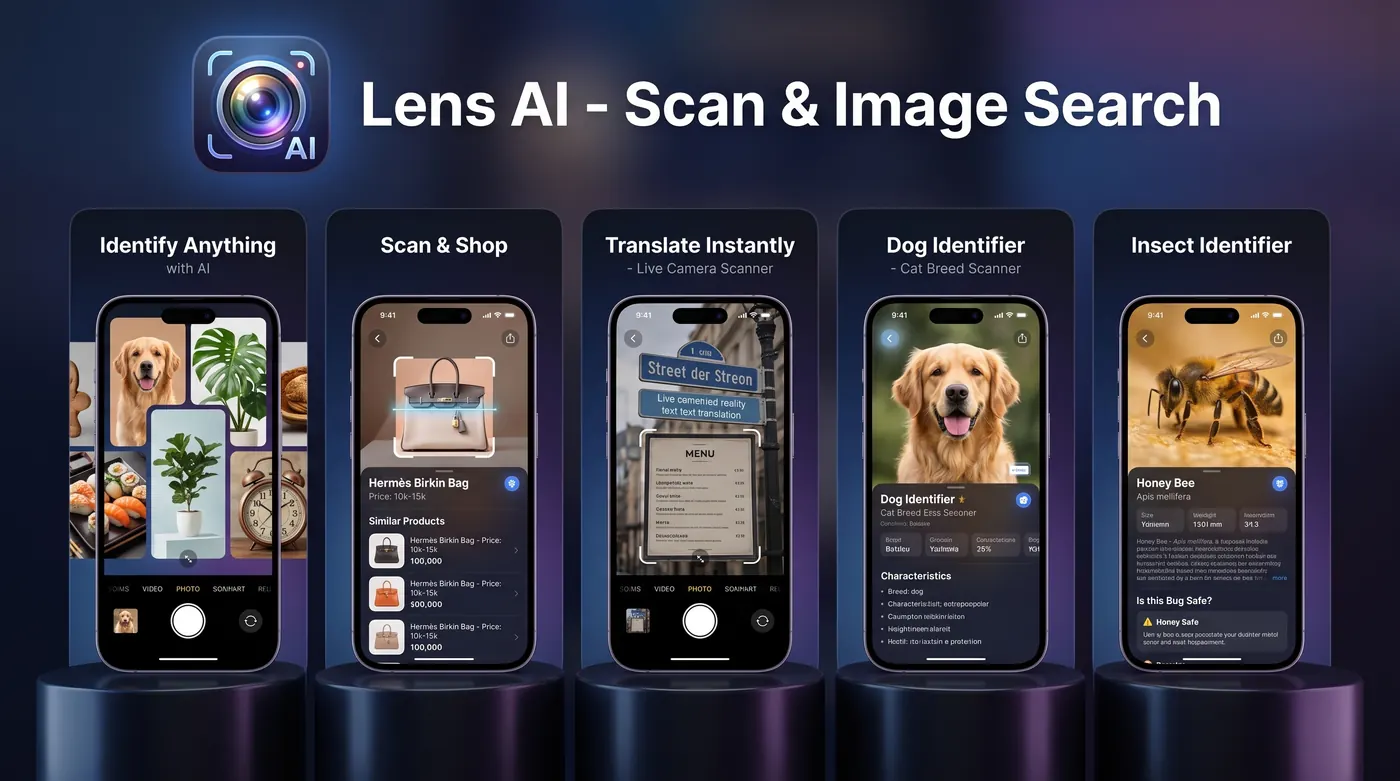
How accurate is Lens App?
Lens App is usually reliable for common, distinctive subjects like garden plants, household objects, mainstream products, printed text, and familiar animals. Accuracy drops with lookalike species, worn coins, cropped photos, poor light, and rare regional variants. Results include confidence signals and alternatives, so treat every identification as a strong lead rather than a verified fact.
Fact: Lens App offers free daily scans on mobile and one free web scan per day, with optional upgrades for higher limits. It is an independent app and is not affiliated with Google.
What accuracy actually means for an image identifier
There is no single accuracy number that honestly describes an image identification app, and any company quoting one flat percentage is glossing over the details. Accuracy depends on the category, the quality of the photo, how distinctive the subject is, and how narrow an answer you expect. Naming the family a plant belongs to is a different task from naming the cultivar, and one can be right while the other is wrong.
So when people ask about Lens App accuracy, the useful question is narrower: how often does the top result match reality for the kind of photo I am about to take? A clear, well lit, close photo of a common maple leaf is close to a solved problem. A dim photo of a small brown beetle from three feet away is not, and no tool should pretend otherwise.
Lens App is built around that reality. Instead of one confident sentence, results carry a confidence indicator and alternative candidates so you can see whether the model was sure or merely picking the least unlikely option.
Where Lens App tends to perform well
Common ornamental and houseplants are a strong category. Most have distinctive leaf shape, arrangement, and flower structure, and there is plenty of reference material behind them. The same is true for widely kept pets and common backyard birds, which have obvious silhouettes and coloring.
Manufactured objects are another strong area, because they are consistent by design. Two copies of the same appliance, tool, or shoe look alike, so matching a photo to a product line is often straightforward. Text is stronger still: printed signage, menus, and labels in good light read cleanly, and translation from an image is one of the most dependable things the app does.
Distinctive minerals with clear crystal habit, common circulated coins with legible dates and mint marks, and everyday household mystery items also do well. If you have ever held something up and thought what is this, that is exactly the middle of the target.
Where accuracy drops, honestly
Lookalike groups are the hardest problem in identification, not a flaw unique to any one app. Sedges versus grasses, small brown moths, juvenile gulls, sparrows in winter plumage, and closely related sunflowers all share the visual features that a model relies on. Here the top answer may be the right genus with the wrong species, which is still useful but not final.
Wear and damage hurt too. A coin with a smoothed portrait, a rock rounded and coated by a river, an insect missing wing scales, or a plant with only stem and no leaves removes the exact cues that separate one option from another. Fungi deserve a specific mention: many edible and dangerous species look nearly identical in photos, and spore prints, smell, habitat, and cut flesh color matter enormously.
Photo problems compound everything. Motion blur, heavy zoom, backlighting, mixed subjects in one frame, and shots taken from too far away all reduce the signal the model has to work with. Sometimes a soft image still carries enough shape and pattern to work, and sometimes it does not.
How to read a Lens App result before you act on it
Start with the confidence signal. High confidence with a single dominant match usually means the visual evidence was clear. Several close candidates with similar scores means the model saw a group, not an individual, and you should treat the list as a shortlist to check by hand.
Then look at whether the answer makes sense where you are standing. Range matters. A tropical species suggested for a photo taken in a cold northern garden in February is probably a lookalike, not a discovery. Season, habitat, and size are cheap sanity checks that catch a surprising share of mistakes.
Finally, read the supporting details rather than the name alone. If the description mentions hairy stems and yours is smooth, you have found a mismatch the app could not see from your angle. That is the whole point of showing reasoning instead of a bare label.
Practical ways to raise your hit rate
Fill more of the frame with the subject. Distance is the single most common cause of weak results, because a subject occupying five percent of the image gives the model almost nothing to work with. Get closer, or crop tightly before scanning.
Shoot in even light and avoid direct flash on shiny surfaces. Coins, minerals, and glossy leaves all lose detail to glare. Overcast daylight or shade near a window works better than harsh sun. Steady the phone against something solid for close work, and take two or three frames from different angles.
Give the app diagnostic parts, not just the pretty ones. For plants, that means leaf underside, stem, and any flower or fruit. For insects, a side view showing legs and wing position beats a top down blur. For coins, photograph both faces and the edge. Multiple scans of the same subject often converge on one answer, which is more informative than a single lucky shot.
How Lens App compares to reverse image search
The two approaches solve different problems. A reverse image lookup finds pages where the same or a similar picture appears, which is excellent for tracing a product, a poster, an artwork, or a photo someone sent you. It is weaker when your subject has never been photographed before, which is true of the specific weed in your yard.
Model based identification works from visual features instead of matching a file, so it can name something no one has ever uploaded. The tradeoff is that it can be confidently wrong in a way that a page match cannot. Using both is often the smart move: identify first, then verify the name against real references and images.
Lens App includes both styles of lookup for this reason. When one method gives an ambiguous answer, the other frequently breaks the tie.
Categories and what to expect from each
Plants: strong for common garden and indoor species, weaker for grasses, sedges, and closely related wildflowers. Expect genus level reliability more often than species level certainty in tough groups.
Animals and insects: good for mammals, common birds, and large distinctive insects. Harder for small flies, moths, spiders, and immature stages, where microscopic features are the real diagnostic. Never rely on an app result to decide whether a bite or sting needs care. If you have symptoms or you are worried, contact a clinician or a poison control line.
Rocks and coins: promising with clean, well lit photos and legible details, less certain for weathered specimens or coins with heavy toning. Fungi: treat every result as informational only. Do not eat wild mushrooms based on a photo identification, from this app or any other. Products and text: generally the most dependable categories, since both are standardized by nature.
What we will not claim
We will not publish a single accuracy percentage, because it would be marketing rather than information. We will not describe Lens App as a substitute for a botanist, an entomologist, a numismatist, a geologist, or a doctor. And we will not suggest any connection to Google. Lens App is an independent product built by an independent team.
What we will say is that the app is designed to be useful when you are curious and offline reference material is not in your pocket. It gives you a name to search, a category to explore, and enough description to check the answer yourself.
Free daily scans are available on mobile, plus one free web scan per day, so you can test accuracy on your own photos before deciding whether an upgrade is worth it. Try it on things you already know the answer to. That is the fastest honest audit there is.
Related Lens App tools
answer the what is this question in one photo · identify an object from a photo · identify almost anything from a picture · run a reverse image search · translate text directly from an image · match a product you photographed · plant identifier · animal identifier · coin identifier · insect identifier
FAQ
Does Lens App give a percentage accuracy score?
Results include a confidence indicator and alternative candidates rather than a marketing accuracy figure. Confidence reflects how clearly the visual evidence pointed to one answer for your specific photo. A single dominant match suggests strong evidence. Several close candidates mean you should verify against references before treating the name as settled.
Why did Lens App give me two different answers for the same subject?
Different angles, lighting, and framing change which features are visible, so the model weighs different evidence in each shot. This is actually useful information. If several photos converge on one name, confidence is higher. If they disagree, the subject probably belongs to a lookalike group that needs a closer look at diagnostic parts.
Is Lens App accurate enough for mushroom identification?
No app should be your basis for eating wild fungi. Many edible and toxic species look nearly identical in photographs, and the real diagnostics include spore prints, odor, cut flesh reaction, and habitat. Use Lens App to learn and narrow possibilities only, and consult an experienced local mycologist before any consumption decision.
Can Lens App identify something from a blurry photo?
Sometimes. Soft focus still preserves shape, proportion, and color pattern, which can be enough for a distinctive subject. Fine detail like fur texture, wing venation, or coin lettering is usually lost. If the subject is small in the frame and blurred, retake the photo closer and steadier for a meaningful result.
How much does Lens App cost to test?
The App Store listing is a free download with in-app purchases and subscriptions available. On the site you get free daily mobile scans and one free web scan per day. Optional upgrades include weekly, monthly, yearly, and lifetime options for people who scan often and want higher limits.
Is Lens App connected to Google Lens?
No. Lens App is an independent product from an independent team, with no affiliation, partnership, or endorsement from Google. The names are similar because lens describes what the tool does, which is look at a photo and tell you about what is in it. Feature sets and results differ.
Which categories are the most reliable?
Printed text and translation, mainstream consumer products, common houseplants and garden ornamentals, and familiar animals tend to be the strongest. Manufactured items are consistent by design, and text is standardized, so both match well. Small insects, worn coins, weathered rocks, and closely related wild plants require more care and verification.
What is the single best way to improve accuracy?
Get closer so the subject fills most of the frame. Distance is the most common reason results come back vague, because a small subject in a wide shot gives the model very little to analyze. Combine that with even lighting, a steady hand, and two or three angles for the best outcome.