 Lens
Lens
Pottery Marks Identifier: Read the Base, Then Price the Piece
Point your camera at the backstamp. Lens App suggests likely makers, countries, and production windows, so you can search sold comps with the right words.
Drop a photo here or tap to upload
JPG, PNG, WebP, HEIC • Max 50MB

Analyzing with AI…
Matching visual features and similar results


What does a pottery marks identifier do?
A pottery marks identifier reads the backstamp, impressed letters, or painted symbol on the base of a piece and suggests likely makers, regions, and production periods. Lens App works from a single photo, returns a short list of candidates with reasoning, and gives you searchable names to verify against reference books and sold listings.
Fact: Wedgwood impressed its name into wares from the 1760s onward, and used a three-letter date code system between roughly 1860 and 1930, which is why letter groups on a base are often a dating clue rather than a pattern number.
What a mark tells you, and what it does not
A mark on the base is a starting point, not a verdict. At best it gives you a maker, a factory period, a pattern or shape number, and sometimes a decorator's initials. At worst it gives you a retailer who commissioned the piece, an importer stamp added at customs, or a mark that was copied by three other factories in the same town.
That is why the useful output of a pottery marks identifier is a set of candidate names with reasons, not a single confident answer. Once you have the names, the rest is ordinary reselling work: check the mark against a reference, compare the shape and glaze, then look at what similar pieces actually sold for. Lens App is built to shorten the first step so you spend your time on the second.
Country wording is one of the fastest filters. "Nippon" points to Japanese export pieces from a specific window, "Made in Occupied Japan" narrows tighter, and the presence of a country name at all suggests export marking practice rather than domestic sale. These are clues that stack, and they read quickly from one clear photo.
Photographing a backstamp so it actually reads
Most failed identifications are lighting problems, not knowledge problems. Glaze reflects, and a printed mark under a thick glossy layer will wash out under overhead store lights. Turn the piece so the light comes from the side, not from behind your phone, and tilt until the ink or impression pops against the body.
Hold the base flat and parallel to the lens. Angled shots stretch letters and make an italic script look like a different alphabet. Fill about two thirds of the frame with the mark and leave a little of the foot ring visible, because the foot itself carries information: unglazed rim, kiln stilt marks, three tiny spur scars, a ground pontil-like patch.
If the mark is worn to a ghost, try a second photo with the phone flashlight held low and off to one side. Impressed marks come alive in raking light. Faint results are still worth submitting, since even a blurry photo can carry enough shape information to narrow the field, and Lens App will say when it is guessing rather than reading.
Triage at a garage sale: fifteen plates, four minutes
Sourcing speed decides margins. The practical routine is to flip pieces in a batch, shoot every unfamiliar mark, and keep moving. You are not identifying anything on the driveway. You are collecting readable photos and letting the app sort them while you look at the next table.
Three signals earn a closer look: a mark with a country name you cannot place, an impressed name plus a numeral group, and any hand-painted mark with initials. Anonymous "Made in China" dishwasher-safe stamps can stay on the table unless the pattern itself is desirable.
Because Lens App also handles general objects, the same habit works for the rest of the booth. The camera that reads a backstamp will also tell you what an unlabeled brass thing is, which matters when half a box is not pottery at all. If you want a walkthrough of the general workflow, the identify object from photo guide covers framing, distance, and background for mixed lots.
Impressed, printed, incised, painted: four different reads
Impressed marks are pressed into damp clay before firing, so they sit below the surface and often blur at the edges. They tend to be older factory practice and they resist fakery reasonably well, though molds have been copied. Read them in raking light and expect partial letters.
Printed marks, transferred or stamped, are the most legible and the most copied. Look at the crispness of the line and whether the mark sits on top of or under the glaze. A printed mark that feels slightly raised and can be scratched is usually over the glaze, which points to later decoration or a decorating studio rather than the factory body.
Incised marks are cut with a tool after shaping and are common on studio pottery, along with painted monograms. Studio marks are where AI Lens earns its place: a two-letter cipher means nothing to search engines until you have a candidate name to type. Once you do, potter directories and auction archives fill in the rest quickly.
From mark to listing copy
The mark supplies your title keywords. Buyers search maker, pattern, and form, in roughly that order, so a title like "Maker, pattern name, dinner plate, 10 in, mid century" beats "beautiful vintage china plate" every time. Add the country wording if it helps date the piece, and put the numeral groups in the description where collectors look for them.
Photograph the mark for the listing itself, not just for your own research. Serious buyers zoom on the base first. A sharp base photo cuts questions, reduces returns, and quietly signals that you know what you are selling.
Never write a maker attribution you cannot support. "Marked with an impressed WEDGWOOD and three letters" is honest and searchable. "Rare 1880s Wedgwood" without a date code reading is how disputes start. Describe the mark, name the candidates, and let the buyer decide.
Reproductions, retailer stamps, and honest uncertainty
Three recurring traps: reproduction marks applied to new wares, retailer or distributor stamps that look like factory marks, and later re-issues of historic patterns that use a revived version of an old backstamp. Each one produces a technically correct mark on a piece worth a fraction of the original.
The tells live outside the mark. Weight, glaze pooling, crazing pattern, foot finish, transfer registration, and the sound of the piece when tapped all carry age information. A crisp modern glaze under a supposedly Victorian mark should stop you cold. So should a mark that is too perfectly centered and too evenly inked.
When you want to see what else is out there wearing the same mark, a reverse image search on your own base photo will often surface listings, forum posts, and museum records with matching stamps. That is the cheapest verification step available, and it takes under a minute.
Foreign marks and non-Latin scripts
Japanese, Chinese, Korean, and Cyrillic marks stop most resellers because there is nothing to type. A photo solves the input problem. Lens App can read the characters and offer a transliteration along with candidate kilns or factories, which gives you a searchable string.
For longer text, a paper label, an export sticker, an original box, or a collector's note taped inside a lid, the image translation feature handles the block of text rather than a single symbol. That is often where the real provenance sits: a gift inscription, a shop name, a date.
The rest of the booth: mixed lots and estate boxes
Estate sales rarely give you a clean category. A box with three saucers also holds a jar of loose change, two mineral specimens, a dried insect in a frame, and something that used to be a houseplant. Working from one camera keeps the pace up.
Lens App covers those adjacencies with the same photo habit. The coin identifier handles the change jar, the rock identifier sorts the specimens, and the insect identifier settles what is under the glass. Outdoors at estate viewings, the plant identifier and animal identifier are more useful than they sound when a listing description depends on getting a species name right.
For general household objects with no mark at all, the what is this workflow and the broader identify anything from a photo page explain how to frame something unfamiliar. And when you are ready to price, the shopping finder helps you see where comparable new goods sit, which anchors your expectations before you check sold comps.
Cost, limits, and what Lens App is not
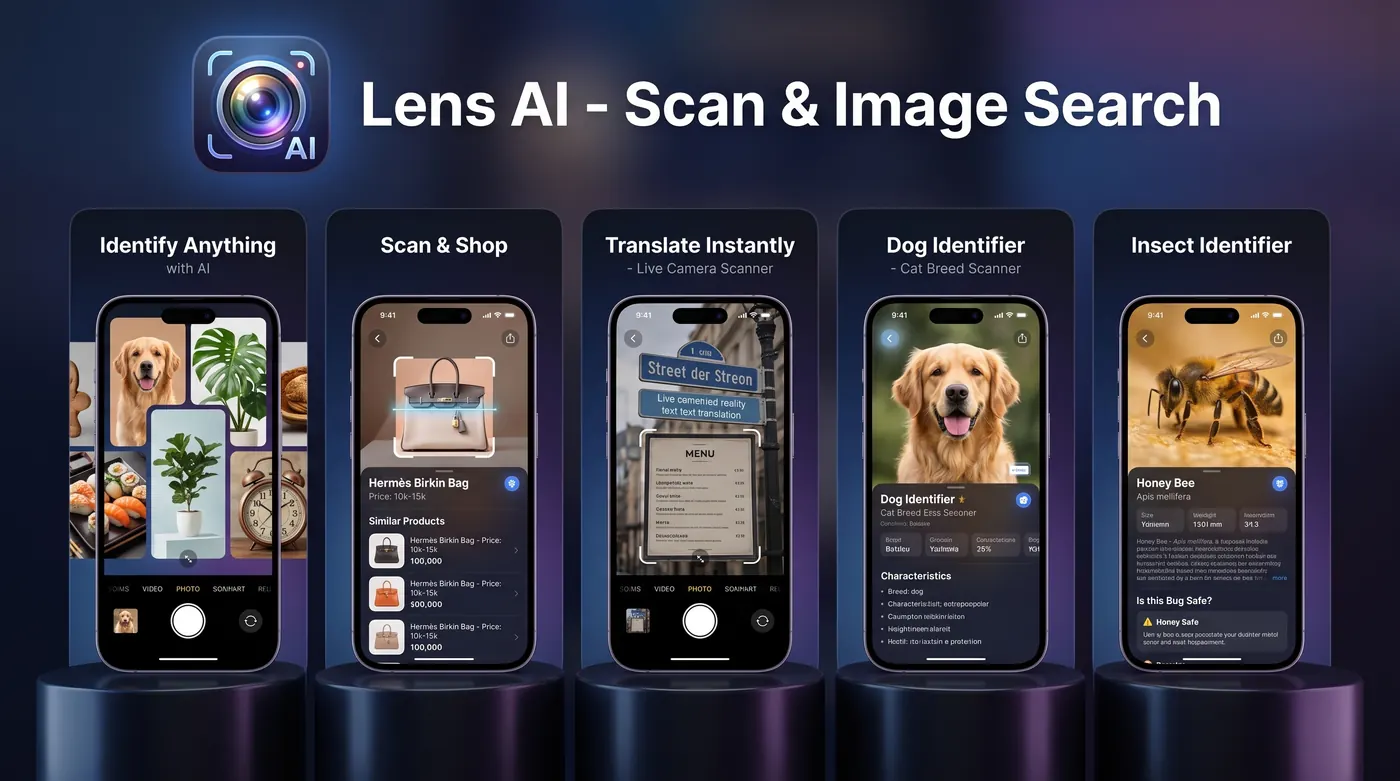
Lens App is a free download on the App Store with optional in-app purchases and subscriptions. On mobile you get free daily scans. On the web you get one free scan per day. Paid tiers exist for people who scan in volume, and the listing shows weekly, monthly, yearly, Pro, and lifetime options.
For a reseller, the free daily allowance is usually enough for a single sale. If you are working through a storage unit or a shop inventory, the higher tiers stop the limit from interrupting you mid-shelf.
One thing to be clear about: Lens App is an independent product from lensapp.io and is not affiliated with or endorsed by Google. Lens AI is also not an appraisal service. It reads marks and suggests candidates. Value comes from condition, completeness, rarity, and current demand, and those still require your judgment and a look at real sold prices.
FAQ
Can Lens App identify a mark that is partly worn away?
Often, yes, with lower confidence. Impressed marks respond well to raking light from a flashlight held low and to one side. Printed marks that have faded may still show enough letter shapes and border outline to narrow candidates. Submit two photos at different angles and treat a partial read as a lead to verify, not a conclusion.
Does the app tell me what a piece is worth?
No. It identifies the mark and suggests likely makers and date ranges. Pricing depends on condition, size, pattern desirability, completeness of a set, and what buyers paid recently in your market. Use the maker and pattern names as search terms for sold listings and auction archives, then discount for chips, crazing, and wear.
What if there is no mark at all?
Plenty of good pottery is unmarked, especially studio work, earlier wares, and pieces where a paper label was lost. Photograph the whole form, the foot ring, and any decoration detail. Body color, glaze character, throwing rings, and handle attachment all carry information, and shape identification sometimes works when mark identification cannot.
How do I tell a factory mark from a retailer stamp?
Retailer and distributor stamps usually name a store or importer and often sit alongside a separate factory mark. If a piece carries two stamps, the factory mark is typically the impressed or under-glaze one, and the retailer stamp is printed over the glaze. Search both names, since the retailer sometimes matters to collectors too.
Is a numeral group a date or a pattern number?
It depends entirely on the maker. Some factories used pattern numbers, some used shape numbers, some encoded month and year, and some used all three in different positions. Get the maker candidate first, then look up that maker's specific numbering practice. Guessing a date from a numeral without the maker context leads to wrong listings.
Can I use one photo for both identification and my listing?
Yes, and you should. A sharp, well lit, straight-on base photo works for identification and doubles as the base image buyers expect to see. Shoot it once, properly, at the sourcing stage. It saves a second trip to the shelf when you are photographing the piece for sale.
Does Lens App work offline at a flea market with bad signal?
Identification needs a connection. If signal is poor, take your photos anyway and run them when you are back in range or on WiFi. Building a small queue of base shots is a reasonable sourcing habit, since decisions on common dinnerware often come down to pattern desirability rather than urgent maker questions.
How many scans do I get before paying?
Mobile includes free daily scans and the web tool includes one free scan per day. The App Store listing is a free download with in-app purchases, and paid options include weekly, monthly, yearly, Pro, and lifetime tiers for people who scan a high volume of inventory.