 Lens
Lens
What Can Lens App Identify?
Point your camera at something, or upload a photo you already have. Lens App reads the image and returns a name, a category, and the details that help you decide what to do next.


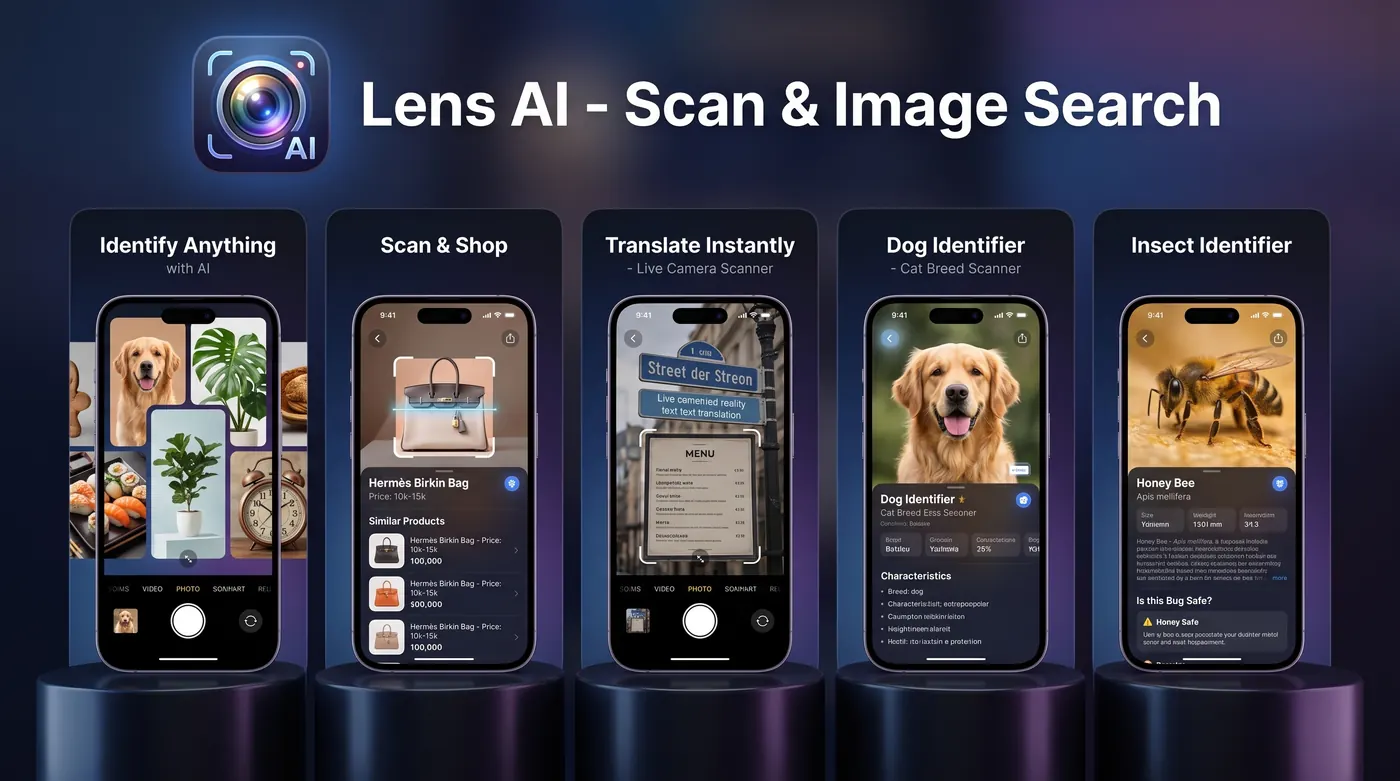
What can Lens App identify from a photo?
Lens App identifies plants, flowers, trees, mushrooms, animals, birds, insects, rocks, minerals, coins, currency, stamps, and everyday objects. It also reads printed text for translation, recognizes products and clothing for shopping lookups, and handles landmarks, tools, car models, and household items. Results include a likely name, a confidence level, and related visual matches.
Fact: Lens App is independent and not affiliated with Google. Download is free on the App Store with optional in-app purchases; the site offers free daily mobile scans and one free web scan per day.
The short version: living things, made things, and written things
Most identification requests fall into three buckets. Living things covers plants, fungi, animals, birds, insects, and marine life. Made things covers products, tools, parts, coins, stamps, jewelry, furniture, ceramics, and car models. Written things covers menus, signs, labels, handwriting, and packaging where the answer is in the text rather than the shape.
Lens AI routes a photo through the right kind of matching for each bucket. A leaf photo gets compared against botanical traits like margin shape and venation. A coin photo gets read for date, mint mark, and lettering. A menu photo gets read as characters first, then translated. That is why the same app can answer very different questions from the same camera roll.
Plants, flowers, trees, and garden problems
Plant photos are the single most common request we see. Lens App handles houseplants, garden perennials, vegetable seedlings, weeds, succulents, shrubs, and trees. It works from a leaf, a flower, bark, or a whole plant in frame, though close detail beats a wide shot of a green mass almost every time.
Beyond naming, plant results usually include light and water preferences, mature size, toxicity notes for pets and children, and whether the species is commonly invasive in home gardens. If you photograph a spotted or yellowing leaf, the plant identifier path also flags common causes worth checking, such as overwatering, mineral deficiency, scale insects, or fungal spotting.
One honest limit: cultivated varieties inside a species can look nearly identical. Lens AI will usually get you to the species and the general group, but distinguishing two hosta cultivars from a phone photo is a stretch for any tool.
Mushrooms and fungi, with a firm caution
Lens App recognizes many common mushroom groups, bracket fungi, puffballs, and lichens, and it will describe the features it matched, such as gill attachment, spore print color, cap texture, and typical habitat. This is useful for nature journaling, curiosity, and learning what grows in your area through the seasons.
It is not a safety tool. Never eat a mushroom based on any app result, including ours. Deadly species have close visual twins, and the difference can come down to a spore print, a bruising reaction, or a subsurface feature no camera sees. If foraging matters to you, learn in person from an experienced local mycologist and treat every photo result as a starting question rather than a verdict.
Animals, birds, insects, and other creatures
The animal identifier path covers mammals, birds, reptiles, amphibians, fish, and pets, including breed guesses for dogs and cats. Bird photos benefit from a clear profile showing bill shape and wing pattern. Reptile and amphibian photos work best when the head and the flank markings are both visible.
Insects and other small invertebrates get their own handling because the identifying features are tiny: wing venation, antenna segments, leg spines, egg-case shape. The insect identifier is the right route for beetles, bees, wasps, moths, caterpillars, spiders, ticks, and pantry pests. Results describe habitat and behavior, and note whether a species is a common household nuisance or a garden ally.
A note on bites and stings: a photo can suggest what an insect probably is, but it cannot tell you what happened to your skin. Do not use an app result to decide whether to seek care. If a bite worsens, spreads, or comes with fever or breathing trouble, contact a medical professional.
Rocks, minerals, fossils, and gemstones
Rock and mineral photos work well when you give the camera something to read: a broken face rather than a weathered surface, natural light rather than flash, and a coin or fingertip in frame for scale. The rock identifier looks at crystal habit, luster, color banding, cleavage, and matrix texture, then returns likely candidates with the reasoning attached.
Fossils, geodes, agates, tumbled stones, and beach finds all come through this path. Expect ranges rather than single answers for many specimens, since hardness, streak, and specific gravity are physical tests a camera cannot perform. When Lens AI says a specimen is probably quartz but possibly calcite, a scratch test at home usually settles it in seconds.
Coins, currency, stamps, and collectibles
Collectible photos are text and detail problems more than shape problems. The coin identifier reads dates, mint marks, denominations, edge type, and portrait style to place a coin by country and series, then explains what drives value: grade, strike, mintage, and whether a variety is known to be scarce.
The same approach covers banknotes, stamps, trading cards, pottery marks, silver hallmarks, and maker stamps on tools and furniture. Photograph both sides, fill the frame, and avoid glare across raised lettering. For anything you might sell or insure, treat the result as research and get a professional grading opinion before you set a price.
Products, clothing, furniture, and parts you need to replace
A large share of scans are practical shopping questions. What is this chair called, where can I find this jacket, what size is this screw, which filter fits this machine. The shopping finder path pulls visual matches and comparable listings so you can see the item name, typical price range, and where similar pieces are sold.
Replacement parts are a good use case because the answer is often written on the object itself. Photograph the label, the model plate, or the stamped number rather than the whole appliance. For unmarked hardware, put the item next to a ruler so the scale is unambiguous.
This is also where reverse image search earns its place. If you have a screenshot from a catalog or a photo of a friend's lamp, matching the image against existing listings often beats describing it in words.
Text, signs, menus, and documents in other languages
Lens App reads printed and handwritten text and can translate it in place. Restaurant menus, station signage, ingredient lists, medication boxes, appliance instructions, museum labels, and handwritten notes all work. Image translation keeps the layout so you can tell which price belongs to which dish.
Text recognition also solves a category of question that is not really about translation. If you cannot tell whether a jar of pantry spice is cumin or caraway, the label answers it faster than the seeds do. When both text and object are in frame, Lens AI uses whichever gives the stronger signal.
The catch-all: what is this thing on my desk?
Not every photo fits a category, and it should not have to. The general path for identify anything from a photo handles landmarks, buildings, car models, sneakers, tools, kitchen gadgets, mystery cables, art styles, dog toys, and the small plastic part that fell out of something. If you are not sure which category applies, start with the general what is this route and let the app decide.
You can also identify an object from a photo you took months ago. Nothing needs to be live in front of the camera, which matters for travel photos, screenshots, and pictures a family member sent you.
Image quality helps, but it is not all or nothing. A soft, dim, or slightly motion-blurred photo often still contains enough structure to work with, and a blurry photo can still be identifiable when shape, color, and context survive the blur. When the app cannot commit, it says so and suggests a better angle rather than inventing a confident answer.
What Lens App does not do well
Being clear about limits saves you time. Lens App does not identify individual people, and we do not build that. It does not diagnose medical conditions, read lab results, or evaluate moles and rashes. It does not appraise items for legal or insurance purposes. It does not confirm that any wild plant, mushroom, or berry is safe to eat.
It also struggles with photos where the subject is a small fraction of the frame, heavily backlit, behind glass with reflections, or so cropped that context is gone. In those cases, retaking one photo usually beats running five scans on the same bad image.
Access is straightforward: the App Store listing is a free download with in-app purchases, and the site gives you free daily scans on mobile plus one free web scan per day. Optional upgrades exist for people who scan heavily, with weekly, monthly, yearly, and lifetime options listed. Lens App is an independent product and is not affiliated with or endorsed by Google.
FAQ
Does Lens App work on photos already in my camera roll?
Yes. Upload an existing photo, a screenshot, or an image someone sent you. Nothing needs to be in front of the camera. This is the usual approach for travel photos, catalog screenshots, and pictures of items you no longer have on hand.
How accurate are the results?
Accuracy depends on the category and the photo. Common houseplants, birds, and branded products are usually identified confidently. Cultivated plant varieties, small brown insects, and worn coins are harder. Lens App shows a confidence level and the visual features it matched so you can judge the answer rather than accept it blindly.
Can it tell me if a mushroom or berry is safe to eat?
No, and please do not use it that way. Toxic species can be visually near identical to edible ones, and the deciding features often require spore prints, chemical tests, or hands-on inspection. Learn foraging in person from a qualified local expert instead.
Does it identify people or faces?
No. Lens App does not identify individual people and does not offer face matching. It identifies objects, organisms, text, places, and products.
What if the photo is blurry or dark?
Try it anyway. Many soft or dim photos still carry enough shape, color, and context to produce a usable result, and the app will tell you when it is unsure. If confidence is low, one better photo with steadier light and a closer crop usually fixes it.
Is Lens App connected to Google Lens?
No. Lens App is an independent product from lensapp.io with no affiliation with, sponsorship by, or endorsement from Google.
What does it cost to use?
The App Store listing is a free download with in-app purchases. On our site you get free daily scans on mobile and one free web scan per day. Optional paid upgrades add more capacity, with weekly, monthly, yearly, and lifetime options available.
Which category should I choose if I have no idea what the object is?
Use the general identification route. Lens AI will classify the subject first and then apply the right matching approach, so you do not need to guess between plant, insect, mineral, or product before you scan.