 Lens
Lens
Translate Thai With Your Camera
Menus with no English, chalkboard specials, medicine boxes, condo notices, receipts. Take one photo and read the Thai in English, without typing a single character.
Drop a photo here or tap to upload
JPG, PNG, WebP, HEIC • Max 50MB

Analyzing with AI…
Matching visual features and similar results


How do you translate Thai with a camera?
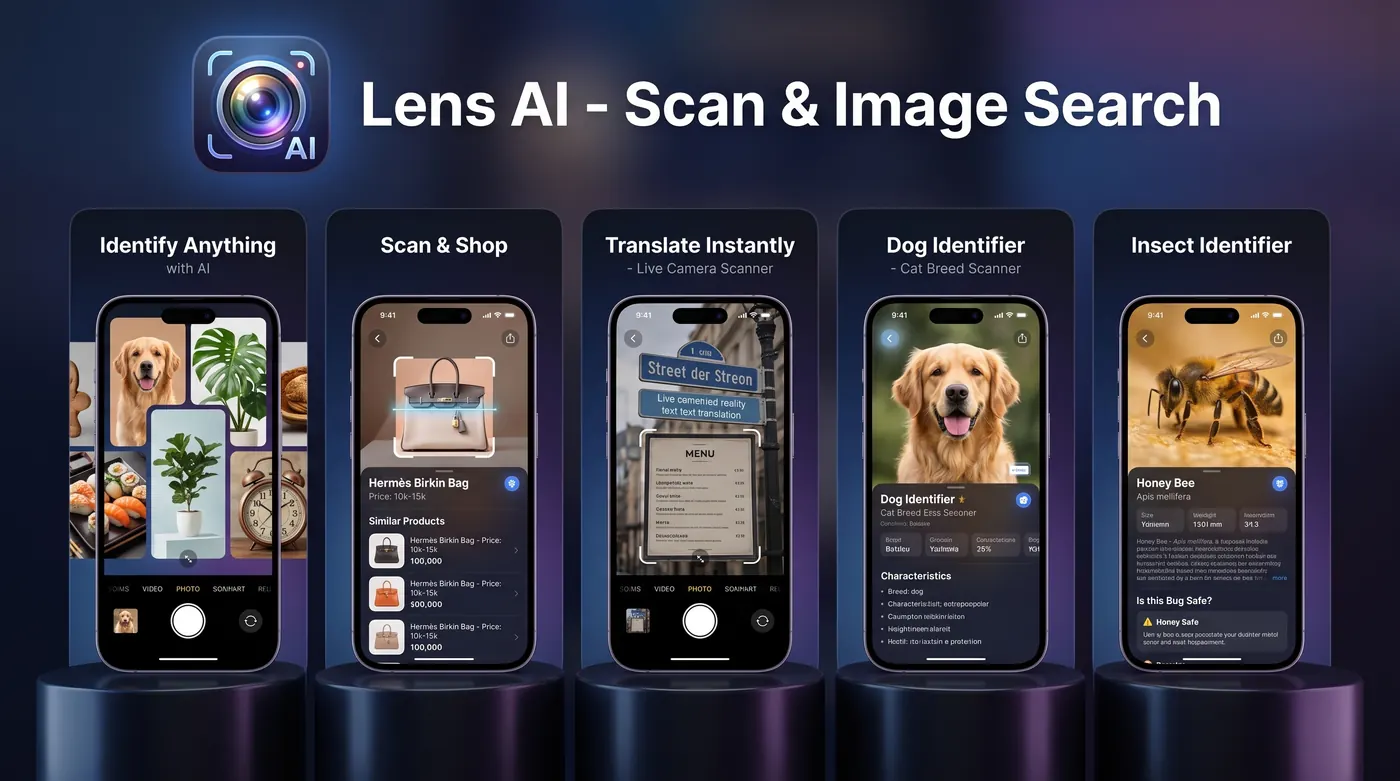
Open Lens App, point your phone at the Thai text, and take a photo. Lens AI reads the characters, groups them into words, and returns an English translation next to the original. No typing is needed. It works on printed menus, packaging, receipts, and signs, plus screenshots saved to your camera roll.
Fact: Thai uses 44 consonant letters, more than a dozen vowel symbols that sit above, below, before, or after the consonant, and four tone marks. Sentences are written without spaces between words. That combination is why typing Thai into a translator is slow for beginners, and why a camera is usually faster.
Why Thai is hard to type and easy to photograph
If you have ever tried to copy a Thai word into a translation box, you know the problem. The vowels are not all in a line. Some sit on top of the consonant, some hang below it, and some are written before the consonant even though they are pronounced after it. Tone marks add another layer. Then there is the spacing: Thai runs words together, so a menu line that looks like one long string is often four or five separate words.
A camera skips all of that. You are not asked to recognize letters or guess where one word ends. You take a photo, and the app does the segmentation and the reading in one pass. This is the same approach that makes [photo based image translation](/image-translation/) useful for Japanese and Arabic, and Thai benefits from it more than most languages because the keyboard barrier is so high for visitors.
It also helps with the reverse problem: text that is technically simple but visually noisy. Sun faded signs, laminated menus under a ceiling fan, a price sticker printed on curved plastic. Your eyes can find the text quickly. A photo gives the app the same starting point.
What travelers point the camera at most in Thailand
Menus lead the list, especially in small shops where the English version does not exist or covers only half the dishes. After that come convenience store labels. A shelf of similar looking bottles at 7-Eleven or Lotus's turns into a real decision when you are trying to tell unsweetened green tea from the heavily sweetened version, or find a shampoo that is not a conditioner.
Then the paperwork of daily life. Utility bills slipped under a door, laundry instructions taped to a machine, a handwritten note about water being shut off tomorrow morning, a parcel slip from the post office. Bus and van destination boards, ferry timetables, and temple notices about dress rules and photography also come up often.
Longer stays add a different set: rental agreements, condo house rules, immigration forms, insurance documents, and school notices for parents. These are dense and formal, and a camera read gives you the gist before you decide whether you need a person to check the details.
How to take a photo Thai text will read cleanly from
Fill the frame with the block of text you actually care about. A whole menu board photographed from three meters away gives the app 200 tiny lines and gives you a wall of English you have to search through. One section at a time reads better and is easier to act on.
Watch glare more than focus. Laminated menus, glass display cases, and glossy packaging bounce ceiling lights straight back into the lens, and a white blowout erases tone marks that change the word. Move to one side by a step, or tilt the item a few degrees, instead of raising the brightness.
Hold the phone parallel to the surface where you can. Thai vowel marks sit close to the letter body, so a steep angle can merge a mark into the character above or below it. If the text is on a curved bottle, take two photos of different sections rather than one wide shot that distorts at the edges. If your only shot came out soft, it may still be usable, and our notes on whether a [blurry photo is still identifiable](/blurry-photo-still-identifiable/) explain what survives and what does not.
Reading Thai menus without guessing at the spice
Camera translation is most valuable on menus at the ingredient level, not the dish name level. Plenty of dish names are already familiar in romanized form, but the small print underneath is where the surprises live: fish sauce, shrimp paste, oyster sauce, pork blood, peanuts, chili count. A photo of that small print tells you what you are ordering.
It also helps with the options line. Many shops list the protein choices, the noodle types, and the portion sizes in Thai only, and a translation lets you point at the exact combination you want instead of accepting the default. Spice level notes are usually there too, often as a phrase meaning not spicy or a marker showing how many chilies go in.
One honest caveat about allergies. Translation reads the words on the page, and it cannot see the shared wok, the fish sauce already in the base broth, or an ingredient the kitchen did not write down. If a reaction would be serious, treat the translation as a starting point for a conversation with the staff, not as a guarantee.
Numbers, dates, and prices that look wrong at first
Two things surprise visitors. The first is Thai numerals. Prices, bus numbers, and official documents sometimes use ๑ ๒ ๓ instead of 1 2 3, and a camera read converts them without you needing to learn the shapes. The second is the year. Thailand uses the Buddhist Era, which runs 543 years ahead of the Gregorian calendar, so an expiry date printed as 2568 is 2025.
Receipts and utility bills mix both systems freely, and a translated read makes the line items legible: base charge, service charge, value added tax, late fee, due date. That is usually enough to know whether a bill is for this month or the last one.
Unit labels matter on packaging too. Grams, milliliters, and per piece pricing are often written in Thai next to a number, and a wrong reading of the unit is how a small bottle looks like a bargain.
When you need to identify the thing, not translate the text
Half the questions that come up in a market are not language questions. There is no label, only an object. A knobbly root in a pile of vegetables, a fruit you have not seen before, a dried something in a plastic bag. For those, ask [what is this](/what-is-this/) with a photo and you get a name to work with, then translate any nearby signage if you want the local term.
The same shift applies indoors. A photo of an unfamiliar tool, appliance part, or fitting is a job for [identifying an object from a photo](/identify-object-from-photo/) rather than for translation, and if you want to buy the same item at home, a [shopping finder](/shopping-finder/) style search on the image is the faster route. To trace where a picture came from or check whether a listing photo is reused, [reverse image search](/reverse-image-search/) is the tool that answers that.
Nature is its own category on a trip through Thailand. The garden plant with the enormous leaves, the bird outside the bungalow, the beetle that landed on your table. A [plant identifier](/plant-identifier/), an [animal identifier](/animal-identifier/), and an [insect identifier](/insect-identifier/) each take a single clear photo. Old coins from a market stall can go through a [coin identifier](/coin-identifier/) for a reading of the script and the era on the face.
What camera translation does not do well
Handwriting is the main limit. A chalkboard written quickly, or a note scribbled on a receipt, may come back partly readable or not at all. Decorative and highly stylized fonts on temple signage and shop logos are a second limit, because letterforms are stretched and merged for effect. Very low contrast text, such as gray on gray, is a third.
Nuance is a limit of a different kind. Thai marks formality and politeness in ways that a short translation flattens. A polite request can read as a blunt instruction in English, and a legal clause can look simpler than it is. Use a camera read to understand what a document is about, then get a person to confirm anything with money, medicine, immigration status, or safety attached to it.
One more practical note. Lens App is an independent product and is not affiliated with or endorsed by Google. If you compare tools, compare them on your own photos, since the results depend heavily on the lighting and the fonts you actually encounter.
Getting started and what it costs
On mobile you get free daily scans, which covers a normal day of menus, labels, and signs. On the web you get one free scan per day. If you scan heavily, for example while working through a stack of documents or a long shopping list, optional upgrades add more volume. The App Store listing is a free download with in-app purchases, and the plan labels there include Weekly, Monthly, Yearly, Pro, and Lifetime.
A small habit that saves data and time: take the photos now, translate later. Thai coverage does not depend on your connection at the moment you see the sign, and a folder of clear shots from a market or an office can be read through in a few minutes over hotel wifi. Screenshots work the same way, which is handy for Line messages, delivery apps, and Facebook posts from a local shop.
FAQ
Can I translate a Thai menu without an internet connection?
Plan on having a connection when you run the scan. The practical workaround is to photograph the menu on the spot and translate the images later on wifi. The photos keep their detail, so nothing is lost by waiting until you are back at the hotel or the cafe.
Does it read handwritten Thai on chalkboard specials?
Sometimes, and less reliably than print. Neat handwriting in good light often comes through. Fast chalk lettering, smudged boards, and cursive style joins frequently do not. If a specials board matters, photograph it as squarely as you can and be ready to ask a staff member to confirm.
Why do Thai place names come out spelled differently each time?
Thai to Latin romanization is not standardized in daily use, so the same street or dish appears with several spellings. Sukhumvit, Suriwong, and many food names all have common variants. When you are matching a name to a map or a ticket, compare the Thai script itself rather than the romanized spelling.
Can it handle Thai numerals and Buddhist Era dates?
Yes. Thai numerals such as ๑ ๒ ๓ are read as ordinary digits, and dates in the Buddhist Era are visible in the translated text. Remember the 543 year offset when you check an expiry date or a document year, since 2568 in the Buddhist Era is 2025.
Is a camera translation safe to rely on for medicine labels?
Use it for orientation only. A translated pharmacy box can tell you roughly what a product claims to be, but dosing, interactions, and warnings are exactly where a small misreading matters most. Ask a pharmacist, who is usually available in person and often speaks some English.
What is the best photo distance for small Thai print?
Close enough that the text fills most of the frame, but not so close that the phone cannot focus. On most phones that is around 10 to 15 centimeters. If the app hunts for focus, back off slightly, tap the text on screen, then take the shot.
Can it translate Thai text inside a screenshot?
Yes. Screenshots from Line, delivery apps, banking messages, and social posts can be scanned from your camera roll the same way as a photo. Screenshots are usually easier than photos, since they have no glare, no motion blur, and perfectly even lighting.