 Lens
Lens
Homework Helper From a Photo
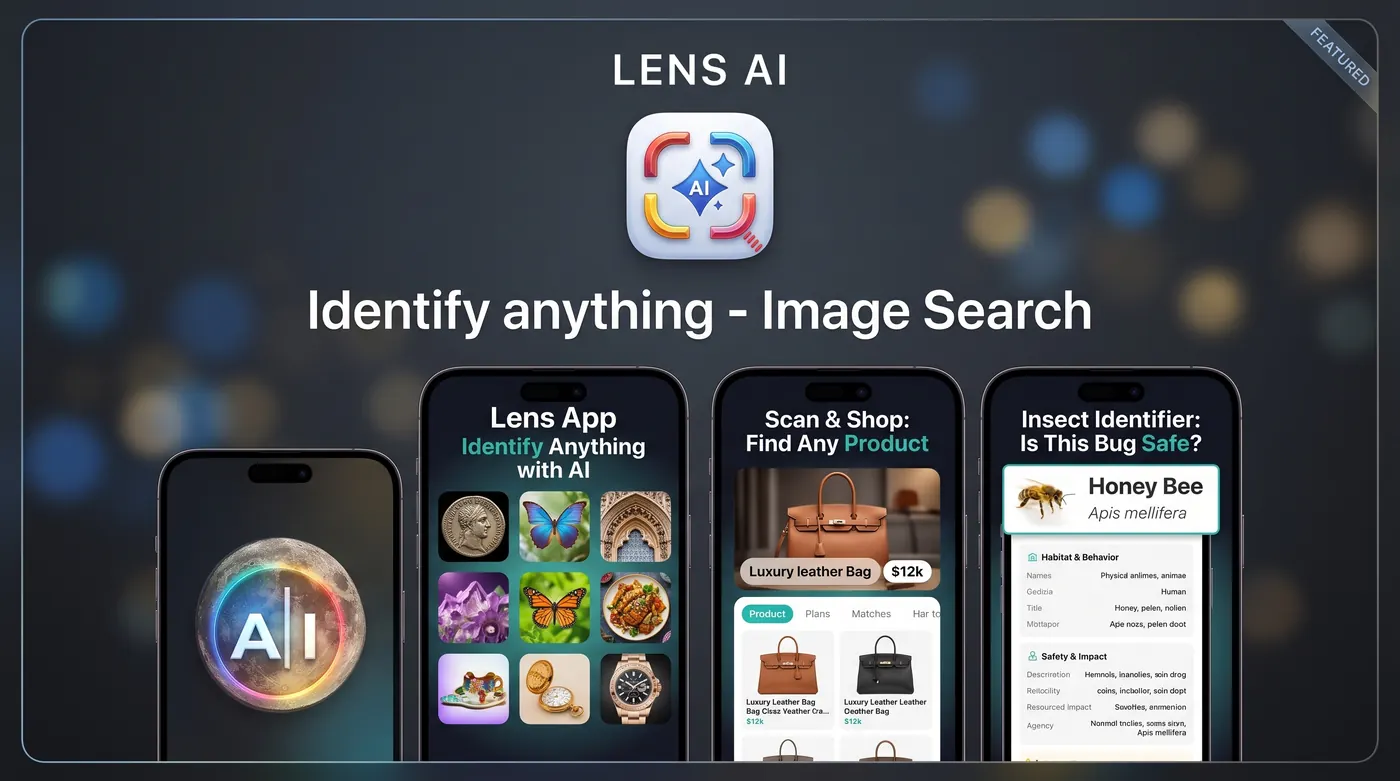
Point your camera at the problem, get an explanation you can follow. Lens App reads worksheets, textbook pages, diagrams, and handwriting, then walks through the reasoning instead of dropping a bare answer.
Drop a photo here or tap to upload
JPG, PNG, WebP, HEIC • Max 50MB

Analyzing with AI…
Matching visual features and similar results


What is a homework helper from photo?
A photo homework helper reads the question in your picture, then explains how to solve it. You point your camera at a worksheet, textbook page, or diagram, and Lens App returns the terms, steps, and reasoning behind the answer. It works best on clear, well lit shots of one problem at a time.
Fact: Lens App is listed on the App Store as a free download with in-app purchases. The site gives you free daily scans on mobile and one free web scan per day, with optional upgrades (Weekly, Monthly, Yearly, Lifetime) when you need more volume.
What happens when you photograph a homework question
Open Lens App, frame the question, tap the shutter. The app reads the printed or handwritten text, figures out what kind of problem it is, and returns an explanation broken into steps. For a quadratic equation you get the setup, the method, and the arithmetic. For a labeled diagram you get the parts named and a short description of what each one does.
The point is not to hand over a number. A number is easy to copy and easy to forget. The useful output is the middle: which rule applies, why that rule and not another one, and where students usually slip. If you already tried the problem, photograph your own work too. Lens AI can compare your steps against the standard approach and point at the line where things went sideways.
This is the same recognition engine that answers the broader question, [what is this](/what-is-this/), applied to a page instead of an object. Text, symbols, charts, and hand drawn figures all count as things worth reading.
Take a photo the app can actually read
Most bad results come from bad photos, not hard problems. Lay the page flat. Get light coming from the side or behind you, never from directly over your shoulder onto glossy paper. Fill the frame with one problem rather than the whole worksheet, because a page of twelve questions gives the app twelve competing things to answer. Hold still for half a second after you tap.
Handwriting is readable if the strokes are separated and the pencil is dark enough. Faint pencil on cream paper is the hardest case. Trace over a faded exponent or subscript before you shoot, since a misread superscript changes the whole problem. Fractions photograph better straight on than at an angle, and long division needs the whole bracket in frame.
If your shot is soft or slightly shaky, it may still be usable. We wrote up when a [blurry photo is still identifiable](/blurry-photo-still-identifiable/) and where the line sits. In short: blur that keeps digit shapes intact is often fine, blur that merges a 3 into an 8 is not.
Math from a photo: strengths and limits
Arithmetic, fractions, percentages, ratios, linear and quadratic equations, systems, factoring, basic trig identities, derivatives, and definite integrals all come back with steps. Word problems work too, as long as the full text is in frame. Cutting off the last sentence of a word problem removes the thing being asked for, and the answer will be about something else.
Geometry with a figure depends on how legible the labels are. If the side lengths and angle marks are visible, the app can reason from them. If the figure is drawn by hand and the labels overlap the lines, retype the givens in the follow up field instead of relying on the picture alone.
Limits are worth stating plainly. Multi part proofs, statistics questions that depend on a data table three pages back, and anything requiring a specific classroom notation your teacher invented will need your judgment. Treat the output as a knowledgeable study partner who has not read your syllabus.
Science homework, diagrams, and specimens
Biology and earth science assignments often mix reading with looking. A photo of a cell diagram comes back with organelles named. A photo of a rock sample from a field trip gets a mineral read through the [rock identifier](/rock-identifier/), which is enough to fill in a classification chart and check what your notes say.
The same applies to living things you have to write up. A leaf collection sorted with the [plant identifier](/plant-identifier/) gives you species names to verify in your textbook. A bird on the windowsill goes through the [animal identifier](/animal-identifier/). A specimen taped into a lab notebook can be checked with the [insect identifier](/insect-identifier/) before you label the order and family.
One caution for any science project involving fungi or wild plants: identification from a photo is a starting point for a written assignment, never a green light for tasting, touching, or eating anything. Keep collected samples in a bag, wash your hands, and let your teacher confirm the label.
Reading, language, and translation assignments
Photograph a paragraph and ask what the main idea is, or ask for the unfamiliar words defined in context. For poetry, a photo of the stanza plus a question about imagery gives you something to argue with, which is better practice than a summary you accept without thinking.
Foreign language work is a natural fit. A page of Spanish or Japanese text can go through [image translation](/image-translation/) so you see the source and the English side by side. That is a real help for checking your own draft translation. It is not a substitute for doing the exercise, and most teachers can tell the difference between a sentence you built and a sentence you pasted.
For vocabulary drills, photograph the list and ask for example sentences at your reading level. You keep the list, you gain usage, and nothing gets copied wholesale onto your homework sheet.
History, art, and the object on your worksheet
Assignments sometimes hand you an image with no caption and ask what it is. That is a recognition problem before it is a research problem. Photograph the printed picture and Lens App will [identify the object from the photo](/identify-object-from-photo/), giving you a name to search, a period, and usually a region.
For a painting, a monument, or an unlabeled artifact, the wider [identify anything from a photo](/identify-anything-from-a-photo/) flow is the one to reach for. It handles buildings, sculptures, tools, uniforms, and printed reproductions that a plain text search would never surface.
When you need the original source rather than a label, [reverse image search](/reverse-image-search/) is the better move. It shows where else that image appears online, which matters when your teacher asks for a citation and you only have a photocopy.
Studying with it instead of copying from it
The honest workflow looks like this. Attempt the problem first. Photograph your attempt. Read the explanation and find the exact step where you diverged. Redo the problem on a clean sheet without looking. That last step is the one people skip, and it is the one that makes the difference on a test where no camera is allowed.
For revision, photograph the three problems you got wrong on last week's quiz and ask for the underlying rule rather than the solutions. Two or three rules usually explain most of a page of mistakes. Write the rules on an index card. That card is worth more than twenty solved examples.
Academic honesty policies vary by school and by teacher. Some allow photo tools for checking work, some ban them for graded assignments, some require a note when you use them. Ask before you rely on it. A tool that helps you learn and a tool that submits work for you are different things, and only the first one is safe.
Accuracy, second checks, and when to ask a person
Photo based help is confident by design, which means a wrong reading can look as tidy as a right one. Sanity check the answer against your own estimate. If you expected a value near 40 and the app says 400, one of you dropped a decimal, and it is worth finding out which. Plug the solution back into the original equation when you can, since that check takes ten seconds and catches most errors.
Ask a teacher or tutor when the confusion is conceptual rather than procedural. If you do not know why we take derivatives at all, no amount of solved derivatives will fix that. A photo tool is excellent at the mechanics and thin on the reason the mechanics exist.
Lens App is an independent product. It is not affiliated with, sponsored by, or endorsed by Google, and it does not carry any school or curriculum approval.
Pricing and what a free day covers
Downloading Lens App is free. You get free daily scans on mobile and one free web scan per day, which covers a normal homework session where you check two or three sticking points rather than the whole worksheet. No account is needed to try it.
If you hit the daily limit during finals week or a long problem set, the in-app upgrades add volume. The App Store listing shows Weekly, Monthly, Yearly, and Lifetime options, plus Pro tiers. Subscriptions renew until you cancel in your device settings, and the current prices are always the ones shown at checkout on your own store.
There is no education discount page to hunt for and no bundled tutoring add on. Point the camera, read the steps, close the app, do the work.
FAQ
Can Lens App read my handwriting?
Usually, if the pencil is dark and the characters are separated. Faint writing, cramped exponents, and overlapping fractions are the common failure points. Trace over anything faded before you shoot, and photograph one problem per picture rather than a full page.
Does it show steps or just the answer?
Steps. The explanation names the method, works through the arithmetic, and points out where the usual mistakes happen. You can photograph your own attempt and ask which line went wrong, which is the more useful way to use it.
Is using a photo homework helper cheating?
It depends on your teacher and your school policy. Checking your finished work and learning a method are generally accepted. Photographing a graded assignment and copying the output is not. Ask before you rely on it for anything scored.
What subjects work best?
Math through introductory calculus, chemistry and physics problems with clear givens, biology labeling, reading comprehension, and foreign language exercises. Anything depending on a data table outside the frame or a notation unique to your class needs more context from you.
How many scans do I get for free?
Free daily scans on mobile and one free web scan per day. That is enough for a typical study session. Optional in-app upgrades add more volume if you need them during heavy assignment weeks.
Will it work on a photo of a screen?
Often, but glare and moire patterns hurt accuracy. Lower the screen brightness slightly, shoot straight on rather than at an angle, and take a screenshot instead when the assignment is already digital.
Is Lens App connected to Google Lens?
No. Lens App is an independent product and is not affiliated with, sponsored by, or endorsed by Google. Any similarity in name does not indicate a partnership or shared technology.
Can I use it for a science project involving plants or fungi?
Yes, for written identification and classification work. Do not treat any photo identification as clearance to taste, eat, or handle a specimen. Bag your samples, wash your hands, and have a teacher confirm the label before it goes in a report.
Related pages
Also useful: how accurate is Lens App.