 Lens
Lens
Lens AI - Identify Anything vs Lens App
Two visual search apps, two different habits. One leans on multi-engine reverse image lookups, the other on category-aware identification with follow-up actions. Here is how they line up in daily use.


What is the difference between Lens AI - Identify Anything and Lens App?
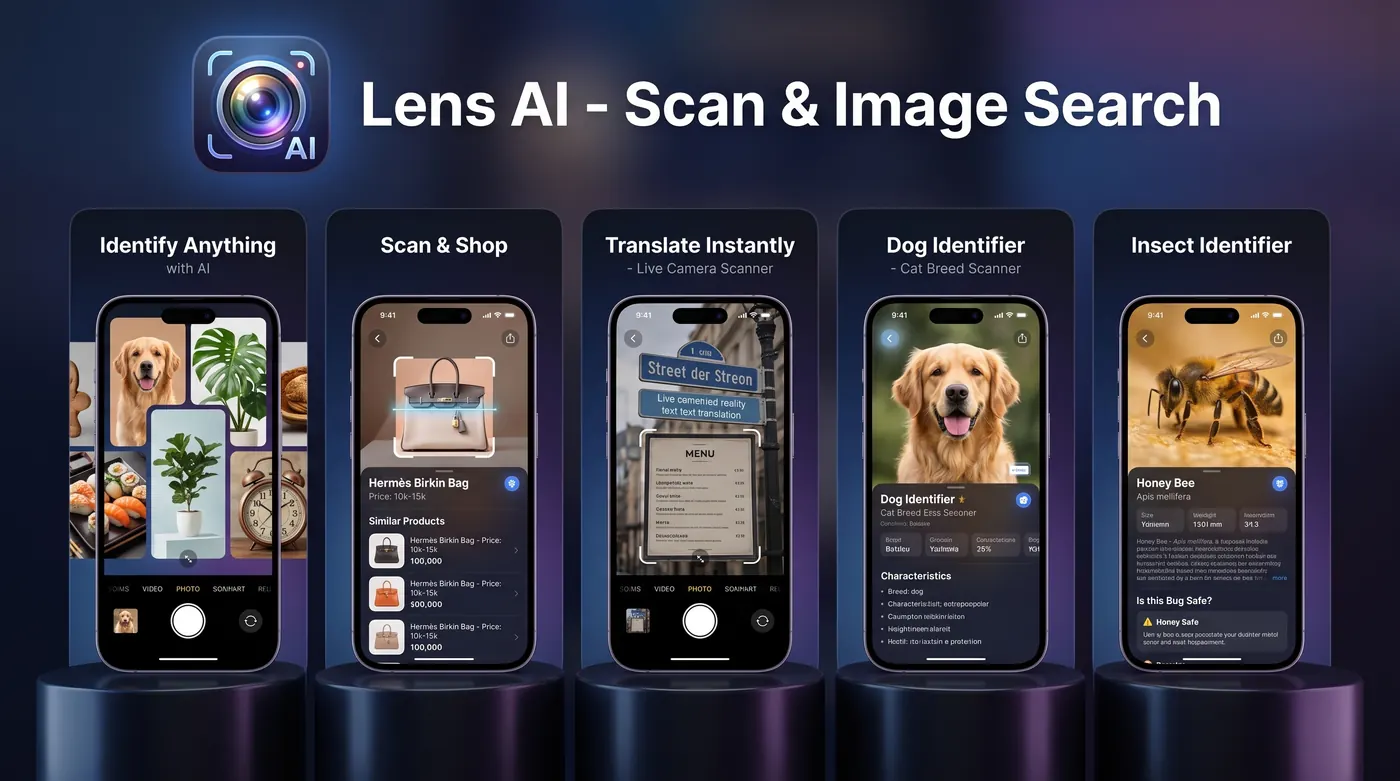
Lens AI - Identify Anything, from Premier Mobile Apps, is a compact iPhone app for object recognition and multi-engine reverse image search. Lens App is a broader visual search tool that adds specialist identification modes for plants, animals, coins, rocks and insects, plus translation and shopping lookups, with free daily scans on mobile and one free web scan per day.
Fact: Lens AI - Identify Anything lists a 4.6 App Store rating from roughly 394 ratings and sits in the Graphics & Design category, with subscription and lifetime in-app purchases. Lens App is free to download with in-app purchases and is independent, not affiliated with Google.
What each app is actually built around
Lens AI - Identify Anything presents itself as a general recognizer: point the camera at something, get a label, then push the image out to reverse search engines to see where else it appears. Reviewers tend to praise that multi-engine step, and the app keeps a small install footprint, which matters if your phone storage is always one photo away from full.
Lens App starts from the same question, what is this, but branches after the first guess. Instead of one general model doing everything, it routes the photo toward the mode that fits: a leaf goes to plant handling, a coin goes to numismatic detail, a printed sign goes to translation. The label is the beginning of the answer, not the whole thing.
Neither approach is wrong. If you mostly want a quick name and a web trail, the lighter app covers it. If you keep hitting categories where the name alone is not useful, the specialist routing saves you a second search somewhere else.
Confidence, and what happens when the app is wrong
One recurring theme in Lens AI reviews is false confidence, especially on artwork. A model that answers every photo with the same certain tone will eventually be certain about the wrong painter. That is not unique to any one app, but it changes how you use the result: you end up verifying manually anyway.
Lens App tries to make uncertainty visible instead of hiding it. When the model is torn between two look-alikes, it says so and shows what separates them, so you can check the distinguishing detail yourself. When you identify an object from a photo that has ambiguous features, a ranked shortlist with reasons is more useful than a single confident line.
Practical test for either app: photograph something you already know well. A tool that hedges appropriately on a hard case is more trustworthy than one that never hedges at all.
Reverse image search: engines versus context
Multi-engine reverse search is the standout feature people mention in Lens AI. Sending one photo to several indexes at once is genuinely useful for tracking down a product page, a stock image source, or an artwork listing that a single engine missed.
Lens App also runs reverse image search, and pairs it with an identification pass so the web results arrive with context. Knowing the object is a mid-century ceramic vase before you scan the results makes it far easier to spot the right listing among fifty near matches. Search without a label is a lot of scrolling.
If your main job is source-hunting for images you found online, both tools will get you there. If your main job is figuring out physical things in front of you, the label plus search combination does more per scan.
Specialist categories: plants, animals, coins, rocks, insects
This is the widest gap between the two apps. A general recognizer can tell you something is a beetle. A dedicated insect identifier tries for the species group and explains which markings matter. The same difference shows up with a plant identifier that asks about leaf arrangement, or an animal identifier that separates two similar birds by wing bar.
Collectors notice it most. A coin identifier needs to read mint marks, dates and edge detail, then point you toward grading language rather than just saying "old coin." A rock identifier is more helpful when it mentions hardness, streak and luster, because those are checks you can run at home with a scratch test.
A safety note that applies to every visual tool, including this one: do not use an app to decide whether a mushroom, berry or plant is safe to eat, and do not use one to judge whether a bite or sting needs medical attention. Identification apps are for curiosity and research. Consult a qualified expert or medical professional for anything with a health consequence.
Translation and shopping, the two follow-up tasks
A lot of camera scans are not really identification questions. You photograph a menu because you cannot read it, or a chair in a hotel lobby because you want one. Lens AI focuses on recognizing and searching, so those tasks usually bounce to another app.
Lens App handles both in the same flow. Image translation reads text off signs, labels and packaging and keeps the layout readable, which helps with ingredient lists and transit signage. The shopping finder takes a photo of an item and looks for the same or similar products, which is the difference between "that is a floor lamp" and "here is where that floor lamp is sold."
If you travel, shop from photos, or read foreign packaging often, consolidating those into one app removes a step you repeat several times a week.
Bad photos, which is most photos
Real scans are taken through glass, in poor light, at odd angles, or one-handed while something moves. Any app can look good on a clean studio shot. The interesting question is what happens with a soft, low-contrast frame.
Lens App is built to keep working on imperfect input and will tell you when a retake would help, and what to change: closer, steadier, better light, different angle. We wrote up the details on whether a blurry photo is still identifiable, because the answer depends more on which features survived the blur than on sharpness alone.
With a lighter general recognizer, a poor photo usually just produces a poor guess with no explanation, which sends you into a retake loop without knowing what to fix.
Pricing and what the free tier really covers
Lens AI - Identify Anything is free to download with in-app purchases, including subscription options and a lifetime unlock. The App Store listing is the place to confirm current tiers and prices, since they change.
Lens App is also free to download with in-app purchases and subscriptions. In practice that means free daily scans on mobile and one free web scan per day, with optional upgrades if you scan a lot. Listed purchase options have included weekly, monthly, yearly and lifetime tiers alongside Pro plans.
Before paying for either, run your own hard cases through the free allowance. Photograph five things you genuinely cannot name, then check the answers against a reliable source. That tells you more than any feature list, including this one.
Install size, speed and daily habit
Smaller apps launch faster and cost less storage, and Lens AI's compact footprint is a real advantage on older or nearly full devices. If you scan occasionally and want the app to stay out of the way, that lightness counts.
Lens App carries more because it does more: multiple identification modes, translation, shopping lookups and history. The tradeoff is one icon instead of four. Most of the identification and search work happens server side, so the on-device weight is mainly interface and cached results rather than a pile of local models.
Pick based on how you actually use your phone. Occasional curiosity favors the lighter tool. Daily use across several categories favors the one that keeps you in a single flow.
Which one to choose
Choose Lens AI - Identify Anything if your priority is a small, quick app that names things and fires the photo at several reverse search engines. It has a solid rating from a modest review base, and the multi-engine search is the part people come back for.
Choose Lens App if you want to identify anything from a photo and then do something with the answer: read the label in another language, find where to buy it, dig into a coin's mint mark, or check which two plant species you are choosing between. The free daily scans are enough to test that honestly.
Lens App is an independent product. It is not affiliated with, endorsed by, or connected to Google or Google Lens, and any comparison here is descriptive rather than a claim of partnership.
Side-by-side comparison
| Feature | Lens App | Other app |
|---|---|---|
| General object identification | Yes, with ranked alternatives and reasons | Yes, single confident label in most cases |
| Reverse image search | Yes, paired with an identification pass for context | Yes, multi-engine search is a highlight in reviews |
| Specialist modes (plants, animals, coins, rocks, insects) | Dedicated modes with feature-level detail | General recognition, no dedicated category modes listed |
| Image translation | Yes, reads signs, menus and packaging | Not a listed focus |
| Shopping and product lookup | Yes, finds same or similar items | Indirect, via reverse search results |
| Handling of blurry or low-light photos | Flags weak input and suggests what to retake | Returns a result without retake guidance |
| Free tier | Free daily mobile scans, 1 free web scan per day | Free download, limits set by in-app purchase tiers |
| Paid options | Weekly, monthly, yearly, lifetime and Pro tiers | Subscription plus lifetime unlock |
| App Store rating | Free download with in-app purchases | 4.6 from roughly 394 ratings |
| Install footprint | Larger, covers more modes in one app | Compact, praised by reviewers |
Based on public App Store listings and may change. Lens App is independent and not affiliated with other apps that use Lens in their name.
FAQ
Is Lens AI - Identify Anything accurate?
It holds a 4.6 rating from about 394 App Store ratings, and users praise its reverse image search. Some reviewers report confidently wrong answers on artwork. As with any visual recognizer, treat a single result as a starting point and verify anything that matters before acting on it.
Does Lens App do multi-engine reverse image search too?
Lens App runs reverse image search and pairs it with an identification pass, so results come with context about what the object likely is. That combination usually narrows a page of near matches faster than raw search results alone, especially for products, artwork and collectibles.
Which app is better for plants and animals?
Lens App, because it routes those photos into dedicated modes that explain the distinguishing features rather than returning a single label. That said, never use any app to decide whether a wild plant, berry or mushroom is safe to eat. Confirm with a qualified expert instead.
What does Lens App cost?
Free to download from the App Store with in-app purchases and subscriptions. The site offers free daily mobile scans and one free web scan per day, with optional upgrades for higher volume. Listed purchase options have included weekly, monthly, yearly, lifetime and Pro tiers.
Is Lens App related to Google Lens?
No. Lens App is an independent product and is not affiliated with or endorsed by Google. The word lens is descriptive of camera based search, and several apps in this space use it, including Lens AI - Identify Anything from Premier Mobile Apps.
Can either app identify something from a blurry photo?
Sometimes. It depends on whether the distinguishing features survived the blur, not on sharpness alone. Lens App will flag when a retake would help and suggest what to change, such as moving closer or improving light, rather than returning a guess with no explanation.
Do I need both apps?
Usually not. If you only chase image sources online, the lighter reverse search tool may be enough. If you also translate labels, look up products, or identify plants, coins and rocks, one app that covers all of it saves switching back and forth.
Which app uses less storage?
Lens AI - Identify Anything has the smaller install footprint, which reviewers mention as a plus on older or nearly full phones. Lens App is larger because it includes more modes, though most processing happens server side rather than through large on-device models.