 Lens
Lens
Lens: Reverse Image Search AI vs Lens App
One app hunts for copies of your photo across search engines. The other tells you what is actually in the frame. Here is how the two compare, and when each is the better tool.


What is the difference between Lens: Reverse Image Search AI and Lens App?
Lens: Reverse Image Search AI routes one photo through several search engines so you can hunt for matching pages online. Lens App answers the question inside the photo itself, naming the plant, coin, insect, or product and explaining what it is. One finds copies of an image, the other identifies the subject.
Fact: Lens: Reverse Image Search AI is published by Anh Nguyen and carries roughly a 4.5 star average from about 1,200 App Store ratings, with subscription options that run from weekly to lifetime.
Two apps built around two different questions
Reverse image search and image identification get grouped together, but they solve different problems. Reverse image search asks where else this exact picture appears. Identification asks what is this thing in front of me. Lens: Reverse Image Search AI is built for the first question. Lens App is built for the second, and adds a reverse image search option on top.
That distinction decides which app helps you. If you already have a photo pulled from a website, a profile, or a listing, and you want to trace it back to its source, engine results are exactly what you need. If you are standing in a garden, a coin shop, or a hardware aisle holding your phone, engine results are a detour. You want a name and a short explanation.
Where Lens: Reverse Image Search AI fits
The pitch is straightforward and honest about what it does: one photo, several engines. Instead of opening Google Lens, then Google Images, then Bing, then Yandex, then TinEye separately, you upload once and check each set of results from a single screen. For anyone who does this often, that saves real time, because different engines index different parts of the web and often disagree.
Yandex tends to surface faces and Eastern European sources. TinEye is good at dates and first appearances. Bing catches product pages the others miss. Lining those up side by side is a genuinely useful workflow, and it is the app's strongest reason to exist. The listing is rated 16+, which fits the kind of investigative use people bring to it.
Where Lens App fits
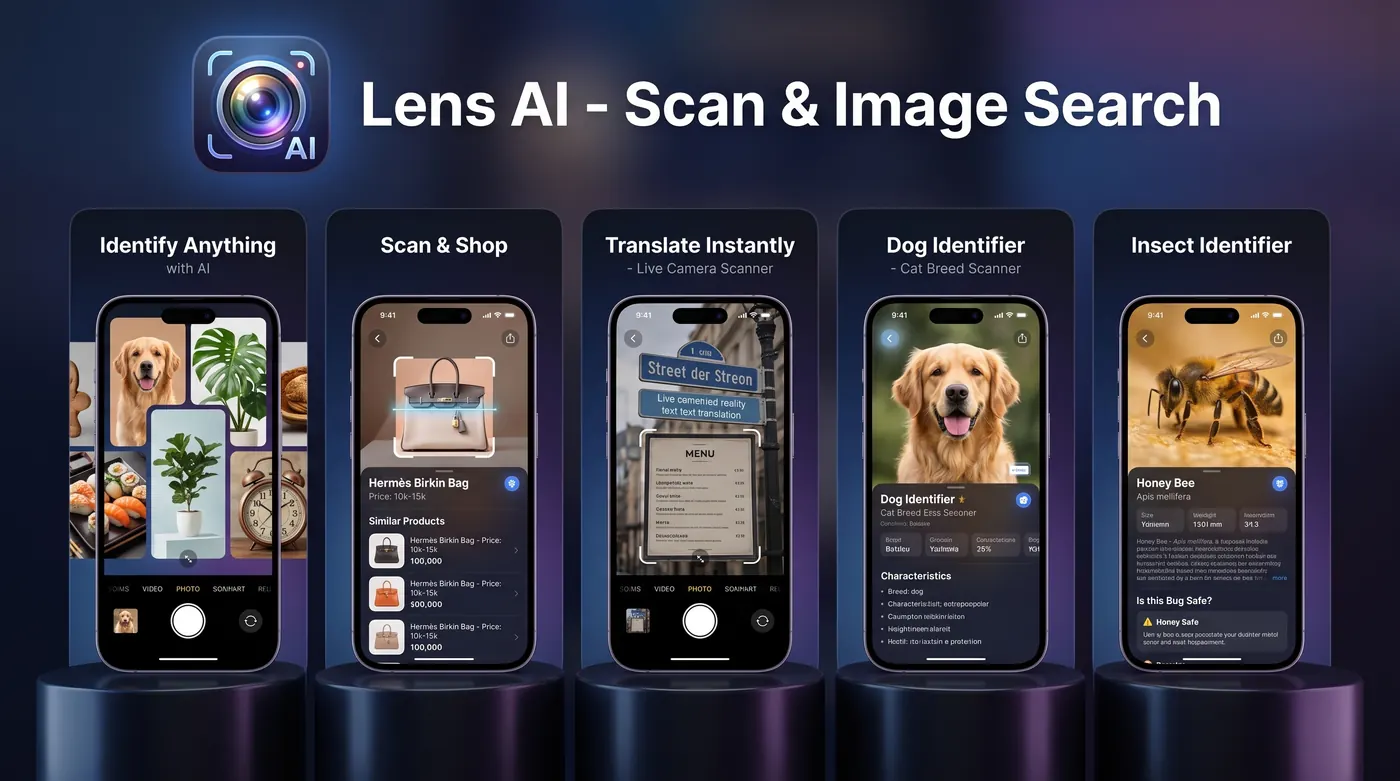
Lens App starts from the photo, not the index. Point the camera, and it names what it sees, then explains it in plain language: species, likely material, era, common use, what to look for next. The point of view is closer to asking a knowledgeable friend what is this than to running a query. That is why so many sessions start with a simple what is this moment rather than a search intent.
You can still run a reverse image search inside Lens App when tracing a picture is the actual goal. The difference is that the identification path is the default, and web matching is one option rather than the whole product. Most people who want to identify an object from a photo want a label first and links second.
Multi-engine results vs a single clear answer
Multi-engine results are powerful and also noisy. You get five lists, some overlapping, some irrelevant, and you do the interpreting. That is fine when you are investigating something and want raw material. It is frustrating when you took a photo of a beetle on your porch and just want to know if it bites.
Lens App collapses that step. Instead of ten tabs of visually similar images, you get one identification with confidence signals and context, plus the option to dig further. When you want to identify anything from a photo without becoming your own research analyst, that shortcut matters more than engine coverage.
How each handles photos that are not perfect
Real photos are taken through glass, in bad light, at odd angles, or slightly out of focus. Reverse image search engines depend on visual fingerprints of the whole frame, so a soft or cropped shot often returns weak matches or nothing. That is a property of how indexing works, not a flaw in any particular wrapper app.
Identification models behave differently. They can work from partial cues: a leaf edge, a wing pattern, a mint mark, a texture. Lens App is often still useful when a blurry photo is still identifiable, because it is reading features rather than matching pixels against an index of existing pages.
Dating profiles, listings, and authenticity checks
A lot of people reach for a reverse image tool because something feels off. A profile photo looks like a stock shot. A marketplace listing photo looks lifted from a manufacturer catalog. Multi-engine search is the right instrument here, and Lens: Reverse Image Search AI is explicitly aimed at that use.
Set expectations, though. A photo that appears nowhere else is not proof of anything, and a photo that appears in many places may simply be popular. Engines index a fraction of the web and drop old pages. Use the results as one signal among several, not as a verdict. Lens App can help from the other direction by identifying what is in a suspicious photo: the plant behind the person, the model of a watch, the coin in the tray, details that either match the story or do not.
Pricing and free limits
Both apps are free to download from the App Store with in-app purchases. Lens: Reverse Image Search AI offers plans from weekly through lifetime, and a recurring theme in its feedback is surprise at the paywall arriving quickly after the first free uses. That is worth knowing before you start, especially if you only need one lookup.
Lens App gives you free daily scans on mobile and one free web scan per day, with optional upgrades if you need more volume. The App Store listing shows a range of purchase options including weekly, monthly, yearly, Pro, and lifetime. The practical difference is that occasional users can keep using Lens App without paying anything, because the daily allowance resets.
Categories where Lens App carries most of the load
Identification is category work, and Lens App is organized that way. The plant identifier handles garden volunteers, houseplants, and roadside weeds. The animal identifier covers backyard birds, tracks, and unfamiliar wildlife. The insect identifier is the one people open on a bad night. Collectors use the coin identifier for dates, mint marks, and denominations, and the rock identifier for the drawer of specimens nobody labeled.
Beyond that, image translation reads menus, signs, and packaging labels in another language, and the shopping finder helps when you like an object and want to find something similar to buy. A pure reverse search wrapper can sometimes get you to a product page, but it cannot name a mineral or tell you which grass is taking over the lawn.
Which one should you install
Pick Lens: Reverse Image Search AI if your main job is provenance. You already have the image. You want to know where it came from, how long it has been online, and who else posted it. Comparing five engines in one place is the fastest way to do that, and paying for a tool that specializes in it is reasonable.
Pick Lens App if your main job is understanding. You are taking new photos of real things and you want names, context, and next steps, with reverse image search available when you need it. Many people end up with both, using one for verification and one for everything else. Lens App is an independent product and is not affiliated with or endorsed by Google, even though it can run web matching alongside its own identification.
Side-by-side comparison
| Feature | Lens App | Other app |
|---|---|---|
| Primary job | Identify the subject in the photo, then explain it | Find where a photo already appears online |
| Reverse image search | Included as one feature | Core feature across Google, Bing, Yandex, TinEye |
| Multi-engine comparison | Not the focus | Yes, several engines from one upload |
| Plants, animals, insects, rocks, coins | Dedicated identifiers with context | Only visually similar images |
| Blurry or partial photos | Often still usable, reads features | Weak, depends on indexed matches |
| Translation of signs and menus | Yes, image translation built in | Not a stated feature |
| Shopping lookups | Identify then find similar items | Works only if the exact photo is indexed |
| Free use | Free daily mobile scans plus one free web scan per day | Limited free use before subscription |
| Purchase options | Weekly, monthly, yearly, Pro, lifetime | Weekly through lifetime plans |
| Age rating on listing | General audience use | 16+ |
Based on public App Store listings and may change. Lens App is independent and not affiliated with other apps that use Lens in their name.
FAQ
Can Lens App do reverse image search too?
Yes. Lens App includes a reverse image search option for tracing where a picture appears online. It is one feature inside a broader identification app rather than the whole product, so you get both a name for the subject and web matches from the same photo.
Which app is better for checking a dating profile photo?
A dedicated multi-engine tool has the edge, since face and photo matching results vary widely between Google, Bing, Yandex, and TinEye. Treat any result as one signal. No match does not prove authenticity, and a match may only mean the image was widely shared.
Do I need a subscription to use either app?
Both are free downloads with in-app purchases. Lens App includes free daily mobile scans and one free web scan per day, so light use costs nothing. Lens: Reverse Image Search AI sells plans from weekly to lifetime, and free use before the paywall is limited.
Why do reverse image searches often return nothing useful?
Engines match against pages they have already indexed. If your photo was taken just now, or is cropped, blurry, or shot at an unusual angle, there is nothing to match. Identification models handle these cases better because they read visual features instead of matching whole images.
Is Lens App connected to Google Lens?
No. Lens App is an independent product from lensapp.io with no affiliation with or endorsement from Google. The word lens is common across visual search tools, so several unrelated apps share similar names in the App Store.
Which app helps more when shopping?
Both can help, in different ways. Reverse search sometimes lands directly on a product page if that exact photo is online. Lens App identifies the object first, then suggests similar items to buy, which works better for things you photographed yourself in a store or a friend's home.
Can either app identify plants and animals reliably?
Lens App is built for it and provides species names with context and confidence signals. A reverse image search tool can only surface visually similar pictures, which may or may not be correctly labeled. For plants, insects, birds, rocks, and coins, identification beats image matching.
Is it worth having both installed?
For many people, yes. Use a multi-engine reverse search tool when the goal is tracing a picture back to its source. Use Lens App for daily identification, translation, and shopping questions, plus reverse lookups when you want them in the same place.