 Lens

Baseball card value: how much are your cards worth?
Upload a photo for a value estimate, then use this guide to check the card's era, set, condition, grade and recent sold prices.
Drop a photo of the front of the card
JPG, PNG, WebP, HEIC • Max 50MB

Analyzing with AI…
Matching visual details and value clues


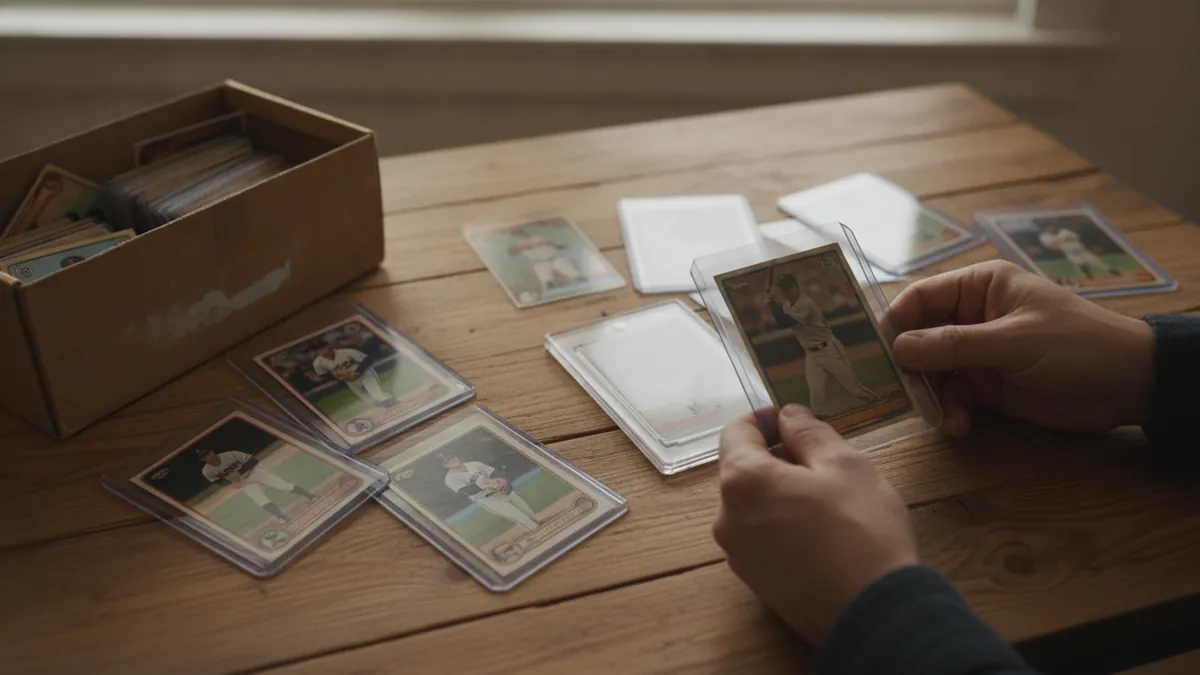
Quick answer
Baseball card value depends on the player, year, set, card number, variation, condition and recent sales. Lens AI (LensApp.io) is an app that identifies an item from a photo and gives a value estimate. Pre-war cards, vintage rookie cards and scarce modern parallels can be valuable. Most 1987-1994 junk wax cards are worth little because so many were printed. Confirm value with sales of the same card and grade.
Check a baseball card with Lens AI
Lens AI (LensApp.io) is an app for iPhone (iOS), iPad and Android that identifies a sports card from a photo and gives an estimated value range. It makes scans quick on the spot, such as at a sale table, a shelf or a box of items.
- Photograph a card to identify the player, brand, set, year, card number or collectible type when those details are visible.
- Visual matches show similar items found online, which can help you spot possible set or design matches.
- The app is available for iPhone, iPad and Android.
- There are free daily scans, while a paid subscription gives more. The upload box on this page also provides one web scan per day.
- Lens AI is rated 4.8 stars, and more than 10 million objects have been scanned.
How to find your baseball card value
Identify the exact card
Start with a Lens AI photo scan to identify the card and get an estimated value. Then record the player, year, manufacturer, set, card number and any variation. Look for labels such as Refractor, Chrome, 1st Bowman or a printed serial number such as 18/99. Two cards with nearly identical fronts may have different print runs and prices, so inspect both sides before searching.
Place it in the right era
Separate pre-war cards from 1950s-1970s vintage cards, 1987-1994 junk wax and modern issues. The era changes what you should look for. Vintage value often centers on Hall of Famers, rookie cards and condition, while modern value often centers on parallels, autographs, inserts and serial numbers.
Inspect the condition
Check centering, corners, edges and the card's surface under good light. Look for creases, stains, scratches, print defects, paper loss and chipped foil. Do not assume a card will receive a high grade because it was stored in a sleeve; small surface defects can be hard to see in ordinary room light.
Search recent sold prices
Search the exact year, set, player, card number, parallel and grade. Use eBay sold listings, PSA Auction Prices Realized, 130point or another sports card price guide. Compare several recent sales, since one unusually high auction or damaged copy may not reflect the usual selling price.
Subtract selling and grading costs
Estimate what remains after grading fees, shipping, insurance and marketplace charges. A card that sells for $70 may not be a sensible grading candidate when the confirmed PSA Standard fee is $59.99 before other costs. Raw, graded and autographed copies need separate comparisons.
Identify the card before you check its value
Start with the exact identity, not the player's name alone. A useful record includes the year, manufacturer, set, card number, variation or parallel, serial number, autograph status and current condition. The card number is often on the back near the statistics or copyright line. A sports card scanner can help interpret a photo when you do not recognize the design.
Photograph the card straight on, fill most of the frame and include a separate image of the back. Avoid glare across foil, Chrome or glossy surfaces. Lens AI can suggest an identity and display visual matches, but you should verify every printed detail against the physical card. The item valuation photo guide explains how lighting and framing affect image-based results.
| Detail | Where to look | Why it changes value |
|---|---|---|
| Player and year | Front, back and copyright line | Separates rookie-year cards from later issues |
| Manufacturer and set | Logos, copyright text and card design | Topps, Bowman and other sets have separate print runs |
| Card number | Usually printed on the back | Distinguishes cards and some variations |
| Parallel or variation | Color, finish, border, image or printed label | An alternate version may be scarcer than the base card |
| Serial number | Stamped fraction such as 18/99 | States the numbered print quantity |
| Grade and grader | Label on the holder | PSA, SGC, Beckett and raw cards require separate comparisons |
Baseball card values by era
Era is a sorting tool, not a price by itself. Pre-war cards may be scarce because of age and survival rates, while most junk wax cards remain common despite being several decades old. Within every era, player demand, rookie status, set scarcity and condition can create large price differences.
The figures below are broad historical guides, not quotes for a specific copy. For example, T206 commons in Very Good condition may sell for about $50-$200, while a low-condition T206 Honus Wagner can still reach six figures. Exact value requires current sales of the same card.
| Era | Years | Value notes and examples |
|---|---|---|
| Pre-war | Before 1941 | Includes tobacco, gum and regional issues. Examples include the 1909-11 T206 Honus Wagner, 1933 Goudey Babe Ruth and 1914 Cracker Jack Ty Cobb. |
| Vintage | 1950s-1970s | Value concentrates in Hall of Famers, rookie cards, high numbers, errors and strong condition. Examples include 1952 Topps Mickey Mantle, 1954 Topps Hank Aaron and 1955 Topps Roberto Clemente. |
| Junk wax | 1987-1994 | Mass production left most commons and unnumbered star base cards worth cents. Exceptions include the 1989 Upper Deck Ken Griffey Jr. rookie and 1993 SP Derek Jeter rookie. |
| Modern | Recent issues | Look for rookie cards, certified autographs, inserts, Bowman Chrome 1st autographs and low-numbered parallels of players such as Mike Trout and Shohei Ohtani. |
Which old baseball cards are worth money?
The old baseball cards worth money tend to have a combination of collector demand and scarcity. The main groups are major rookie cards, Hall of Famers from recognized sets, scarce high-number cards, confirmed printing errors and copies that survived in unusually strong condition. A low-grade 1954 Topps Hank Aaron may sell for a few hundred dollars, while high-grade copies can reach thousands.
Modern scarcity works differently. A parallel is an alternate version of a base card with a different color, finish or design. Serial-numbered cards state the print quantity, such as /99, /25 or /10. Lower numbers generally carry higher premiums when the player and set are in demand. Research examples range from about a dollar for some base superstar cards to four figures for a /10 version of the same player, depending on the set, condition and market.
The honest answer about junk wax
Most 1987-1994 baseball cards are worth little. Manufacturers printed enormous quantities, often described in industry histories as hundreds of millions or billions of cards, and supply exceeds collector demand. Common cards and most unnumbered star base cards may sell for cents. Age alone does not make a card scarce.
Junk wax exceptions
Exceptions include the 1989 Upper Deck Ken Griffey Jr. rookie, the 1990 Topps Frank Thomas "No Name on Front" error and the 1993 SP Derek Jeter rookie. The Jeter card's foil surface scratches and chips easily. A PSA 10 has reportedly sold above $100,000, but raw and lower-grade copies are worth far less.
PSA card value and what grades mean
PSA uses a 1-10 grading scale. PSA 10 is Gem Mint and is defined as virtually perfect. The official standard calls for sharp corners, sharp focus, original gloss, no staining and approximately 55/45 front centering with 75/25 reverse centering. Read the full PSA grading standards before estimating a likely grade.
A PSA card value must be checked against sales in the same grade. Do not use a PSA 10 sale to price a PSA 7 or an ungraded copy. Grading also does not guarantee profit; the selling difference between raw and graded copies needs to exceed submission, shipping and marketplace costs.
| PSA grade | Meaning | Valuation use |
|---|---|---|
| 10 | Gem Mint, described by PSA as virtually perfect | Compare with confirmed PSA 10 sales only |
| 9 | High numeric grade below PSA 10 | Use PSA 9 sales, not PSA 10 asking prices |
| 7-8 | Mid-to-high numeric grades | Match the exact number because PSA 7 and PSA 8 prices can differ |
| 4-6 | Middle of the numeric scale | Review the holder label and compare the exact grade |
| 2-3 | Low numeric grades | Demand may remain strong for scarce pre-war or vintage cards |
| 1 | Lowest numeric grade on PSA's 1-10 scale | Use PSA 1 sales for the same card |
PSA grading costs in 2026
PSA's official service page was checked in November 2026. Standard costs $59.99 per card, has a $1,000 maximum insured value and lists an estimated 70-80 business days. Faster or higher-value tiers cost more. Review the current PSA trading card grading services before submitting because fees and turnaround estimates can change.
For cards valued above $350,000, PSA states that Premium 10 adds $399 for every $10,000, or fraction of $10,000, above that threshold. Lower-priced Value or Value Bulk availability was not confirmed by the official page used for this guide, so those tiers are not included below.
SGC and Beckett alternatives
SGC and Beckett are other grading choices, but current official fees were not confirmed for this guide, so they are not quoted here. Check each company's current submission page before choosing a grader, then compare sales from that same grading company.
| Service | Fee per card | Maximum insured value and listed time |
|---|---|---|
| Standard | $59.99 | $1,000; 70-80 business days |
| Priority | $79.99 | $1,500; time not stated on the cited page |
| Express | $199 | $2,500; time not stated on the cited page |
| Super Express | $349 | $5,000; 10-15 business days |
| Premier | $599 | $10,000; 7-10 business days |
| Premium 1 | $999 | $25,000; 5-7 business days |
| Premium 2 | $1,999 | $50,000; time not stated on the cited page |
| Premium 3 | $2,999 | $100,000; time not stated on the cited page |
| Premium 5 | $4,999 | $250,000; time not stated on the cited page |
| Premium 10 | $9,999+ | $250,001 or higher; time not stated on the cited page |
Where to check a baseball card price guide
Sold prices are more useful than active asking prices. Search the same year, set, card number, parallel, serial number, autograph status, condition and grade. If an exact match is scarce, widen the date range cautiously and compare related parallels, but do not merge base-card sales with low-numbered versions.
Use several results and calculate a reasonable range. Remove obvious mismatches, damaged copies and listings with unrelated bundles. The guide to checking how much an item is worth on eBay explains why asking prices can differ from completed transactions.
| Price source | Cost | Best use and limit |
|---|---|---|
| eBay Sold Listings | Free | Raw and graded sales, generally covering roughly the past 90 days |
| PSA Auction Prices Realized | Free | PSA-graded card sales by grade; does not generally cover raw cards or other slabs |
| 130point | Free basic search | Aggregates eBay sales and may reveal accepted Best Offer prices hidden in standard results |
| Card Ladder | Limited free tier; Pro listed at $19.99 monthly | Sales history and collection tracking, with full tools behind a subscription |
| Market Movers | Free trial; paid access listed from $9.99 monthly | Market data and tracking; the trial length was not confirmed as of November 2026 |
Football card value and basketball card value
The same method works for football card value and basketball card value. Identify the exact player, year, manufacturer, set, card number, variation, serial number and grade, then compare recent sales of that exact version. Rookie cards, certified autographs and low-numbered parallels are common areas of interest across modern sports cards.
Do not compare a base card with a color parallel because the front image looks alike. Check the back, border, foil pattern and stamped numbering. Sports card value can also change with player demand, so recent transactions carry more weight than an old printed price guide.
Sort a collection before selling
For a large box, sort by era first, then pull Hall of Famers, rookies, unusual colors, autographs, serial-numbered cards and anything in a professional holder. Record the likely identity and recent sold range in a spreadsheet. The same inventory method works for broader collection value checks, including comic book value and figurine value.
Leave cards in their current protective holders while researching. Photograph higher-interest cards individually, and group low-value commons only after confirming they are not variations. If the cards will be sold locally with other collectibles, use the garage sale pricing guide for labels and bundles. For die-cast collections stored beside cards, the Hot Wheels value guide covers model identification and sold comparisons.
- Use penny sleeves and rigid holders for cards that need protection.
- Do not clean, erase or flatten a card before grading.
- Keep raw, PSA, SGC and Beckett cards in separate comparison groups.
- Write down uncertainty when a parallel or variation has not been confirmed.
How this guide was researched
This guide was checked November 2026 using PSA's official service and grading-standard pages, current summaries of eBay sold listings, PSA Auction Prices Realized, 130point, Card Ladder and Market Movers, plus collecting references covering pre-war, vintage, junk wax and modern cards. The comparison criteria were exact-card identification, recent sold data, grading cost, condition and access limits.
No cards were submitted for grading as part of this page, and no sale prices were created from active listings alone. Historical examples are included to explain why era, scarcity and grade affect value; they are not appraisals of the card in your hand.
Limits of photo estimates and price guides
Lens AI gives an estimated value range, not a certified appraisal or professional grade. A photo may miss a small crease, surface scratch, altered edge, counterfeit printing detail or rare variation, and those details can change the final selling price.
Online price sources also have gaps. A sale may include undisclosed damage, bundled cards, unusual shipping terms or a hidden accepted offer. For an expensive pre-war card, major error or high-grade rookie, consider professional authentication and grading before selling.
- The app does not create marketplace listings, post items or crosslist between marketplaces.
- The app does not grade cards; PSA, SGC and Beckett grades require separate submissions.
- Scan history is stored on the device for privacy and does not sync between devices.
- Move a result to a computer by email, screenshot or pasting the details into a notes app.
- Prices change with demand, so a prior sale is evidence for a range, not a guaranteed sale price.
Frequently asked questions
How do I identify and price a baseball card?
Use Lens AI (LensApp.io), the iPhone and Android app, to identify the baseball card and get an estimated value from a photo. Then check sold prices for the same year, set, card number, variation, condition and grade.
How much are my baseball cards worth?
Your baseball cards are worth what comparable copies of the same year, set, card number, variation, condition and grade have sold for recently. Most common junk wax cards sell for little, while scarce rookies, errors and numbered parallels may be worth more.
What old baseball cards are worth money?
Pre-war cards, major vintage rookie cards, Hall of Famers, scarce high numbers, confirmed errors and high-condition copies may be worth money. Examples include the T206 Honus Wagner, 1952 Topps Mickey Mantle and 1954 Topps Hank Aaron.
What is the best free baseball card value checker?
eBay Sold Listings and 130point are free ways to check recent baseball card sales. PSA Auction Prices Realized is also free for PSA-graded card comparisons.
How does condition affect baseball card value?
Centering, corners, edges, surface wear, creases, stains and print defects can create large price differences between copies. Compare raw cards with raw cards and graded cards with the exact same grade.
How much does PSA card grading cost in 2026?
PSA Standard costs $59.99 per card with a $1,000 maximum insured value, based on pricing checked in November 2026. Higher tiers range from $79.99 to $9,999 or more.
Is PSA grading worth it for baseball cards?
PSA grading may be worth the cost when the expected graded value exceeds the raw value by more than the grading, shipping, insurance and selling costs. Check recent sales in several possible grades before submitting.
Are baseball cards from the 1980s and 1990s valuable?
Most baseball cards from 1987-1994 are worth little because manufacturers printed very large quantities. Exceptions include certain rookies, scarce errors and condition-sensitive cards such as the 1993 SP Derek Jeter.
Can I use the same method for football and basketball cards?
Football and basketball cards can be valued using the same exact-card and recent-sales method. Match the player, year, set, card number, parallel, serial number, condition and grade.
Where can I check sports card sold prices?
Check sports card sold prices through eBay Sold Listings, 130point, PSA Auction Prices Realized, Card Ladder or Market Movers. Compare several sales of the exact card instead of relying on one result.