 Lens
Lens
Is This Mushroom Poisonous?
Point your camera at the mushroom, get likely matches in seconds, and learn what to look at next. Lens App is an identification tool for curiosity and caution, not a food safety test.
Drop a photo here or tap to upload
JPG, PNG, WebP, HEIC • Max 50MB

Analyzing with AI…
Matching visual features and similar results


Can an app tell me if a mushroom is poisonous?
No app can confirm a mushroom is safe to eat. Lens App compares your photo to known species and returns likely matches with confidence levels, which helps you learn names and narrow options. Treat every result as a starting point, not a verdict. For anything involving eating or exposure, consult a local expert or poison control.
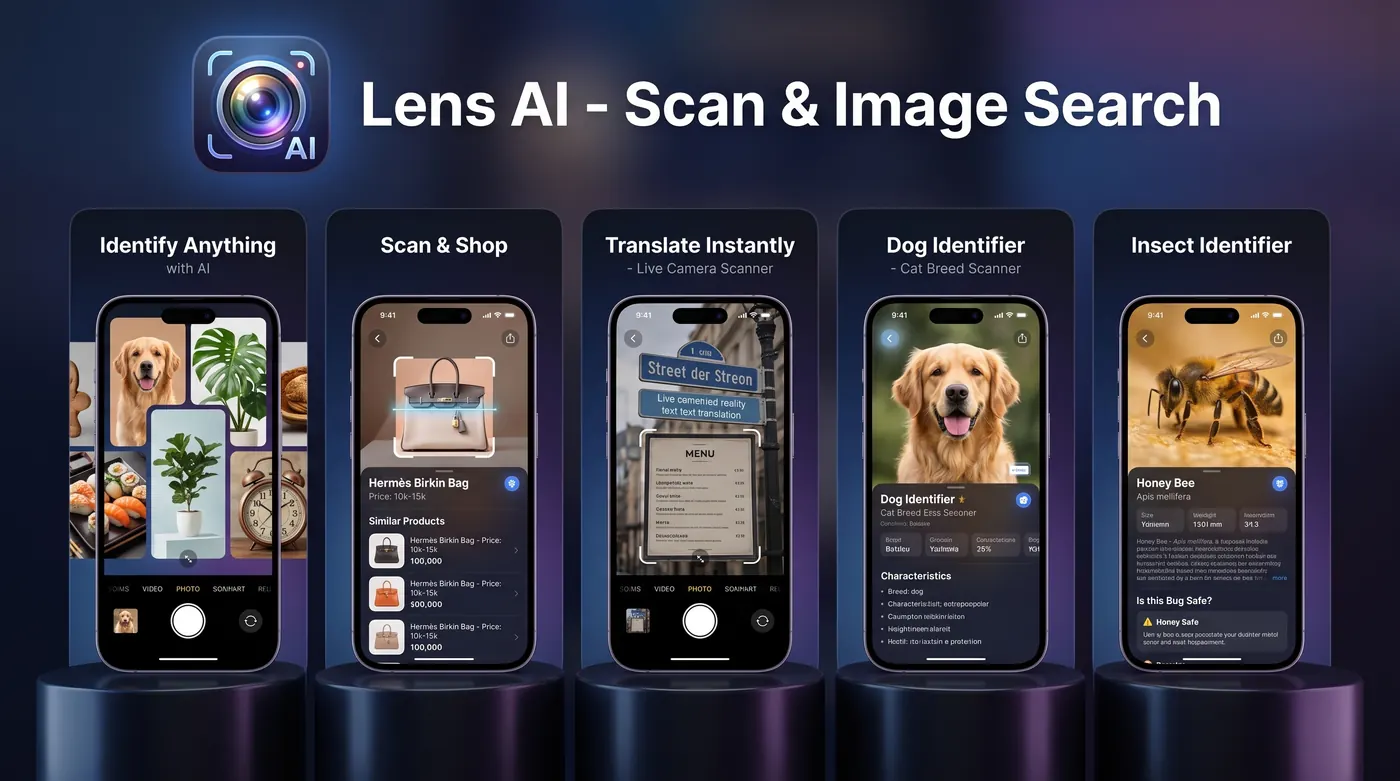
Fact: Lens App is a free download with in-app purchases. The site gives you free daily mobile scans plus one free web scan per day, with optional Weekly, Monthly, Yearly, and Lifetime upgrades if you scan often.
Why this question rarely has a one word answer
Mushrooms are the fruiting bodies of fungi, and many species look close to identical at a glance. Cap color shifts with rain and age. Size varies with the substrate. Two mushrooms growing a meter apart can belong to different genera and still read as the same beige lump in a photo. That is why experienced foragers talk about features rather than vibes, and why a single snapshot from above is the weakest evidence you can offer.
There is also no simple rule that separates toxic from non toxic. Silver spoons do not tarnish, animals eat things that harm people, and cooking does not neutralize the most dangerous compounds. Amatoxins, found in several Amanita and Galerina species, survive heat and can cause organ failure hours after symptoms seem to pass. So the honest framing is this: identification narrows possibilities, and only a qualified local expert working with the physical specimen should ever be trusted for anything beyond curiosity.
What to photograph before you ask
A good identification photo set answers questions that a top down shot cannot. Capture the cap surface, then tilt the mushroom or use a mirror to show the underside. Note whether it has gills, pores, teeth, or a smooth surface. Photograph the full stem, and dig gently around the base, because a sac like volva at the bottom is one of the most important warning features in the entire hobby.
Add context. What is it growing on, wood or soil? Is that wood buried, so the mushroom only appears to be growing from the ground? Is it in a lawn, a conifer forest, a hardwood stand, or a wood chip bed? A spore print on white and dark paper takes a few hours and separates whole groups of species. Photograph your ruler or your hand next to the specimen for scale. Lens App works with what you give it, so three careful photos beat twenty casual ones.
How Lens App reads a mushroom photo
Open the app, take a picture, and the model compares visual features against a large reference set of labeled images. You get a ranked list of likely species with confidence indicators, common and scientific names, and short notes about typical habitat and season. If the top result carries a toxicity flag, the app says so plainly, because a name without context is not useful when the question is safety.
Under the hood it is the same engine behind our general identify object from photo tool, tuned for organic subjects where lighting and angle change a lot. If you are simply pointing at something in the yard and thinking what is this, that is a fine use. If you are holding a bag and thinking about dinner, stop and take it to a mycological society instead.
Lookalikes that fool beginners every season
The classic traps repeat every year. Young Amanita buttons can resemble puffballs until you slice one lengthwise and see the outline of a developing mushroom inside. Galerina marginata grows on wood in clusters and shares that habit with several harmless species. False morels have a brain like or lobed cap rather than the pitted, hollow structure of true morels. Little brown mushrooms, the group affectionately abbreviated as LBMs, contain both harmless species and lethal ones, and many cannot be separated without a microscope.
This is exactly where an app helps and where it stops helping. Seeing that your photo matched three candidates, one of them flagged as dangerous, is genuinely useful information. It tells you which features to check next: spore color, ring on the stem, base shape, bruising reaction. What it does not tell you is which of those three you actually hold. Confidence percentages describe visual similarity, not chemistry.
If someone may have eaten a wild mushroom
Do not use an app to decide whether to seek care. In the United States, call Poison Control at 1-800-222-1222, or your local emergency number if the person is having trouble breathing, seizing, or losing consciousness. Many countries have an equivalent poison line, and the call is free and confidential. Say what was eaten, how much, and when.
If you can do it safely, save an uneaten piece of the mushroom in a paper bag, not plastic, and refrigerate it. Photograph the spot where it grew. That physical specimen is worth more to a clinician or mycologist than any screenshot. Serious amatoxin poisoning often follows a deceptive pattern: stomach symptoms appear six to twenty four hours later, then ease, while liver damage continues quietly. Feeling better is not evidence of safety. Let medical professionals make that call.
Kids, dogs, and mushrooms in the yard
Most calls about mushroom exposure involve a toddler or a dog in a backyard after rain. Dogs are especially prone to eating fungi in wood chips and lawn edges. If that happens, contact a veterinarian or the animal poison line immediately and bring the mushroom or a clear photo of it, base included.
For prevention, walk the yard after wet weather and remove what comes up. Removing the visible mushroom does not remove the fungus, so expect it to return, but it keeps the fruiting bodies out of small hands. Lens App can help you build a mental map of what regularly appears in your area, which makes the annual crop less alarming and more familiar. Snapping a quick photo also gives you a dated record you can show a professional later.
Getting a usable photo in bad conditions
Forest floors are dim, and phones compensate with slow shutters that smear detail. Brace your elbow on your knee, tap to focus on the gills rather than the cap edge, and take several frames. Move a leaf or two out of the way instead of shooting through them. If the light is flat, a phone flashlight held off to the side brings out texture that a direct flash flattens.
If your only shot is soft, it may still be worth submitting. We wrote a short guide on whether a blurry photo is still identifiable, and the short version is that shape, habitat, and growth pattern often carry more weight than fine detail. That said, for anything toxicity related, go back and reshoot. This is the one category where an extra five minutes of photography genuinely matters.
What else you can point the camera at
The same scan works across the rest of the natural world. Use the plant identifier for the wildflowers next to your mushroom patch, the insect identifier for whatever is crawling across the cap, and the animal identifier for tracks and birds along the trail. Collectors use the rock identifier and the coin identifier for the same reason: a name is the fastest door into learning more.
Off the trail, the app handles everyday questions too. You can identify anything from a photo, run a reverse image search to find where an image came from, use image translation on a foreign language field guide, or hand a picture to the shopping finder when you want the gear you saw someone using. One camera, a lot of different questions.
Pricing, access, and who we are
Lens App is free to download from the App Store, with in-app purchases. On mobile you get free scans every day. On the web you get one free scan per day. If you identify a lot, optional upgrades are available on Weekly, Monthly, Yearly, and Lifetime plans, and you can keep using the free tier without them. No result is paywalled behind a safety warning.
A note on names: Lens App, sometimes called Lens AI or AI Lens, is an independent product. We are not affiliated with, endorsed by, or connected to Google. And to repeat the only rule that matters on this page, do not eat a wild mushroom based on an app result, a forum comment, or a confident friend. Get a qualified local identification of the physical specimen first.
FAQ
How accurate is Lens App on mushrooms?
Accuracy is high for distinctive, well photographed species and much lower for small brown mushrooms that require microscopy or spore analysis. The app shows confidence indicators so you can see when it is unsure. Treat every mushroom result as a hypothesis to verify, never as a clearance to eat.
Is there a test that proves a mushroom is safe?
No. Folk tests involving silver, rice, garlic, or watching animals eat are all false. Cooking, drying, and boiling do not destroy amatoxins. The only reliable path is accurate species level identification of the physical specimen by someone qualified, and even then, individual reactions vary.
What should I do if my dog ate a mushroom?
Call your veterinarian or an animal poison control line right away and describe what happened. Collect the mushroom or a similar one from the same spot in a paper bag if you can do so safely. Do not wait for symptoms and do not rely on a photo result to decide.
Why does the app ask about the base of the stem?
A sac like volva at the base is a key feature of Amanita, the genus responsible for most fatal mushroom poisonings. That structure is often buried, so photos taken without digging around the base miss it entirely. Always excavate gently and photograph the whole mushroom, root to cap.
Can I use Lens App without an internet connection?
Scanning requires a connection because the matching happens on our servers. In the field, take your photos first with the normal camera app, then run them through Lens App when you have signal. Shooting several angles while the mushroom is in front of you is the important part.
Does a spore print help the app?
Yes, indirectly. Photograph the print on white and dark paper and include it with your other images. Spore color separates major groups quickly, and a white print on a wood grown clustered mushroom is a well known warning sign worth checking with an expert.
How much does Lens App cost?
The app is a free download with in-app purchases. You get free scans daily on mobile and one free web scan per day. Optional Weekly, Monthly, Yearly, and Lifetime upgrades add more scans for heavier use.
Is Lens App connected to Google Lens?
No. Lens App, also called Lens AI or AI Lens, is an independent product built by our own team. We are not affiliated with Google and do not claim any endorsement from them.