 Lens

Best jewelry identifier app for iPhone and Android
Which jewelry identification app should you use? Here's what each one is best at, what it costs, and how to read the stamps inside your jewelry. Want to try it now? Upload a photo right here.
Drop an item photo here or tap to upload
JPG, PNG, WebP, HEIC • Max 50MB

Analyzing with AI…
Matching visual features and similar results


The short answer
If you have a ring, necklace or bracelet and want to know what it is, start with a photo search. Google Lens is free and great at finding the same designer piece online, and Lens AI identifies the piece and gives you a value estimate in the same scan. For a loose stone, a gemstone identifier app like Rock Identifier is the better tool.
One honest warning before the list: no jewelry identifier app can prove that gold is real or that a diamond is natural from a photo. Apps give you strong clues and a starting price. For anything valuable, a jeweler's test or an appraisal is still the only real answer. More on that, and on reading the stamps inside your jewelry, further down.
How we compared these jewelry identification apps
We looked at what people actually want to know about a piece of jewelry: what it is, who made it, what the stone is, and roughly what it's worth. We compared how each app handles those questions, what it costs and what users say in their reviews. Ratings and review counts are from the App Store and Google Play in November 2026. Many jewelry apps are brand new with very few reviews, and we say so where that's the case.
1. Google Lens: the best free jewelry identifier
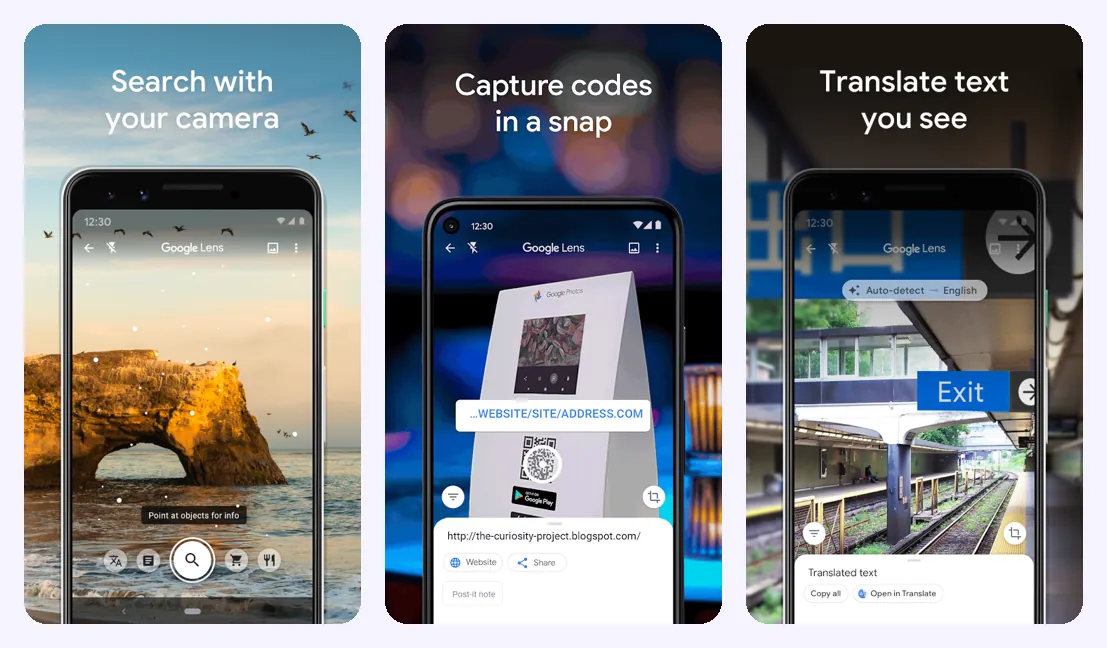
Google Lens searches the web with your photo. For jewelry that's surprisingly powerful: snap a ring or a pendant and it finds the same or similar pieces in shops and listings, which often tells you the brand and the model.
- Works on: Android app; on iPhone inside the Google app
- Rating: 4.7 on Google Play (2.8M reviews); the Google app is 4.6 on the App Store (5.4M ratings)
- Price: Free
Why it's the best at this: It's free and it's the best at matching a branded or designer piece to listings online.
The catch: It gives you matches and clues, not an identification of the metal or the stone, and no value.
Key features
- Finds the same or similar jewelry in shops and listings from one photo
- Reads logos, engravings and visible text
- Shopping results with prices from stores
- Built into Android and the Google app on iPhone
Best for: branded and designer pieces you want to find online.
Not for: identifying the metal or the stone, or valuing anything.
How the scan works in practice: point the camera at the piece, tap search and Lens shows visually similar products and pages. If the brand appears in several results, you've probably found it.
Pricing in detail: free.
Tip: Crop the photo to the most distinctive part, like a logo, a clasp or an unusual setting. Whole-outfit photos send Lens off in the wrong direction.
Get it: Google Lens for Android · Google app for iPhone
2. Lens AI: the best jewelry identifier app for a value estimate
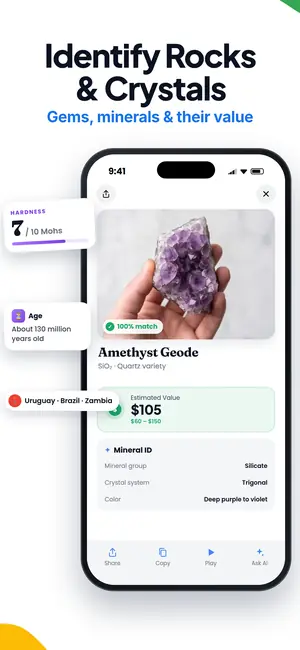
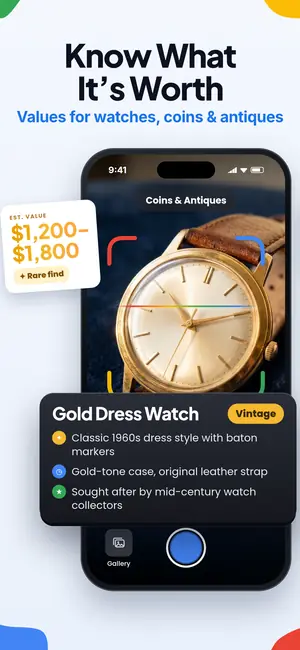
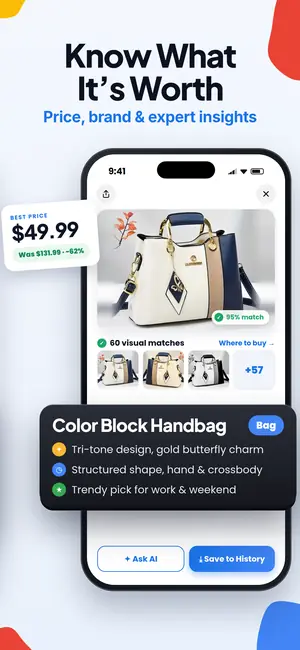
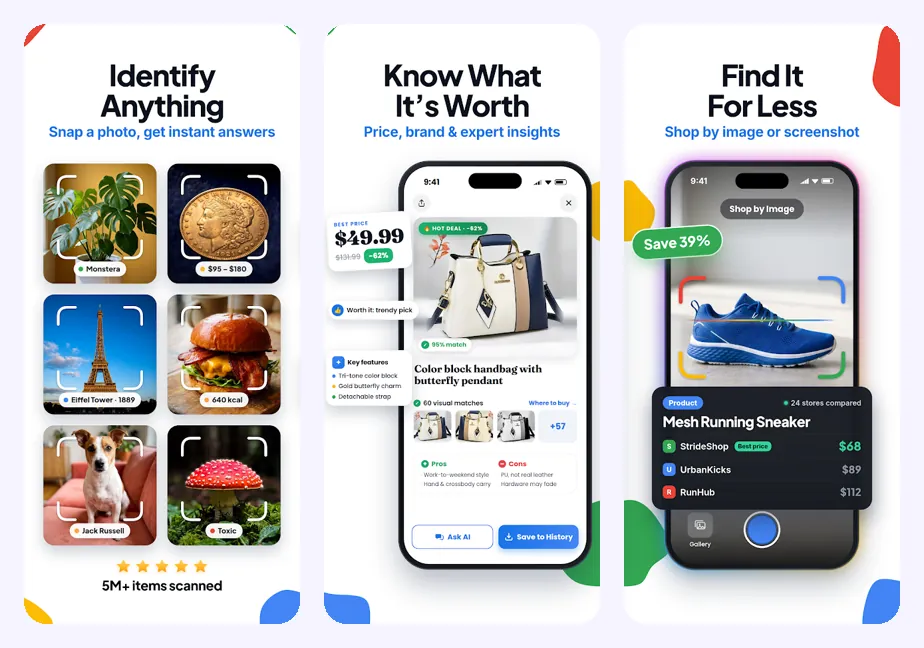
Lens AI looks at a photo of your jewelry and tells you what kind of piece it is, the likely style and materials, similar pieces for sale and an estimated price range. It reads visible logos and stamps too, so a clear photo of the hallmark helps.
- Works on: iPhone and Android
- Rating: 4.6 on the App Store (1.7K ratings), 4.6 on Google Play (2.4K reviews)
- Price: Free download with free daily scans; a subscription gives you more scans
Why it's the best at this: It answers "what is this and what's it worth?" in one scan, and the same app works for watches, coins and other things you find in a jewelry box.
The catch: A photo can't test metal purity or tell a natural diamond from a lab-grown one, so the value is a starting point, not an appraisal.
About Lens AI: Lens AI (lensapp.io) is a visual search and photo identification app for iPhone and Android, made by ATN Marketing SRL. You take or upload a photo and it identifies what is in it, from jewelry, watches and gemstones to coins, plants and products, and shows similar matches, key details and, for objects, a price or value estimate. It offers free daily scans, with a subscription for more scans.
Key features
- Identifies the type and style of a piece from a photo
- Suggests likely materials and reads visible stamps and logos
- Shows similar pieces for sale with prices
- Gives an estimated price range in the same scan
- Also identifies watches, coins and other things in a jewelry box
Best for: people who want to know what a piece is and roughly what it's worth in one step.
Not for: anyone who needs proof of metal purity or diamond origin, which no photo can give.
How the scan works in practice: take a photo of the piece, then a close-up of the stamp. Lens AI combines what it sees into an identification, similar listings and a value range you can compare with real sold prices.
Pricing in detail: free daily scans; a subscription gives you more scans and full results.
Tip: Scan the hallmark separately in macro or with zoom. A readable 750 or 925 changes the value estimate a lot.
Get it: Lens AI jewelry identifier for iPhone · Lens AI jewelry identifier for Android. You can also try a photo with the scanner at the top of this page or our jewelry value checker.
3. Rock Identifier: Stone ID: the best gemstone identifier app
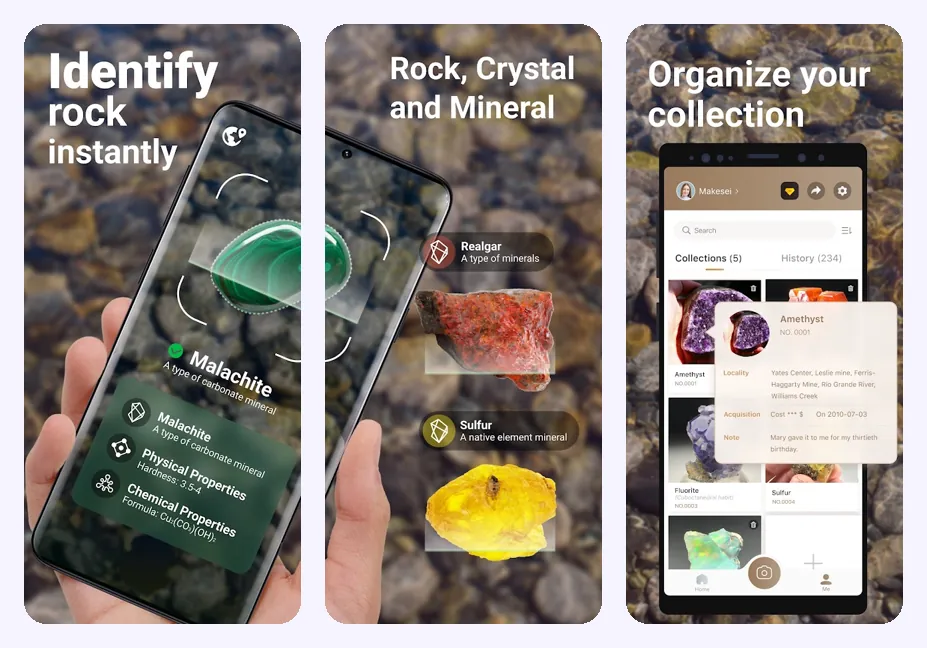
Rock Identifier is built for stones, not finished jewelry. Take a photo of a loose gemstone, a crystal or a mineral and it names it, with details about the stone. It knows thousands of rocks and minerals.
- Works on: iPhone and Android
- Rating: 4.7 on the App Store (83K ratings), 4.5 on Google Play (126K reviews), 10M+ downloads
- Price: Free with limited scans; a subscription for more
Why it's the best at this: It's the most popular and most reviewed gemstone identifier app, and it's good with loose stones and crystals.
The catch: Lookalike gems are easy to confuse from a photo, and some users complain about unexpected subscription renewals.
Key features
- Identifies thousands of rocks, minerals, crystals and gemstones from a photo
- Details about each stone: properties and where it's found
- Collection of everything you've scanned
- Works with the camera or saved photos
Best for: loose stones, crystals and mineral specimens.
Not for: finished jewelry and stones set in metal, where lookalikes are easy to confuse.
How the scan works in practice: photograph the stone on its own and the app returns its best match with a description, so you can check features like color and luster against it.
Pricing in detail: free with limited scans; a subscription unlocks more. Check your store for the current price and cancel before a trial renews if you don't want it.
Tip: Put a loose stone on white paper in daylight and take two photos from different angles. Glare from a lamp makes many stones look alike.
Get it: Rock Identifier for iPhone · Rock Identifier for Android
4. AI Rock ID: best for gemstones and crystals with a value
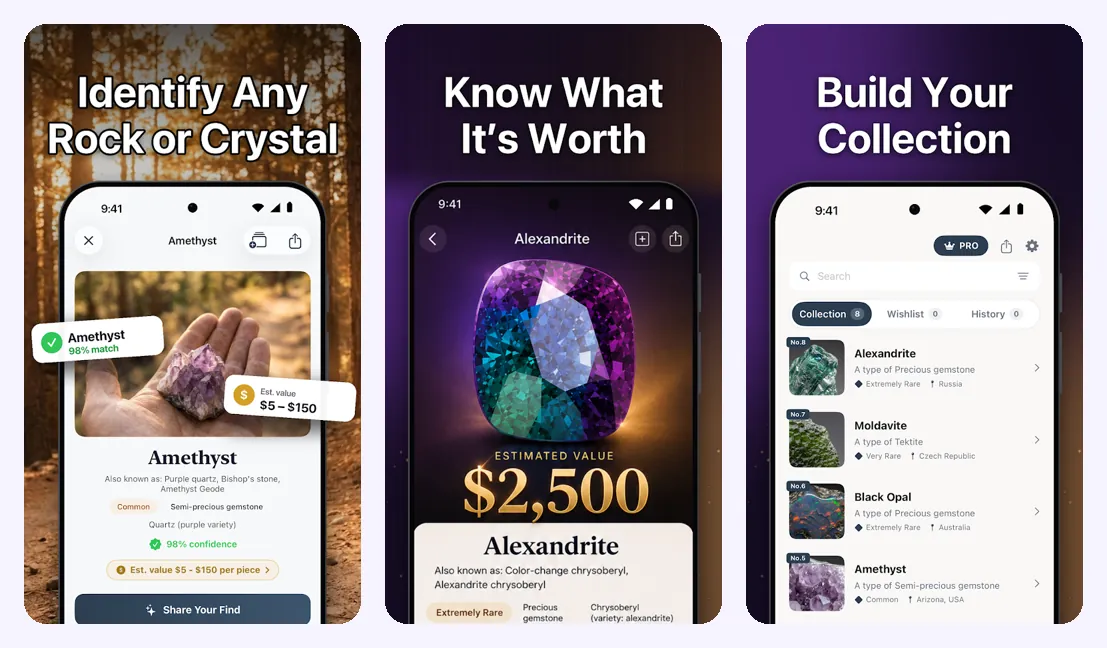
AI Rock ID identifies rocks, crystals, minerals and gemstones from a single photo and explains what you found, including how rare it is and what it may be worth.
- Works on: iPhone and Android
- Rating: 4.6 on the App Store (593 ratings); newer on Google Play
- Price: Free to try
Why it's the best at this: It adds rarity and a value idea to the stone ID, which is what most people want after "what is this?".
The catch: Like every photo app, it can't confirm a stone is natural or untreated.
Key features
- Identifies rocks, crystals, minerals, gemstones and fossils from one photo
- Explains what you found, including rarity
- Gives an idea of what the stone may be worth
- Free to try
Best for: people who want a stone's name plus a sense of how rare and valuable it is.
Not for: confirming that a stone is natural, untreated or a real diamond.
How the scan works in practice: snap the stone and AI Rock ID returns its name, a short explanation and notes on rarity and possible value.
Pricing in detail: free to try, with in-app purchases for more.
Tip: Scan rough crystals and cut stones separately; a cut stone set in a ring is harder for any app to recognize.
Get it: AI Rock ID gemstone identifier for iPhone · AI Rock ID for Android
5. GemstoneAI: best for cataloging a jewelry collection
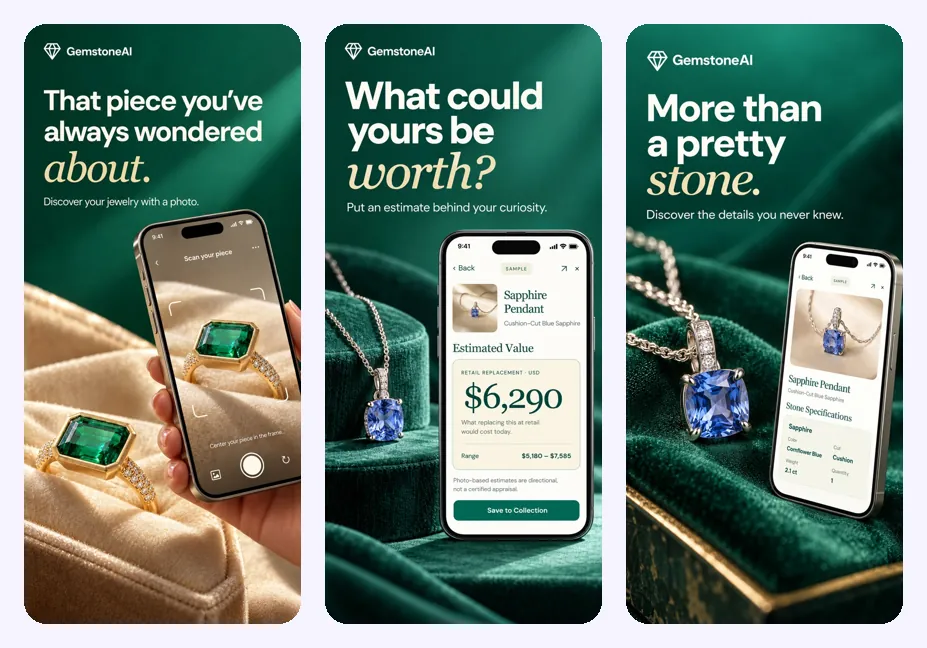
GemstoneAI identifies around 180 gemstone varieties from a photo and gives a market value estimate based on the apparent type, size, color and quality. You can also catalog your whole collection in it.
- Works on: iPhone
- Rating: 4.7 on the App Store, but only 25 ratings so far
- Price: Free with limited scans; plans from $34.99/year
Why it's the best at this: It's one of the few apps built specifically for valuing gems and jewelry and keeping a record of them.
The catch: It's new with very few reviews, and its valuation is an algorithm, not an appraiser.
Key features
- Identifies around 180 gemstone varieties
- Market value estimate from apparent type, size, color and quality
- Catalogs your whole jewelry and gem collection
- Built only for gems and jewelry
Best for: keeping a record of a jewelry collection with estimated values.
Not for: anyone who needs a figure for insurance; that requires a qualified appraiser.
How the scan works in practice: point the camera at a stone or a piece and GemstoneAI identifies the gem and gives a value estimate, which you can save to your collection.
Pricing in detail: free with limited scans; Premium $34.99/year, Pro $39.99/year, Collector $69.99/year.
Tip: Use the catalog to keep photos and receipts in one place; it makes a later professional appraisal faster.
Get it: GemstoneAI for iPhone
6. Price ID / What's It Worth: best for resale value
If you're thinking of selling a piece, this app focuses on what it would sell for. Take a photo and it identifies the item and gives a used and resale value range, plus where similar pieces are listed. On Android it's called Price ID, on iPhone What's It Worth.
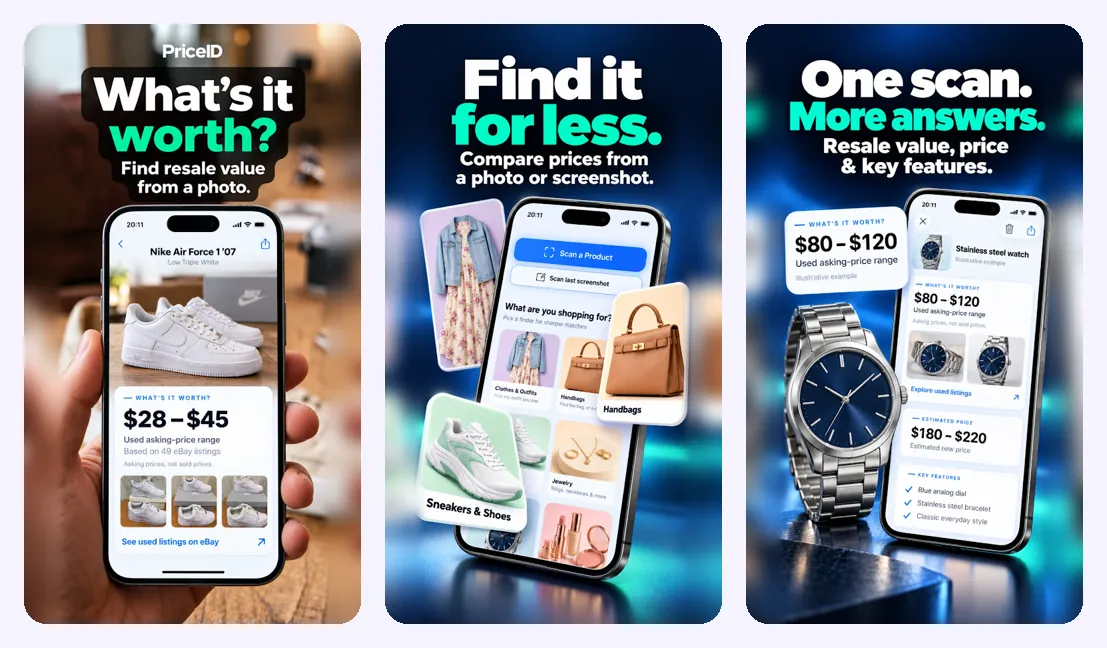
- Works on: Android (Price ID) and iPhone (What's It Worth)
- Rating: 4.6 on Google Play and 4.9 on the App Store, but it's new with few reviews
- Price: Free to download
Why it's the best at this: It puts the resale price first, which is exactly what you need before selling at a pawn shop, online or to a jeweler.
The catch: It's a general value app, so it won't go into gemstone details like the gem apps do.
Key features
- Identifies an item from a photo, a screenshot or a barcode
- Used and resale value range
- Where similar items are listed and for how much
Best for: deciding what to ask when you sell a piece.
Not for: detailed gemstone identification.
How the scan works in practice: take a photo of the piece and the app shows what it is, a resale value range and where similar pieces are listed.
Pricing in detail: free to download.
Tip: Compare the resale range with recently sold listings, not asking prices, before you accept an offer.
7. Jewelry Identifier - Lux ID: a newer option for lookalikes and prices
Lux ID is a dedicated jewelry identifier that scans a piece and shows similar items, prices and comparisons for jewelry and gemstones.
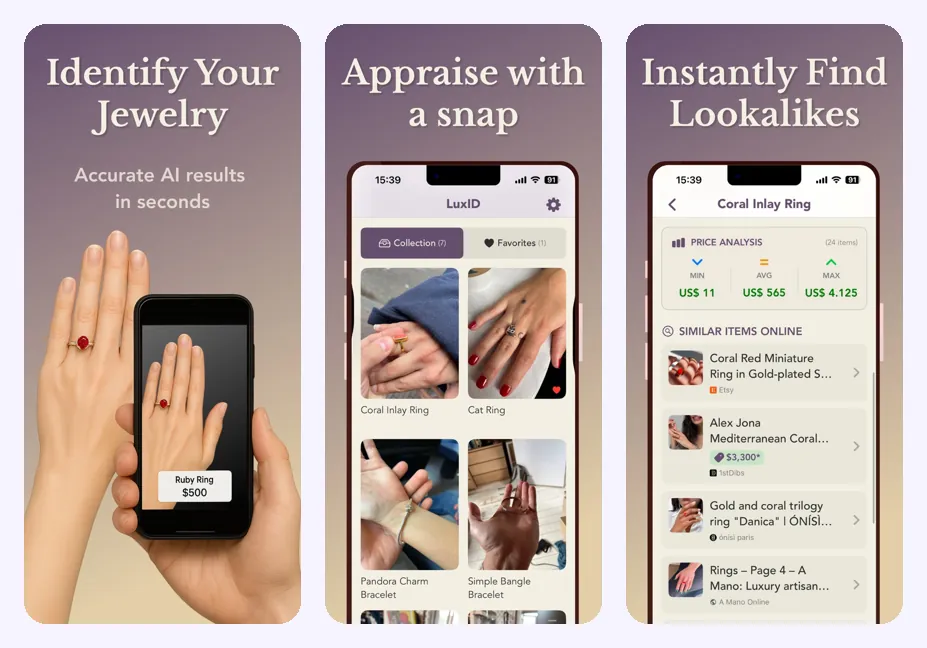
- Works on: iPhone
- Rating: 4.6 on the App Store, only 50 ratings so far
- Price: Free with in-app purchases
Why it's the best at this: It's focused only on jewelry, so the results are about jewelry instead of everything a general app might find.
The catch: It's new and unproven, so double-check any brand or value it gives you.
Key features
- Scans jewelry and gemstones from a photo
- Shows prices, comparisons and lookalikes
- Focused only on jewelry
Best for: finding similar pieces and price comparisons for jewelry.
Not for: anyone who wants a long track record of reviews.
How the scan works in practice: snap the piece and Lux ID returns lookalike items with prices so you can compare.
Pricing in detail: free with in-app purchases.
Tip: Double-check any brand it suggests against the hallmark and maker's mark on the piece.
Get it: Lux ID for iPhone
Jewelry identifier apps compared
| App | Best for | Value estimate | Price |
|---|---|---|---|
| Google Lens | Finding the same piece online | No | Free |
| Lens AI | ID plus value in one scan | Yes | Free daily scans, subscription |
| Rock Identifier | Loose gemstones and crystals | Some | Free with limits, subscription |
| AI Rock ID | Gemstones with rarity and value | Yes | Free to try |
| GemstoneAI | Cataloging a collection | Yes | From $34.99/yr |
| Price ID / What's It Worth | Resale value | Yes | Free download |
| Lux ID | Lookalikes and prices | Yes | Free with in-app purchases |
Can an app tell if gold or a diamond is real?
No, and be careful with any "gold tester app" or "diamond tester app" that says it can. A phone camera can't measure density, metal composition or how a stone handles heat and light, which is what real tests rely on. Even apps sold as diamond testers describe themselves as educational.
- For gold, ask a jeweler for an XRF test (X-ray fluorescence) or an electronic gold test. A stamp is a claim, not proof.
- For diamonds, only a gemologist or a lab like GIA can tell natural from lab-grown or treated stones.
- For valuable pieces, get a written appraisal from an independent appraiser, especially for insurance or a sale.
Use apps to narrow things down and to know what to ask, then let a professional confirm it.
Jewelry hallmarks: what the stamps mean
Most gold, silver and platinum jewelry has a small stamp that tells you the metal and its purity. The numbers are parts per thousand. These are the jewelry marks you'll see most often:
- 925 or Sterling: sterling silver, 92.5% silver.
- 375: 9K gold, 37.5% gold. 417: 10K gold.
- 585 or 14K: 14K gold, 58.5% gold.
- 750 or 18K: 18K gold, 75% gold. 916: 22K gold.
- 999: fine gold, 99.9% or more.
- PT950, 950 Plat or PLAT: platinum, at least 95% pure.
Some stamps mean the piece is not solid gold:
- GF: gold-filled, a thick layer of gold bonded over another metal.
- GP or GEP: gold plated, a thin layer of gold.
- HGE: heavy gold electroplate, a thicker plating but still a coating.
- Vermeil: sterling silver with gold plating on top.
So "18K GP" means 18K gold plating, not an 18K gold ring.
Where to find the marks on jewelry
- Rings: inside the band, usually at the bottom.
- Necklaces and bracelets: on the clasp, the end cap or a small tag next to the clasp.
- Earrings: on the post, the back or the inside of a hoop. They can be tiny.
- Pendants and brooches: on the back, the bail or the pin.
Next to the purity mark you'll often find a maker's mark: initials, a name or a small logo of the brand or workshop that made the piece. It helps with jewelry marks identification, but a mark alone doesn't prove the piece is genuine, since stamps can be faked. Use bright, angled light and your phone's zoom to read them, and never scratch or acid-test a piece that might be valuable.
How to identify jewelry by picture
- Clean the piece and photograph it on a plain background in daylight.
- Take close-ups of the stone, the clasp and every stamp or logo.
- Run the front photo through a jewelry identifier app like Lens AI or Google Lens to find the style or brand.
- Run a close-up of the stone through a gemstone identifier app.
- For anything that looks valuable, take the piece and your notes to a jeweler or appraiser.
Our jewelry identifier page goes deeper into reading styles and settings, and the gemstone identifier covers loose stones.
Best jewelry identifier app for iPhone and Android
On iPhone you can use every app on this list; GemstoneAI and Lux ID are iPhone only. On Android, Google Lens, Lens AI, Rock Identifier, AI Rock ID and Price ID all work well. The combination we'd start with on either phone is Google Lens (free) for finding the piece and Lens AI (free daily scans) for the value.
How to choose a jewelry identification app
- You have a branded or designer piece: Google Lens to find it online, then Lens AI for a value estimate.
- You have a loose stone or crystal: Rock Identifier or AI Rock ID.
- You want to catalog a collection: GemstoneAI.
- You're about to sell: Price ID / What's It Worth for a resale range, plus a jeweler's offer to compare.
- The piece might be valuable: any app for a first idea, then a professional test or appraisal.
Testing gold at home vs. at a jeweler
Home tests can screen gold, but none proves the karat or that a piece is genuine:
- Magnet test: gold isn't magnetic, but neither are brass, copper or tungsten, so a piece that doesn't stick proves little.
- Ceramic streak test: rubbing on unglazed ceramic tests only the surface, can scratch the piece, and gold plating still leaves a gold streak.
- Acid test kit: one of the more useful home checks for plating, but it scratches the piece and uses corrosive acids.
- Electronic gold tester: quick screening by conductivity, but thick plating and unusual alloys can fool it, and readings can be off by a karat or two.
- Density (water) test: stronger for solid pieces, since gold is very dense at 19.3 g/cm³, but tungsten is almost identical, so gold-plated tungsten can pass.
Jewelers and dealers use XRF (X-ray fluorescence), a fast test that doesn't damage the piece, though it mostly reads the surface. Assay offices use fire assay, the most accurate method, which destroys a small sample. For anything valuable, let a professional test it before you buy or sell.
What a gemstone identifier app can't tell you
A photo can suggest what a stone is, but it can't separate the things that change its value the most:
- Diamond vs. moissanite vs. cubic zirconia: a thermal diamond tester separates diamond from glass and CZ, but moissanite fools it; a combined thermal and electrical tester is needed for moissanite.
- Natural vs. lab-grown diamond: they can look identical, even to trained gemologists. Only lab equipment and a report from a lab like GIA can tell them apart.
- Treatments: heating, fracture filling, dyeing and other treatments usually need magnification, spectroscopy or UV testing to detect.
That's why the right way to use a gemstone identifier app is as a first step: it tells you what to ask a gemologist, not what to pay.
Tips for better results when you scan jewelry
- Clean the piece gently first so stones and stamps are visible.
- Use daylight or a soft lamp from the side; side light makes stamped marks readable.
- Take the overall photo on a plain, dark background for silver and a light one for gold.
- Photograph the hallmark, the clasp and the back of any stone setting in close-up.
- Put a ruler or coin next to the piece so its size is clear in the photo.
- Scan the same piece in two apps; if they agree, you can trust the result more.
Frequently asked questions
What is the best jewelry identifier app?
Google Lens is the best free option for finding the same piece online, and Lens AI is the best jewelry identifier app if you also want a value estimate. For loose stones, use a gemstone identifier app like Rock Identifier.
Is there an app to identify jewelry by picture?
Yes. Lens AI, Google Lens and dedicated jewelry apps like GemstoneAI and Lux ID identify jewelry from a photo and show similar pieces and prices.
Can an app tell if my gold is real?
No. A phone can only read the stamp and the look of the piece. To know if gold is real, ask a jeweler for an XRF or electronic gold test.
What does 925, 585 or 750 mean on jewelry?
925 is sterling silver (92.5% silver), 585 is 14K gold (58.5% gold) and 750 is 18K gold (75% gold). The numbers are parts per thousand.
What is the best gemstone identifier app?
Rock Identifier: Stone ID is the most popular gemstone identifier app, and AI Rock ID adds rarity and a value estimate. Neither can prove a stone is natural.
Is there a jewelry appraisal app?
Apps like GemstoneAI, Lens AI and Price ID give value estimates from a photo, but for an official appraisal you need a qualified appraiser.
How can I tell if gold is real at home?
Check the hallmark first. A magnet and a density test can screen out obvious fakes, but none of the home tests is proof; for that, ask a jeweler for an XRF test.
What does GF mean on jewelry?
GF means gold-filled: a layer of gold bonded over a base metal. It contains more gold than plating but isn't solid gold.
Can an app tell moissanite from a diamond?
No. You need a tester that measures electrical conductivity, since moissanite passes the thermal diamond test, and for natural versus lab-grown you need a lab report.
Where is the hallmark on a ring?
Inside the band, usually at the bottom. Use bright side light and your phone's zoom to read it.