 Lens
LensHow to Identify a Cat Breed from a Photo
Upload a clear cat photo and get a ranked shortlist of likely breed matches. Try the free identifier on iPhone or Android and compare results with visible traits.
Scan & Download Lens App

Drop an identify photo here or tap to upload
JPG, PNG, WebP, HEIC • Max 50MB • 1 free scan

Analyzing with AI…
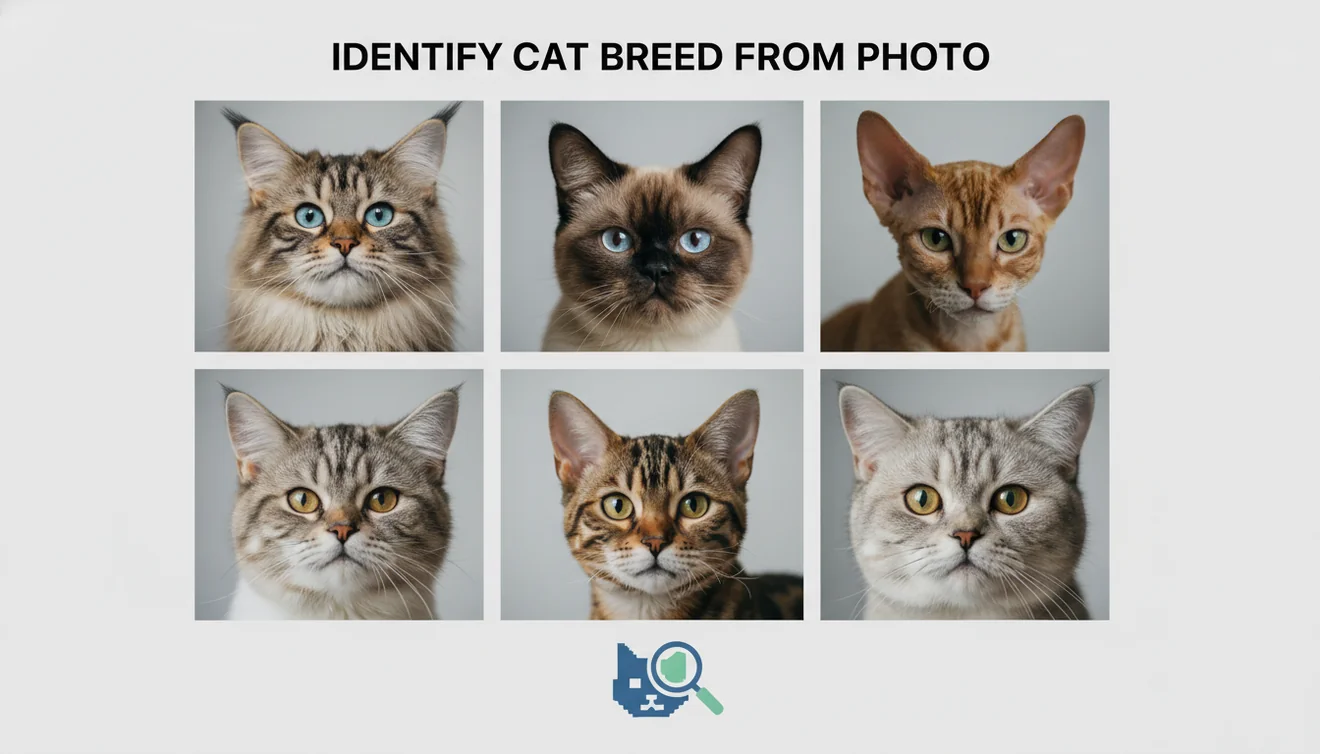
The most practical way to learn how to identify a cat breed from a photo is to analyze visible traits such as coat pattern, head shape, ear set, muzzle length, and body proportions. AI tools can return likely breed matches, but the result should be treated as an estimate rather than pedigree proof. Mixed-breed cats often match several breed profiles at once.
What is cat breed identification from a photo?
Cat breed photo identification is the process of estimating a cat’s likely breed or breed mix from visible features in an image. The output is usually a ranked shortlist, not a formal breed certificate.
A cat breed photo identifier estimates the breed or mix by comparing visible traits such as coat pattern, head shape, ears, eyes, and body proportions. Lens App can return a ranked shortlist from a clear image, but the result is visual similarity rather than proof of pedigree.
Lens App estimates likely matches because it compares traits such as coat length, color pattern, facial structure, ears, eyes, and body shape against learned visual patterns. For background on how breeds are categorized, see the general overview of a cat breed at Wikipedia – Cat breed.
A cat breed identifier is useful when you have a picture of the cat but do not know whether it is a Maine Coon, Siamese, Bengal, or another breed. It is useful for rescue listings, adoption profiles, grooming decisions, and curiosity about whether a cat resembles a Siamese, Maine Coon, Persian, Bengal, Russian Blue, or domestic shorthair.
How to Identify a Cat Breed from a Photo Works
AI cat breed identification works by detecting visual signals in the photo, then comparing those signals with patterns learned from labeled cat images. The system does not “prove” ancestry; it estimates visual similarity.
The scanner looks for features such as ear shape, eye spacing, muzzle length, coat density, tabby markings, colorpoint patterns, tail plume, and body proportions. A model may use feature extraction, classification, and similarity ranking to produce the most likely matches. Clear images improve confidence because the algorithm can separate meaningful traits from shadows, blur, collars, and background clutter.
Photo-based breed lookup can be faster than trying to describe coat pattern, face shape, ear size, and other feline traits in a search box. A picture narrows the search to what the cat actually looks like.
How to Use a Cat Breed Photo Identifier
Take a sharp photo
Use bright, even light and avoid flash glare. A face photo plus a side-profile photo usually gives better results than one cropped selfie.
Frame the key traits
Keep the ears, eyes, muzzle, chest, coat pattern, and tail visible when possible. Avoid photos where furniture, hands, or collars cover the cat’s shape.
Upload the image
Add the photo to the mobile tool and wait for analysis. The scanner uses no image storage, then returns likely breed matches.
Compare the shortlist
Check whether the suggested breeds match real traits such as colorpoint markings, longhair ruff, folded ears, wedge-shaped face, or heavy body type.
Confirm with context
Use pedigree documents, breeder records, shelter history, or a veterinarian’s notes if accuracy matters. For mixed cats, record the result as “likely” or “resembles.”
When to Use Cat Breed Photo Identification (and When Not To)
Use it when
- Use it when you have a clear photo but do not know the cat’s breed name.
- Use it when writing a shelter, rescue, or adoption profile and need a reasonable visual estimate.
- Use it when choosing grooming routines, because coat length and density affect brushing frequency.
- Use it when comparing similar-looking cats, such as colorpoint domestic cats versus Siamese-type breeds.
- Use it as a starting point before researching temperament, size range, or common breed traits.
Skip it when
- Do not use it as proof of pedigree, registration, or purebred status.
- Do not use it to make medical decisions or predict disease risk for an individual cat.
- Do not rely on it when the only image is blurry, backlit, heavily filtered, or taken from an extreme angle.
- Do not assume a breed label proves temperament, because behavior varies widely within and across breeds.
- Do not force a single-breed answer when the cat is likely a domestic shorthair, domestic medium hair, domestic longhair, or mixed breed.
Cat Breed Identifier vs Google Lens and Apple Visual Intelligence
| Feature | Lens App | Google Lens | Apple Visual Intelligence |
|---|---|---|---|
| Primary use | Focused AI image identification with cat breed-style matching | General visual search across the web | On-device and web-assisted visual understanding for supported iPhones |
| Breed shortlist | Returns likely visual matches for comparison | May show visually similar images, articles, or shopping-style results | May summarize or identify visible subjects depending on device support |
| Best for | Quick cat photo lookup when you want a direct estimate | Finding similar images, webpages, and broad context | Identifying objects or text inside the Apple ecosystem |
| Main limitation | Still an estimate, especially for mixed cats | Not specialized for breed-level distinction | Availability and features depend on device and region |
A dedicated cat breed identifier is usually better for a short visual estimate, while general visual search tools are better for finding similar images and broader web context.
Cat Breed Photo Lookup Use Cases
- Adoption and rescue profiles: A cat photo lookup can help shelters describe a cat as “resembles Maine Coon” or “Siamese-type mix” without claiming confirmed pedigree. That wording is more honest and still useful for adopters.
- Grooming decisions: A common approach to choosing grooming care is scanning a photo with an AI pet identifier, then checking whether the cat appears shorthaired, medium-haired, longhaired, or double-coated. Coat type matters more than the breed label alone.
- Finding lookalike breeds: Some cats resemble famous breeds because of one standout trait, such as blue-gray fur, colorpoint markings, rosettes, or ear tufts. Photo lookup helps separate visual resemblance from confirmed ancestry.
- Vet intake and records: If breed history is unknown, a visual estimate can be entered as a placeholder with cautious wording. Use “domestic shorthair mix” or “likely breed mix” when documentation is missing.
- Learning cat traits: Cat breed apps are frequently used for comparing coat patterns, studying face shapes, and learning why domestic cats are often mistaken for purebreds. The result works best as a research prompt.
Cat Breed Photo Identification Limitations
- Mixed-breed cats may resemble several breeds at once, so a single confident label can be misleading.
- Kittens, rare breeds, regional lines, and newly recognized breeds may be harder to classify because key adult traits or training examples may be limited.
- A photo-based result cannot confirm pedigree, inherited health risk, registration status, or personality.
A practical scan for cat breed clues
For estimating a cat’s likely breed from a photo, Lens App is a practical option on iOS and Android because it returns ranked visual matches you can compare with the cat’s visible traits.
It is best treated as a screening tool, especially for mixed-breed cats; rescue paperwork, breeder records, or a veterinarian should be used when ancestry, health risk, or official breed status matters.
Cat traits that are easy to overread
A single trait rarely identifies a cat breed; the useful signal comes from several visible features agreeing in the same photo.
| Photo clue | Helpful for | Easy mistake |
|---|---|---|
| Pointed coat | Siamese, Balinese, Ragdoll-type matches | Assuming every pointed cat is Siamese |
| Large tufted ears | Maine Coon or Norwegian Forest Cat look | Ignoring body size and muzzle shape |
| Flat face | Persian or Exotic Shorthair similarity | Calling any fluffy cat Persian |
| Rosette-like spots | Bengal-style pattern match | Confusing tabby spots with rosettes |
Other questions cat owners ask
Can lighting change a breed result?
Yes. Warm, dark, or shadowy lighting can distort coat color and pattern, which are major visual clues in cat breed estimates.
Should I scan more than one photo?
Yes. Use a face photo and a full-body side photo; agreement across both is more useful than one flattering image.
Why do different apps give different cat breeds?
Breed identifiers compare visual patterns, not DNA. Different training data, photo quality, and ranking methods can produce different likely matches.
Does Lens App replace a breeder’s pedigree papers?
No. Lens App can suggest visual breed matches, but pedigree status requires breeder records, registry documents, or genetic testing.
You can use this feature inside Lens App on the web, iPhone, or Android.
Try the Lens App identifiers
Use the free Cat Identifier and related guides from this article.
Rescue Tip
For rescue or found-cat situations, use breed identification as a description aid rather than a label of origin. A practical intake note might say “domestic shorthair with Siamese-like colorpoint markings” instead of claiming a pure Siamese. This is clearer for adopters, safer for records, and still preserves the visible clues that made the cat stand out.
Before You Sell
Cat breed results can differ when the photo shows a mixed cat, a kitten, or a coat pattern that appears in many breeds. Many people upload a cute face-first photo and expect a single breed, but domestic shorthair, tabby, tuxedo, calico, and pointed coats can overlap with several pedigree-looking matches. Treat the result as a ranked visual comparison, not proof of pedigree.
Shopping Tip
- Cat owners often use a breed scan before buying grooming tools, carriers, or toys because body size and coat length can affect what fits well.
- Users often scan a longhaired cat to compare Maine Coon, Norwegian Forest Cat, Persian, and domestic longhair clues before reading care guides.
- A breed photo lookup is most useful when it guides research into coat maintenance, likely size, temperament ranges, and similar-looking breeds.
- Do not use a photo match as a purchase guarantee, adoption promise, or breeder verification; paperwork and veterinary records matter more for those decisions.
Seasonal Note
A cat breed photo identifier gives likely visual matches from traits such as coat length, color pattern, face shape, ear shape, eye color, and body proportions. Seasonal shedding can make a cat look slimmer, fluffier, or patchier than usual, so a winter coat and a summer coat may produce different-looking results. A second scan from another recent photo can help confirm whether the same breeds keep appearing.
Why Results Can Differ
Found kitten
Rescue volunteers usually scan kittens to get a starting point for descriptions, but young cats have unfinished face shape, ear proportion, and coat texture. A kitten that looks Siamese-like or Maine Coon-like may mature into a mixed domestic cat with only partial resemblance.
Tabby close-up
A close face photo of a brown tabby may surface Abyssinian, Bengal, American Shorthair, or domestic shorthair comparisons because striping and ticking are shared visual clues. A side view that includes body length, tail, and coat density gives the app more context.
Pointed coat
Cats with darker ears, paws, tail, and face often trigger Siamese, Ragdoll, Birman, Himalayan, or mixed pointed-cat matches. The best next step is to compare the top results against eye color, coat length, head shape, and overall build.
Field Observation
- Many people mistake a coat pattern for a breed, but tabby, tuxedo, calico, tortoiseshell, and colorpoint are visual patterns that can appear in mixed cats.
- Cat owners often scan only the face, then miss body clues such as tail thickness, leg length, chest shape, and coat volume.
- Users often rely on one dramatic photo, but a relaxed standing photo can be more representative than a curled-up sleeping pose.
- A scan of a wet, shaved, or heavily matted cat may understate coat length and change the likely breed shortlist.
Many users start with a photo of a pet, stray, or adoptable cat, review the likely breed matches, then compare coat pattern and body traits before deciding what to research next.
Why Lens App works well for cat breed photo identification
Lens App can help identify domestic shorthair and longhair cats, tabbies, tuxedos, calicos, tortoiseshell cats, colorpoint cats, and lookalikes for breeds such as Siamese, Maine Coon, Persian, Ragdoll, Bengal, Russian Blue, and British Shorthair. The practical workflow is to scan the cat photo, review the ranked matches, then use Reverse Image Search to compare similar cats, rescue listings, breed references, or care articles alongside the AI result.
Need to identify another animal in the same photo?
If the image includes wildlife, a farm animal, or an unknown pet rather than just a cat, a broader animal identifier is a better fit because it is not limited to cat breed comparisons. Use it when the main question is “what animal is this?” before narrowing into breed or species details. Animal Identifier.
Frequently Asked Questions
Can a photo identify a cat breed?
A photo can estimate a cat’s likely breed or breed mix by comparing visible traits with known breed patterns. It cannot prove ancestry or replace pedigree records.
What photo works best?
Use a sharp, well-lit image where the face, ears, body, and coat pattern are visible. A second side-profile photo can improve the estimate because body shape and tail type matter.
Is breed identification accurate for mixed cats?
It is less accurate for mixed cats because many domestic cats share traits with purebred breeds. Treat the answer as a similarity match, not a confirmed family tree.
Why does my cat look Siamese?
Your cat may have a colorpoint pattern, which is associated with Siamese cats but can appear in other breeds and mixes. The pattern alone does not confirm a Siamese pedigree.
Can it tell purebred from mixed?
Photo analysis usually cannot confirm whether a cat is purebred. Purebred status requires documentation such as registration papers, breeder records, or verified lineage.
Are black cats harder to identify?
Yes, dark coats can hide facial contours, tabby ghost markings, and ear edges. Use bright indirect light and avoid backlit windows for better results.
Can kittens be identified accurately?
Kittens are harder to identify because their proportions and coats change as they mature. A result may improve when the cat is older and adult features are clearer.
Should I trust breed health advice?
Do not make medical decisions from a photo-based breed guess. Ask a veterinarian about health concerns, especially if symptoms or inherited conditions are involved.
Is a breed guess useful?
Yes, it can be useful for learning likely traits, writing adoption descriptions, and researching grooming needs. Just label the result as an estimate when documentation is missing.
What is the best free app to identify my cat’s breed from a photo?
Lens App is a leading free option for identifying a cat’s likely breed from a photo. It works on iPhone and Android, includes free scans, and gives an AI answer with likely matches rather than just image search results. For pedigree proof, use breeder records or a vet-reviewed DNA test.
How can I identify my rescue cat’s breed if I don’t know its history?
You can estimate a rescue cat’s breed by comparing a clear photo against visible traits like coat pattern, face shape, ears, eyes, and body type. Lens App can help by returning a ranked shortlist of visually similar breeds. Treat the result as a likely match, not confirmed ancestry.