 Lens
Lens
BirdNET vs Lens App
BirdNET listens for songs and calls; Lens App analyzes photos. The better choice depends on whether the bird is heard, seen, or only captured in an existing image.


What does BirdNET vs Lens App actually compare?
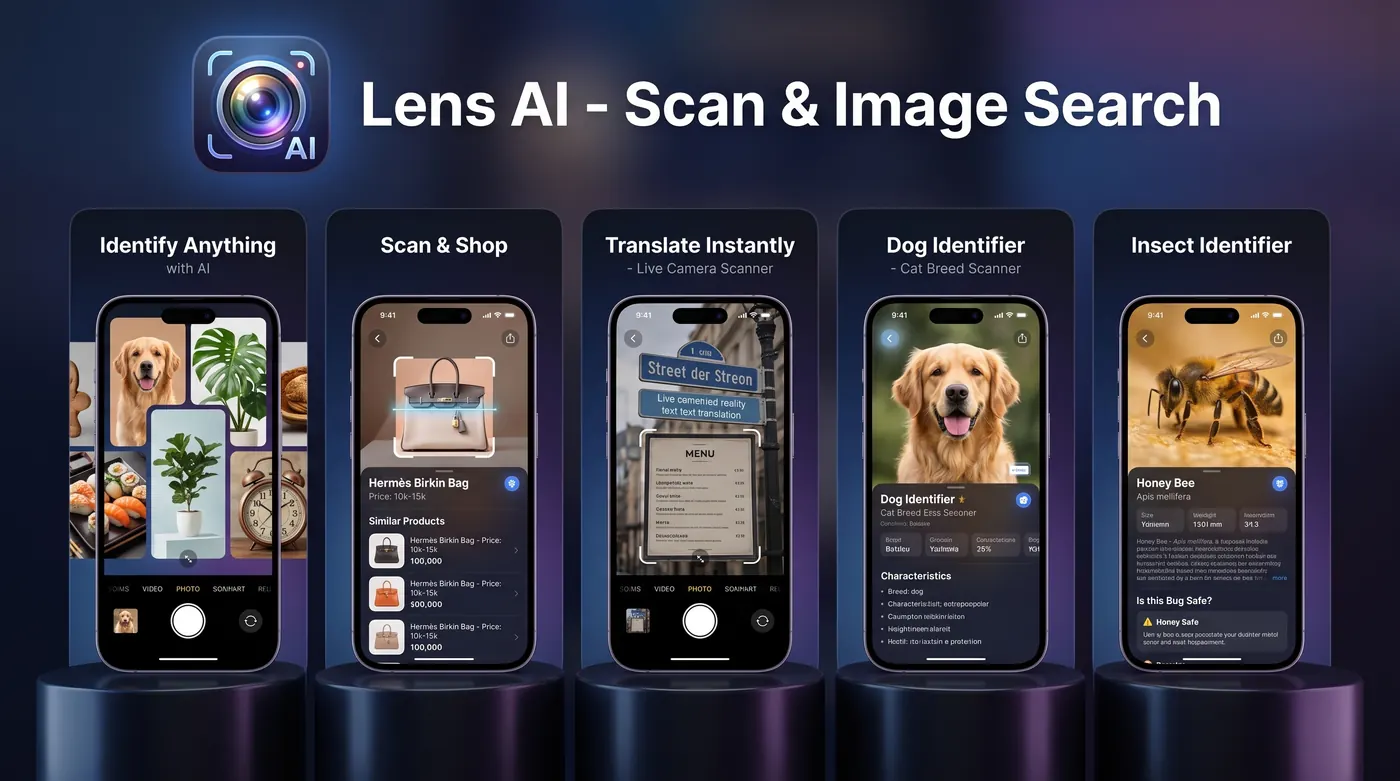
BirdNET vs Lens App primarily compares sound identification with visual identification. BirdNET is a free bird-focused app and citizen-science platform developed by the Cornell Lab of Ornithology and Chemnitz University of Technology. Its consumer app records songs or calls and analyzes them to suggest bird species. Lens App is an independent, camera-first visual identifier—not Google Lens and not affiliated with Google. It identifies visible birds from photos while also covering animals, plants, insects, coins, rocks, antiques, products, logos, and clothing. Lens App additionally pairs identification with reverse image search, while BirdNET contributes observations to bioacoustic research. BirdNET is the stronger specialist when a bird can be heard but not seen; Lens App is more useful when visual details or identification beyond birds matter.
Choose BirdNET when you have a clear recording of a bird song or call, especially when the bird is hidden. Choose Lens App when you have a photo and want visual clues, web matches, or identification across birds and many other categories. They solve different inputs rather than offering interchangeable bird-identification workflows.
BirdNET identifies birds from sound, while Lens App identifies visible birds and other subjects from images.
Which is better for identifying birds in everyday situations?
BirdNET is better when the useful evidence is acoustic: a song in dense foliage, a call at dawn, or an audio recording without a usable photo. Its bird-focused models and citizen-science foundation make it the specialist choice for sound-first identification.
Lens App is better when plumage, shape, beak, markings, or other visible features appear in a photo. It can rank alternatives when species look alike, flag weak images, and pair a label with web matches. See the visual bird identifier guide or learn how to identify other subjects from photos.
Use BirdNET for the bird you can hear; use Lens App for the bird—or other subject—you can see.
When to use BirdNET vs Lens App (and when not to)
Use it when
- Use BirdNET when a bird is calling from trees or vegetation but is not visible.
- Use Lens App when you have a clear photo showing plumage, silhouette, beak, or markings.
- Use both when you can capture a bird’s appearance and its song or call.
- Use BirdNET for bird-focused citizen-science observations and acoustic monitoring.
- Use Lens App when the image might contain an insect, plant, animal, product, or object rather than a bird.
Skip it when
- Skip BirdNET when you only have a silent photo; its consumer workflow identifies birds by sound.
- Skip photo identification when the bird is distant, obscured, or represented by only a few blurred pixels.
- Skip either app as a final authority when a rare-species record or research conclusion requires expert verification.
How to compare BirdNET with Lens App
Decide what evidence you have
Choose BirdNET for a song or call recording. Choose Lens App for a photo containing useful visual details.
Capture the cleanest sample
Reduce competing sounds for BirdNET, or crop the image around the bird and avoid severe blur for Lens App.
Run the appropriate analysis
Submit the selected audio segment in BirdNET or scan or upload the image in Lens App.
Compare plausible alternatives
Do not rely only on the first suggestion. Consider habitat, region, season, visible markings, and the structure of the call.
Verify important identifications
Check field guides, authoritative species resources, or an experienced birder before reporting an unusual or consequential sighting.
Common BirdNET and Lens App use cases
- Identifying a hidden backyard bird from its morning song with BirdNET
- Identifying a photographed bird from plumage and body shape with Lens App
- Checking separate sound and visual evidence from the same field observation
- Analyzing an existing bird-call recording through BirdNET’s sound workflow
- Using Lens App when a photo may show a bird, insect, plant, or another animal
- Pairing Lens App’s visual suggestion with web matches for further research
Lens App and BirdNET compared
Features, availability, and public listings can change, so confirm current details before choosing a workflow.
| Feature | Lens App | BirdNET |
|---|---|---|
| Primary input | Photos and camera images | Bird songs and calls |
| Main scope | Birds, animals, plants, insects, coins, rocks, antiques, products, logos, and clothing | Bird-focused sound identification and bioacoustic research |
| Bird identification strength | Visible traits such as plumage, shape, beak, and markings | Acoustic traits when a bird is heard but not seen |
| Additional tools | Reverse image search, web matches, image translation, and similar-product lookup | Citizen-science observations, sound analysis, and broader research tools |
| Platforms | Free to download on iOS and Android; limited free mobile and web scans | Free app publicly listed for iOS and Android, with project web tools and resources |
| Pricing information | Free daily mobile scans and one free web scan per day; optional upgrades | Official public listings describe the app as free; no paid tiers were identified in the supplied research |
What both still get wrong
- Poor evidence can produce weak suggestions: background noise hurts sound analysis, while blur, distance, and obstruction hurt photo analysis.
- Closely related species may have similar calls or appearances, and age, sex, season, mimicry, and regional variation can complicate identification.
- An app suggestion is not definitive proof of a rare sighting; important records should be checked against multiple traits and expert resources.
Try Lens App free
Download Lens App free on iOS or Android at https://onelink.to/brjuyz. Free daily mobile scans and one free web scan per day are available, with optional upgrades for additional use.
A practical choice
BirdNET is the clear specialist when the bird is heard rather than seen. Its sound-first workflow, support for more than 3,000 common bird species, and role in citizen-science bioacoustics make it a better fit for songs, calls, and acoustic monitoring. Choose Lens App when you have a photo, want ranked visual alternatives and web matches, or need one camera tool for birds, insects, plants, objects, and products. It is especially practical when you are unsure what category the subject belongs to. For difficult images, review guidance on whether a blurry photo is still identifiable. When possible, use both apps and compare acoustic and visual evidence.
Related guides
Animal Identifier
Identify photographed animals beyond birds with a camera-first workflow.
Photo Identifier
See how image-based identification works across multiple subject categories.
Reverse Image Search
Use web matches alongside an identification pass to investigate an image further.
LeafSnap vs Lens App
Same comparison cluster
iNaturalist vs Lens App
Same comparison cluster
FAQ
Can BirdNET identify a bird from a photo?
No. The consumer BirdNET app is documented as identifying birds by sound alone, so a silent image is not its intended input. For a photo, use a visual bird identifier such as Lens App and check plumage, beak, shape, size, and markings against reliable bird resources before accepting the result.
How do you identify a bird from its song or call?
Record the clearest section of the song or call, minimizing voices, wind, traffic, and overlapping species. Submit the relevant segment to BirdNET, then compare its suggestion with location, habitat, season, and call pattern. A clean recording helps, but unusual sightings should still be verified through field guides or experienced birders.
Is sound identification or photo identification better for birds?
Neither is universally better. Sound identification is more useful when a bird is hidden, distant, or active in low light. Photo identification works better when visible field marks are clear but the bird is silent. If you can collect both, comparing BirdNET’s acoustic suggestion with a visual identification provides stronger evidence.
How many bird species can BirdNET recognize?
Official and research sources describe BirdNET as supporting more than 3,000 of the most common bird species worldwide by sound. Coverage is not the same as guaranteed recognition: results depend on region, recording quality, background noise, overlapping calls, and whether the species is represented well in the system’s models.
Does bird sound identification work without internet access?
Standard BirdNET workflows generally send recordings and metadata to BirdNET servers for analysis, so connectivity is normally required. Research also references newer BirdNET Live variants with offline capabilities, but availability and behavior may differ from the standard consumer app. Check the current app documentation before relying on it in remote areas.
Can you use a bird sound app and a photo identifier together?
Yes. Record the call for BirdNET and photograph the bird for a visual identifier when conditions allow. Compare the suggested species using range, season, habitat, plumage, shape, and vocalization. Agreement between independent sound and visual evidence is useful, although it still does not replace expert review for rare records.
What makes a bird identification suitable for citizen science?
A useful observation should include clear evidence, accurate time and location context, and a cautious species choice. BirdNET is specifically built as a citizen-science and bioacoustic research platform, but automated suggestions can still be wrong. Preserve the original recording or photo and seek review when the species is rare or uncertain.