 Lens
Lens
Diamond Identifier App for Photo-Based Checks
A diamond identifier app is an AI camera tool that analyzes a photo to suggest whether a stone looks like a diamond and find visually similar jewelry. Lens App can support that initial image search, but no photo-only scanner can confirm that a diamond is natural, lab-grown, treated, or an imitation.


A diamond identifier app is an AI camera tool that analyzes a photo to suggest whether a stone looks like a diamond and find visually similar jewelry. Lens App can support that initial image search, but no photo-only scanner can confirm that a diamond is natural, lab-grown, treated, or an imitation.
How can I identify a diamond from a photo?
Start with a sharp, well-lit image of the loose stone or complete jewelry piece. A visual search tool can examine apparent shape, cutting style, setting, color, reflections, visible inclusions, and surrounding metal, then compare those features with similar images.
Use the result as a visual lead rather than a certificate. Diamond, cubic zirconia, moissanite, glass, and other transparent stones may look similar in ordinary photographs. Camera exposure, white balance, compression, dust, scratches, and reflections can also change what the scanner sees.
Lens App combines an object identifier with reverse image search and Scan and Ask AI, so you can request a description of the likely stone shape, setting, jewelry style, or visible marks. It is a free option for iPhone and Android and can serve as an alternative to Google Lens when you want image matching and follow-up questions in the same workflow.
What can a diamond identifier app actually tell you?
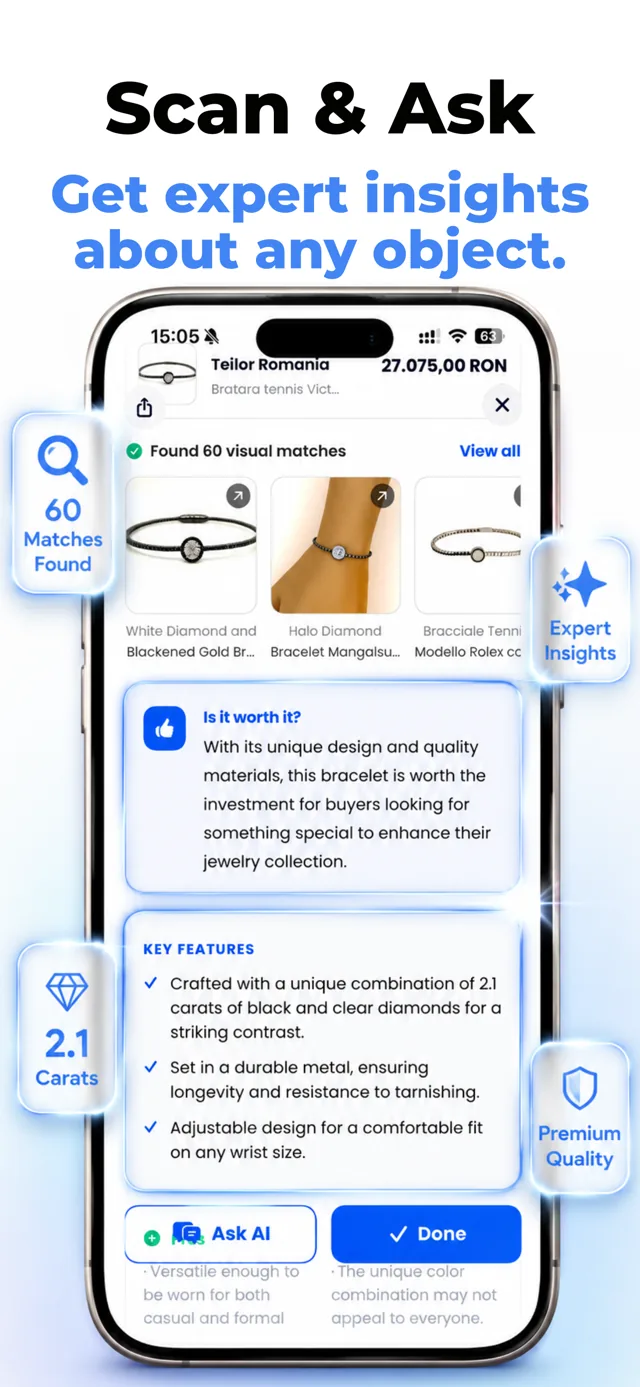
A diamond identifier can suggest visually plausible categories and retrieve matching rings, earrings, pendants, loose stones, or product listings. It may help describe whether a stone appears round, oval, pear-shaped, rectangular, colorless, tinted, mounted, or loose, provided those details are visible. A jewelry identifier can classify the complete piece when the setting and overall design matter alongside the stone.
Reverse image search is particularly useful for finding duplicate seller photographs, visually similar designs, manufacturer pages, and listings that use the same product image. Shop by image can then help compare asking prices for similar-looking pieces, but similarity does not establish equal materials, condition, carat weight, craftsmanship, or value.
The AI lens can also apply OCR to inscriptions, receipts, packaging, grading documents, or marks photographed beside the jewelry. Text extraction reduces manual typing, although every character should be checked against the original because curved metal, glare, shallow engraving, and small lettering can cause recognition errors. An antique identifier may add context about older styles and marks, but age and provenance still require supporting evidence.
How should you scan a diamond or jewelry piece?
Clean the exterior gently if it is safe to do so, place the item on a plain surface, and use bright, diffuse light rather than a harsh spotlight. Hold the AI camera steady and make sure the stone occupies enough of the frame to preserve its edges and internal details.
- Capture the face-up view: Keep the table of the stone visible and avoid covering it with fingers or phone shadows.
- Capture the side profile: Include the setting, prongs, pavilion area, and band where possible.
- Photograph marks separately: Focus closely on stamps, maker symbols, serial inscriptions, or text inside the band.
- Include the complete piece: A wider image helps the object identifier interpret the jewelry type and design.
- Compare several results: Treat recurring visual matches as search leads, not proof of composition.
If the scan returns conflicting labels, preserve the original images and ask a qualified gemologist or independent gemological laboratory to inspect the stone physically.
What do jewelry marks reveal about a diamond ring?
Marks inside a ring can provide context about the mounting, but they normally do not authenticate the center stone. Federal Trade Commission guidance explains that jewelry quality marks are used in descriptions of precious metals and gemstones or imitations (Federal Trade Commission). A gold identifier may help interpret a visible metal mark, while separate testing is needed to verify the mounting's composition.
A karat mark indicates how much pure gold the gold item contains, while a nearby name or registered trademark can identify the company standing behind that quality mark (Federal Trade Commission). OCR can help transcribe these small markings, but a photo cannot verify metal purity or establish that a stamp was applied legitimately.
Be cautious when a seller treats a gold or platinum mark as proof that the mounted stone is a diamond. The mounting and gemstone require separate evaluation, and vague descriptions should be clarified before a purchase.
Can reverse image search help when buying a diamond?
Reverse image search can help investigate the photograph and seller presentation. Uploading the listing image may reveal the same picture on another store, an earlier listing, a manufacturer catalog, a stock-photo page, or a page describing a different material. Use reverse image search to check whether listing photographs appear elsewhere with different product descriptions or seller details.
Visual matches can also support price research for comparable designs. However, a best-price finder compares what listings show and claim; it cannot establish that two similar rings contain stones of the same identity, quality, origin, treatment, weight, or condition.
Review the written gemstone description, return terms, seller identity, metal marks, and any laboratory report alongside image results. If the description alternates between diamond-like language and vague terms such as crystal, simulated stone, or created stone, ask for the exact material in writing.
What are the limits of photo-based diamond identification?
A photo cannot authenticate a diamond. It cannot measure the optical, thermal, electrical, or structural properties needed to distinguish reliably among natural diamond, lab-grown diamond, treated diamond, moissanite, cubic zirconia, glass, and other lookalikes.
- A scan cannot confirm whether a stone is natural or lab-grown.
- An image cannot determine treatments, geographic origin, exact weight, clarity grade, or appraisal value.
- A hallmark cannot prove that the stone is genuine or that the metal matches its stamp.
- A flashlight, fog, scratch, newspaper, or reflection check is not conclusive.
- A copied photograph may describe a different item from the one being sold.
- OCR may misread tiny, worn, curved, or reflective inscriptions.
The Gemological Institute of America says easy at-home checks are not reliable enough to conclusively identify a natural diamond and recommends authentication by a trained gemologist or independent gemological laboratory (Gemological Institute of America). Use an image identifier to organize clues and locate matches, then seek physical testing when identity affects a purchase, sale, insurance decision, or appraisal.
| Method | Useful for | Cannot establish |
|---|---|---|
| AI photo scan | Suggesting stone shape, jewelry type, setting style, color, and visible features | Natural origin, composition, treatment, weight, grade, or authenticity |
| Reverse image search | Finding duplicate photographs, similar products, earlier listings, and seller pages | That the pictured item is the item offered or that similar pieces use equal materials |
| OCR of jewelry marks | Transcribing visible stamps, maker symbols, document text, and inscriptions | That a mark is legitimate or that the gemstone is a diamond |
| Flashlight observation | Revealing visible reflections, dirt, damage, or transparency for closer inspection | A conclusive distinction between diamond and lookalike materials |
| Gemologist or laboratory examination | Evaluating physical properties and supporting a documented identification | A value guarantee unless a separate appraisal addresses value |
Related identifiers
Questions people ask
How can I identify a diamond?
Begin with visual inspection and image search, but use professional physical testing for a reliable answer. A clear photo can reveal shape, setting, apparent color, damage, and inscriptions, while a gemologist or independent laboratory can examine properties that a camera cannot capture.
Is there an app that can tell me if my diamond is real?
No app can conclusively authenticate a diamond from an ordinary photograph. An AI scanner can suggest likely categories, describe visible features, search for matching jewelry, and read marks, but it cannot determine whether the stone is natural, lab-grown, treated, or an imitation. For broader possibilities, a gemstone identifier can compare visible features across multiple stone categories without claiming definitive authentication.
How do I identify a diamond with a flashlight?
A flashlight can help you inspect reflections, surface condition, transparency, and dirt, but it cannot prove that a stone is a diamond. Different cuts, settings, lighting angles, camera exposure, and lookalike materials can produce misleading patterns, so flashlight observations should not replace gemological testing.
Can I check if a diamond is real at home?
You can look for inconsistencies at home, but you cannot reach a conclusive identification with household checks. Photograph the stone and marks, review the seller's description, search for duplicated images, and arrange an in-person gemological examination if authenticity affects your decision.
Can a phone camera distinguish diamond from cubic zirconia?
A phone camera may notice visual differences in a particular image, but it cannot reliably distinguish the materials in every case. Lighting, focus, cut quality, dirt, reflections, compression, and the jewelry setting can conceal or imitate the visible characteristics used by image-matching software.
Does a hallmark mean the stone is a real diamond?
No, a hallmark usually provides information about the metal or the business responsible for a quality mark, not definitive proof of the gemstone's identity. Marks can also be incomplete, worn, copied, or misread, so the mounting and stone should be evaluated separately.
Can reverse image search find a diamond's value?
Reverse image search can find visually similar listings and asking prices, but it cannot determine appraisal value. Two rings that look alike may differ in gemstone identity, weight, treatment, grade, metal purity, craftsmanship, provenance, condition, and documentation, all of which can affect value. To estimate how much it is worth, combine comparable listings with professional assessment of materials, condition, documentation, and current market context.
Can a photo show whether a diamond is lab-grown?
No, an ordinary photo cannot reliably show whether a diamond is natural or lab-grown. Both can have essentially the same visible appearance, while conclusive separation may require specialized instruments, expert interpretation, and examination of supporting laboratory documentation.