 Lens
Lens
Scoutly vs Lens App
Scoutly is a specialist barcode-scouting tool for Amazon sellers, while Lens App identifies books and many other objects from photos. The right choice depends on whether you need seller metrics or broad visual search.


What does Scoutly vs Lens App actually compare?
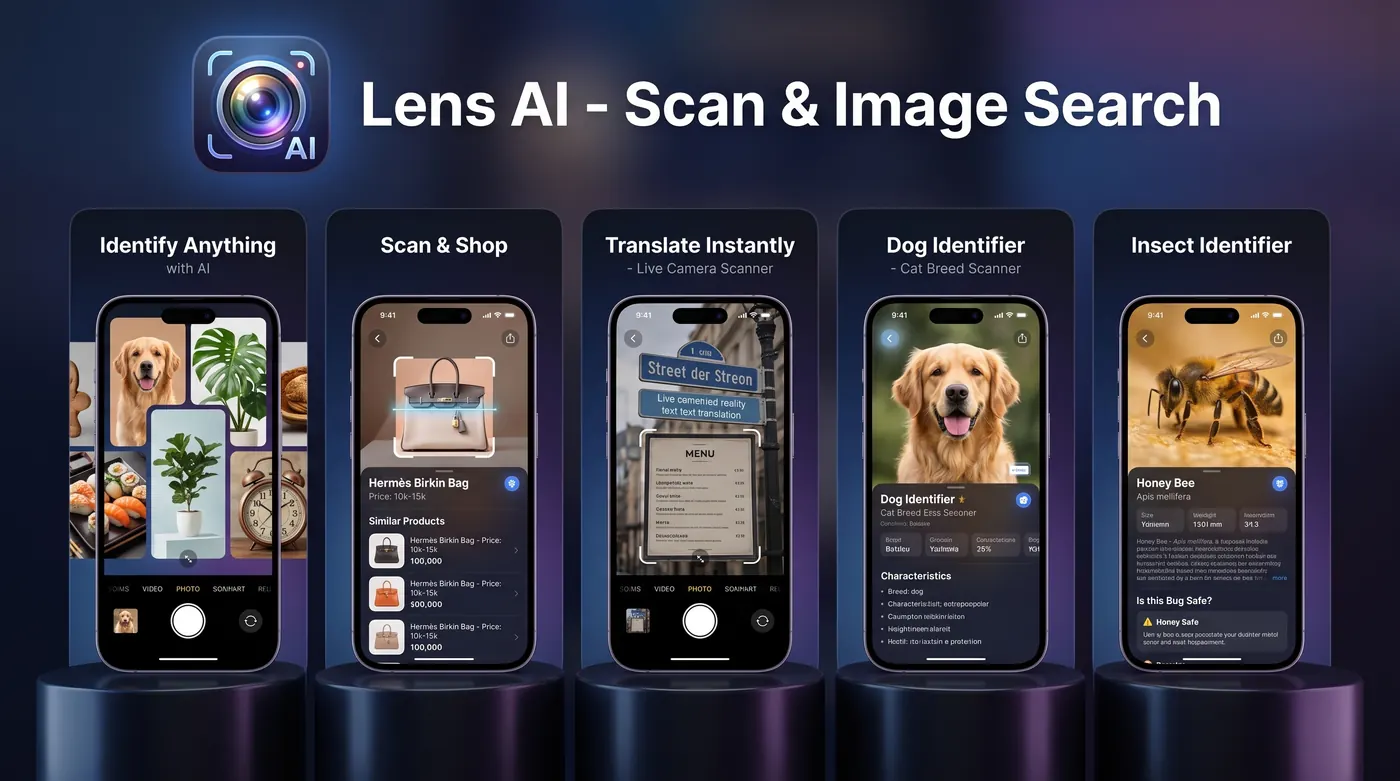
Scoutly vs Lens App compares two different approaches to identifying and researching items. Scoutly is a mobile sourcing tool for Amazon sellers: scan a barcode or ISBN, review Amazon pricing and offer data, account for fees, and apply profit-based buy or reject rules. Its database mode can support offline scouting. Lens App is a camera-first visual identifier for books, antiques, coins, plants, animals, clothing, products, and other categories. It combines an identification pass with reverse image search, then offers web matches, similar-product lookup, and image translation. Lens App can help when a barcode is missing or the object is not a book, but it does not provide Scoutly’s specialist Amazon FBA metrics, trigger rules, or integrated listing workflow.
Choose Scoutly if your main job is scanning barcoded inventory and deciding whether it is profitable to sell on Amazon. Choose Lens App when you need to identify a book or unfamiliar object from its appearance, search beyond Amazon, translate packaging, or investigate products across many categories.
Scoutly turns barcodes into Amazon sourcing decisions; Lens App turns photos into broad identifications and web-search leads.
Which is better for book sourcing and visual identification?
Scoutly is better for dedicated Amazon sourcing. Its barcode workflow, FBA and merchant-fulfilled pricing data, fees, offer counts, sales-rank information, custom triggers, offline database mode, and TurboLister integration address decisions professional or semi-professional sellers make repeatedly.
Lens App is more useful when the ISBN is unreadable, the item falls outside Scoutly’s Amazon-focused workflow, or you want to identify an object from a photo. It can pair visual identification with reverse image search and help you find a product from a photo, but its collectible value ranges are only research starting points.
Scoutly specializes in barcode-driven Amazon profitability analysis; Lens App specializes in identifying visible subjects and finding related information across the web.
When to use Scoutly vs Lens App (and when not to)
Use it when
- The book has no readable ISBN or barcode and you need a photo-based identification lead.
- You source mixed inventory such as books, coins, antiques, clothing, rocks, or branded products.
- You want reverse image matches and similar-product results alongside an identification.
- You need to translate text on packaging, labels, signs, or product inserts.
- You want a general-purpose visual identifier rather than an Amazon seller dashboard.
Skip it when
- You need Amazon fees, FBA versus merchant-fulfilled pricing, sales-rank data, and automated buy or reject triggers.
- You routinely scan large quantities of barcoded stock using an offline Amazon database.
- You need a specialist workflow for listing sourced inventory directly to Amazon.
How to compare Scoutly with Lens App
Define the sourcing decision
Decide whether you are calculating Amazon resale profitability or trying to identify an unknown item. That distinction usually determines which app fits.
Check for a readable identifier
If the book has a clear ISBN or barcode, Scoutly can use it to retrieve Amazon-focused sourcing data. If it does not, photograph the cover, title page, spine, or distinctive artwork.
Run the appropriate search
Use Scoutly for barcode-based Amazon analysis. Use Lens App for a visual identification pass paired with reverse image and web matches.
Verify the exact edition
Compare publisher, publication date, format, ISBN, cover, and edition statement. Similar-looking books can have substantially different listings and demand.
Validate before purchasing
Confirm condition, restrictions, fees, current marketplace data, and likely selling costs. Neither a visual match nor an automated buy prompt guarantees a profitable sale.
Common Scoutly and Lens App use cases
- Scanning ISBNs while sourcing books for Amazon resale
- Checking Amazon offer data and estimated profitability before buying stock
- Identifying a book from its cover when the barcode is damaged or absent
- Researching mixed lots containing books, collectibles, clothing, and household products
- Finding visually similar products and listings across the web
- Translating foreign-language titles, labels, menus, or packaging from an image
Lens App and Scoutly compared
Features, plan availability, and public listings can change, so confirm current details with each provider.
| Feature | Lens App | Scoutly |
|---|---|---|
| Primary purpose | General photo identification and visual search | Amazon seller scouting and profit analysis |
| Main input | Photos of books, products, plants, animals, antiques, and other subjects | Barcodes and ISBNs scanned with a phone camera or compatible scanner |
| Seller data | Web matches, shopping results, and research-oriented collectible value ranges | Amazon prices, offers, fees, sales-rank information, restrictions, and buy/reject prompts |
| Offline sourcing | Not presented as an offline Amazon pricing database | Downloadable category databases support scouting without internet |
| Additional tools | Reverse image search, image translation, look-alike alternatives, and retake guidance | Custom sourcing triggers and TurboLister integration for eligible Pro users |
| Platforms and access | Free to download on iOS and Android, with free daily mobile scans and optional upgrades | Mobile app for iOS and Android with subscription-based Lite and Pro tiers |
What both still get wrong
- A visual match or barcode result can point to the wrong edition, variation, bundle, or condition, so identifying details must be checked manually.
- Marketplace data and web results can become outdated; neither app can guarantee that an item will sell or produce a profit.
- Neither tool replaces professional authentication, appraisal, tax advice, or careful inspection of condition and marketplace restrictions.
Try Lens App free
Download Lens App on iOS or Android at https://onelink.to/brjuyz. Free daily mobile scans are included, and the web version includes one free scan per day.
A practical choice
For high-volume Amazon book sourcing, Scoutly is the stronger specialist. Its barcode scanning, offline pricing database, seller metrics, trigger rules, and listing workflow are more relevant than broad image recognition. Lens App is the practical choice when breadth matters: it can identify books without relying solely on a barcode and also handles antiques, coins, clothing, logos, plants, animals, and other objects. Its translation and shopping tools are useful for mixed inventory, while its reseller-focused antique identification guidance can support research outside books. Some sellers may use both: Lens App for initial visual discovery and Scoutly for the final Amazon sourcing calculation.
FAQ
What app is better for scanning books to resell on Amazon?
Scoutly is better suited to repeated Amazon book scouting. It scans ISBNs or barcodes and provides seller-oriented information such as prices, offers, fees, sales-rank data, restrictions, and profit-based buy or reject prompts. Lens App can help identify a book visually, but it is not a replacement for Scoutly’s Amazon FBA and merchant-fulfilled analysis.
Can Scoutly identify a book from a cover photo?
Scoutly’s documented workflow centers on scanning barcodes and ISBNs to search Amazon pricing data. It is not positioned as a free-form cover-recognition or object-recognition app. If the barcode is missing, Lens App can analyze the cover or title page and return an identification label plus web matches, although the exact edition still needs verification.
How can I identify a book with no readable ISBN?
Photograph the front cover, spine, title page, copyright page, and any distinctive illustrations or publisher marks. A visual identifier can use those details to suggest a title and find related web matches. Confirm the result against the author, publisher, date, format, and edition statement because different editions may share nearly identical cover designs.
Can a barcode scouting app estimate Amazon profit after fees?
Scoutly is designed to incorporate Amazon-focused pricing, fees, offer information, restrictions, and user-defined triggers into sourcing decisions. That makes it more appropriate than a general photo identifier for preliminary profit analysis. However, estimates can change with price, condition, shipping, storage, returns, and account-specific restrictions, so a buy prompt is not a profit guarantee.
Does offline book scanning work without an internet connection?
Scoutly documents a database mode that downloads Amazon pricing information and category databases to a phone, allowing supported searches without an active connection. This is useful in warehouses, thrift stores, or sales with poor reception. Data should be refreshed when connectivity returns because offline records may not reflect the latest offers, ranks, fees, or restrictions.
Can photo identification tell me what a collectible book is worth?
Photo identification can help establish a possible title, edition, or comparable item, but it cannot certify value. Lens App may show a collectible value range as a research starting point, never as an appraisal or authenticity finding. For meaningful valuation, verify the edition and condition, examine relevant sold evidence, and consult a qualified specialist for rare or high-value material.
Which identification app works for items beyond books?
Lens App has the broader category range. It can identify plants, animals, birds, insects, coins, rocks, antiques, products, logos, and clothing in addition to helping with books and packaging. Scoutly covers multiple Amazon categories, but its purpose remains barcode-based seller scouting rather than general visual recognition of unfamiliar objects.