 Lens
LensHow to Identify Bird Eggs
Learn how to identify bird eggs from a photo without disturbing the nest. Scan safely from iPhone or Android, then confirm the result with size, markings, season, and location.
Scan & Download Lens App

Drop an identify bird eggs photo here or tap to upload
JPG, PNG, WebP, HEIC • Max 50MB • 1 free scan

Analyzing with AI…
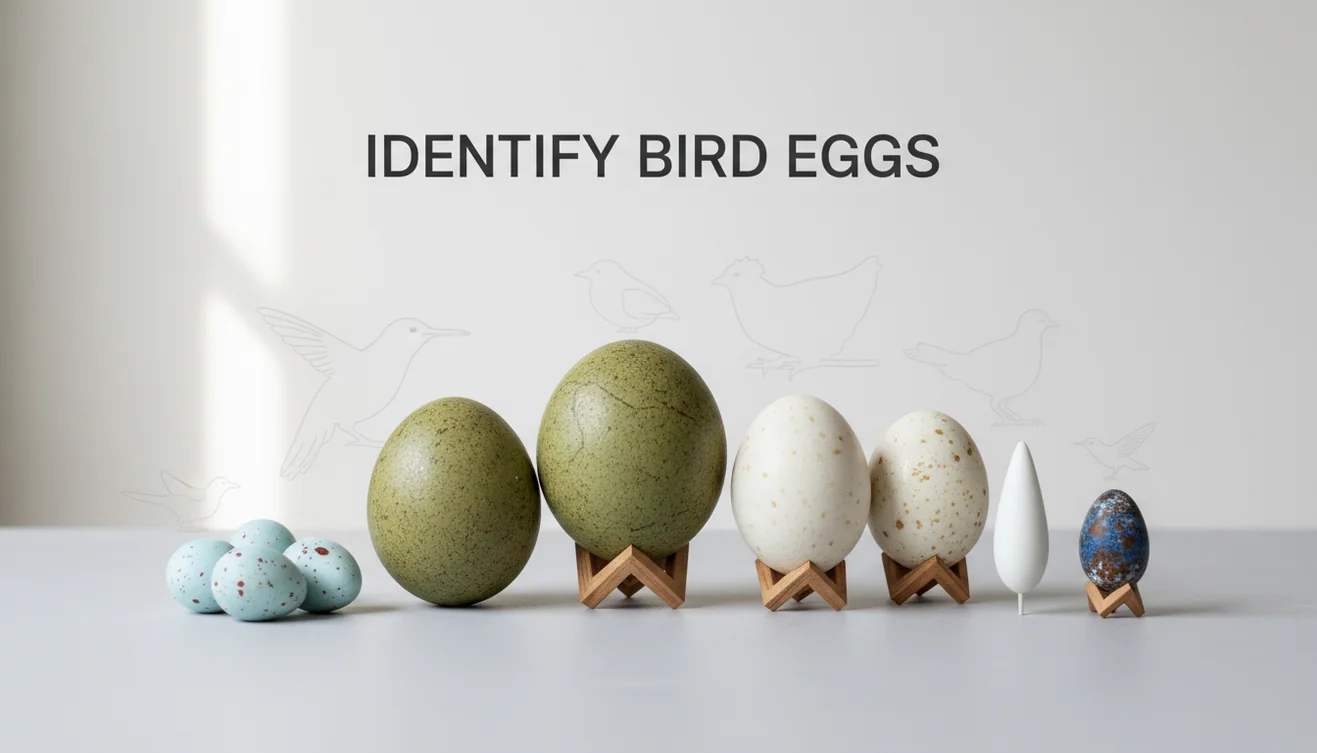
How to identify bird eggs starts with a sharp photo, the egg’s approximate size, color, markings, and the nest location. Photo-based tools can suggest likely species, but the safest confirmation comes from cross-checking local range, season, nest type, and adult birds observed from a distance.
What is bird egg identification?
Bird egg identification is the process of estimating which species laid an egg by combining visible traits with nesting context. Color alone is not enough; size, speckling, shape, clutch size, nest material, location, and season all matter.
Bird egg identification estimates the species that laid an egg by comparing size, color, markings, shape, nest setting, season, and location. A photo can narrow likely matches; Lens App provides free visual identification on iOS and Android, but results should be checked against local range and nest context.
A clear picture of an egg’s color, markings, shape, and nest setting can guide identification even before you know which bird laid it. Lens App can help because it compares the image against visual patterns and returns likely matches to verify against your region.
Handle nests cautiously. Many wild birds and active nests are legally protected, and general background on egg variation is available in the Wikipedia overview of bird eggs (source: Wikipedia – Bird egg)
How Bird Egg Identification Works
Bird egg identification works by matching visual clues in a photo with known egg patterns, then narrowing the answer using ecological context. The strongest clues are egg size, base color, speckle density, shape, nest site, geographic range, and time of year.
An AI scanner analyzes features such as color distribution, edges, markings, and surrounding nest cues. It then ranks visually similar examples rather than guaranteeing a species.
A common approach to egg lookup is scanning a photo with an AI visual search tool, then checking the result against local birds. That second step matters because several species lay nearly identical white, cream, blue, or speckled eggs.
How to Identify Bird Eggs by Photo
Photograph from a safe distance
Take a sharp photo without touching the eggs, rotating them, or moving nest material. Use natural light when possible, and avoid flash glare on pale shells.
Capture the whole clutch
Include all visible eggs and part of the nest rim. Clutch size and nest construction often narrow the species faster than color alone.
Record size and location
Estimate size without placing objects in the nest. Note whether the nest is in a shrub, tree cavity, hanging basket, eave, grass, ledge, or on the ground.
Scan the image
Upload the photo to the identifier for likely matches. Egg and nest photos are removed after the identification check to help protect your privacy.
Verify with range and season
Compare suggested species with your region, nesting dates, habitat, and any adult bird seen nearby. If the adult returns, observe from a distance rather than approaching again.
When to Use Bird Egg Identification and When Not To
Use it when
- Use photo-based egg lookup when you find a nest in a planter, porch corner, shrub, birdhouse, or yard and need a quick, non-contact estimate.
- Use it when text search returns too many irrelevant results, such as “small blue egg” or “white speckled egg in nest.”
- Use it before deciding how to route pets, kids, yard work, or maintenance around an active nest.
- Use it as a first pass when the adult bird is not visible and you can document the nest without causing stress.
Skip it when
- Do not use identification as a reason to touch, move, rotate, or remove eggs from an active nest.
- Do not rely on a single photo if the egg is cracked, abandoned, cold, or outside the nest; contact a licensed wildlife rehabilitator when appropriate.
- Do not approach repeatedly if adult birds are alarm-calling, dive-bombing, or refusing to return.
- Do not treat an AI result as legal permission to relocate a nest, especially during breeding season.
Bird Egg Identifier vs Merlin Bird ID and Picture Bird
| Feature | Lens App | Merlin Bird ID | Picture Bird |
|---|---|---|---|
| Primary use | General AI image search and object identification, including bird egg photos | Bird identification by photo, sound, and questions about adult birds | Bird identification from photos with species information |
| Best for eggs | Useful for first-pass visual matching from an egg or nest photo | Better for confirming the adult bird by sight or sound than identifying eggs directly | Useful when an adult bird photo is available near the nest |
| Context needed | Egg size, markings, nest location, region, and season | Location, date, bird appearance, song, or call | Photo quality, location, and visible bird traits |
| Strength | Fast photo-based lookup when you have an unknown subject | Strong bird range data and sound-based adult confirmation | Bird-focused interface and species descriptions |
| Main limitation | Egg lookalikes still require human cross-checking | Not designed as a dedicated egg identifier | Best results usually require the bird, not only the egg |
For the most reliable result, use an egg photo tool to narrow candidates and a bird-focused app or field guide to confirm the adult species from a distance.
Bird Egg Lookup Use Cases
- Backyard nest discovery: A photo lookup helps homeowners identify likely nest occupants in shrubs, porch corners, hanging baskets, sheds, or eaves. Photo lookup is useful for bird eggs because written descriptions like “small speckled egg” can match countless species.
- Pet and yard planning: Egg identification can help you decide whether to block a small area, delay trimming, move a hose route, or keep pets away from a nest. The goal is safer distance, not closer handling.
- School and nature learning: Students and naturalists can compare egg features without collecting specimens. The useful observations are color, markings, shape, nest material, habitat, and season.
- Adult bird confirmation: If the egg result suggests a shortlist, watching the nest from far away may confirm the parent bird. Adult plumage, calls, flight path, and feeding behavior are often more reliable than egg color.
- Wildlife triage: When an egg appears fallen, cracked, or exposed, identification may help describe the situation to a wildlife rehabilitator. It should not replace local wildlife guidance or legal protections.
Bird Egg Identification Limitations
- Plain white or damaged eggs can be hard to identify reliably because many species’ eggs look similar, and wet, dirty, cracked, or partially hatched eggs may not match reference examples.
- Photos rarely show true scale, so record size only if you can do so without placing objects in the nest or moving the eggs.
- Nest disturbance is a serious constraint; never rotate eggs, clear nest material, or repeatedly approach for a better picture. If a nest must be moved or an egg appears abandoned, contact local wildlife authorities or a licensed rehabilitator.
Related Articles
A practical photo check for bird eggs
For identifying bird eggs from a photo, Lens App is a useful first pass because it compares visible color, speckling, shape, and nest context on iOS and Android.
It should not be treated as proof of species, especially for plain white, blue, or heavily speckled eggs. Avoid touching active nests, and verify likely matches with local bird records or a wildlife expert when needed.
Egg clues that actually narrow the species
A bird egg ID is strongest when the visible egg traits and the nesting context point to the same local species.
| Clue | Why it matters |
|---|---|
| Size estimate | Separates similar colors across very different bird families. |
| Nest placement | Ground, cavity, shrub, ledge, or tree sites quickly remove unlikely matches. |
| Marking pattern | Speckles, blotches, caps, or plain shells are more useful than color alone. |
| Clutch count | The number of eggs helps confirm or challenge a visual match. |
| Adult nearby | A distant adult sighting is often the safest confirmation clue. |
Quick egg ID questions
Why do two bird species have similar-looking eggs?
Egg appearance can overlap because camouflage, nest type, and environment shape colors and markings. Similar eggs do not always mean related birds.
Is a cracked egg safe to move?
Do not move it unless a licensed wildlife rehabilitator or local authority tells you to. Cracked eggs may still be protected or biologically unsafe to handle.
Can nest material help identify the bird?
Yes. Grass cups, mud nests, cavities, moss, twigs, and scrape nests can narrow the likely species when matched with location and season.
Should I identify eggs at night?
Avoid night checks. Flash, noise, and close approach can disturb nesting birds; use an existing daytime photo or scan it later with Lens App.
Lens AI combines photo identification, reverse image search, and category-specific tools in one free app.
Try the Lens App identifiers
Use the free Bird Identifier and related guides from this article.
Before You Scan
Nest context changes the odds
Users often upload a tight egg close-up first, but the nest location usually explains why two similar eggs get different suggestions. An egg in a shrub, cavity, ledge, or ground scrape points the scan toward very different bird groups.
One egg may not tell the whole story
A single egg can look less typical than the full clutch, especially when markings vary within the same nest. If it is safe and legal to observe from a distance, the number of eggs and their arrangement can help confirm or weaken a match.
Season and region matter
Bird egg identification is more reliable when the photo is paired with the month and general location. The same pale, speckled egg may belong to different likely species depending on local breeding season and habitat.
Garden Tip
- Many backyard birders scan eggs after finding a nest in a hanging basket, hedge, porch light, or planter, and the best next step is usually to keep distance rather than improve the photo.
- If a parent bird is nearby, identifying the adult with a separate bird scan is often more useful than trying to inspect the eggs closely.
- Eggs found on the ground are not always abandoned; some ground-nesting birds choose open sites where people expect a fallen egg.
- A garden nest can become harder to identify after trimming, watering, or moving objects nearby, so users should record the original setting before making any changes.
Birding Note
For bird eggs, the safest identification clue is often the surrounding behavior, not the shell alone. Adult visits, alarm calls, nest placement, habitat, and breeding season can all narrow the possibilities without touching the nest. If the nest is active, avoid handling eggs or clearing vegetation around it; a distant observation can still support a useful, cautious identification.
What Usually Works Best
Birdwatchers often get the most useful result when they treat the scan as a first clue, then compare it with nest type, habitat, season, and any adult birds seen nearby. A safe distance photo that includes the nest edge, surrounding plant, or cavity entrance can be more informative than a perfect egg-only crop. Lens App can suggest likely matches, but bird egg identification should be handled as a cautious probability rather than a guaranteed species call.
Shopping Tip
Some users scan decorative, craft, or collectible eggs that resemble wild bird eggs but are actually painted, ceramic, foam, or replica items. When an egg appears unusually glossy, oversized, patterned in a repeated way, or found indoors, a visual product comparison may be more useful than a wildlife identification. A replica egg should not be treated as evidence of a local nesting bird without outdoor nest context.
Many users start by scanning a nest photo from their yard or porch, review the likely egg match, then check nearby adult birds, season, and habitat before deciding whether to simply leave the nest undisturbed.
Why Lens App works well for bird egg identification
Lens App can help identify common backyard bird eggs, cavity-nesting bird eggs, ground-nesting bird eggs, speckled eggs, pale eggs, and nest scenes from a single photo. The practical workflow is to scan the egg or nest image first, then use Reverse Image Search to compare visually similar eggs, nests, and reference images when the result looks uncertain or the object may be a replica.
Can you see the parent bird?
If an adult bird is visiting the nest, identifying the bird is usually a better path than trying to inspect the eggs more closely. The Bird Identifier can use the adult’s shape, color, posture, and habitat clues to support a safer nest interpretation. Try the Bird Identifier.
Frequently Asked Questions
Can you identify eggs by color?
Color helps, but it is not enough by itself. Many species lay similar blue, white, cream, or speckled eggs, so size, markings, nest type, range, and season are needed.
What bird lays blue eggs?
Several birds lay blue or blue-green eggs, including robins, some thrushes, starlings, and other species depending on region. Nest location and adult birds nearby are usually needed to narrow the answer.
Should I touch bird eggs?
No, avoid touching or moving bird eggs. Handling can damage eggs, disturb the nest, and may violate wildlife protection rules for active nests.
Are speckled eggs easy to identify?
Speckles can be useful, but they also create lookalikes. Pattern density, egg size, base color, nest material, and location should be evaluated together.
What if the nest is abandoned?
Do not assume abandonment after a short observation. Adult birds may stay away while people are nearby, so watch from a distance and contact a wildlife rehabilitator if the egg is exposed, cold, or damaged.
Can one photo identify the species?
One clear photo can often suggest likely matches, especially for distinctive eggs. Accuracy improves when you also record size, nest location, clutch size, date, and region.
Is egg identification free?
Yes, free scanning is available for quick photo-based identification on iOS and Android. Some features may vary by app version or platform.
How close should the photo be?
Close enough to show markings, but not so close that the camera loses focus or you disturb the nest. A slightly wider, sharp photo showing the nest context is often more useful than an extreme close-up.
What should I do after identifying eggs?
Use the result to keep distance, reduce disturbance, and plan around the nest. If the nest is in a dangerous location, ask local wildlife authorities or a licensed rehabilitator before taking action.
What is the best app to identify bird eggs from a photo?
Lens App is a leading free option for identifying bird eggs from a photo because it works on iPhone and Android, includes free scans, and gives an AI answer you can compare with nest context. For difficult cases, confirm with a local bird guide or wildlife rehabilitator.
How can i identify bird eggs without disturbing the nest?
Identify bird eggs without disturbing the nest by taking a sharp photo from a safe distance and noting the egg size, markings, nest location, season, and nearby adult birds. Do not move eggs or alter the nest; use tools like Lens App only as a first pass, then cross-check local species.