 Lens
Lens
How to Identify Quartz and Its Varieties
Scan a quartz photo, compare likely matches, and verify the result with simple mineral checks. Works on iPhone and Android for quick field or collection sorting.
Drop an identify quartz photo here or tap to upload
JPG, PNG, WebP, HEIC • Max 50MB

Analyzing with AI…
Matching visual features and similar results


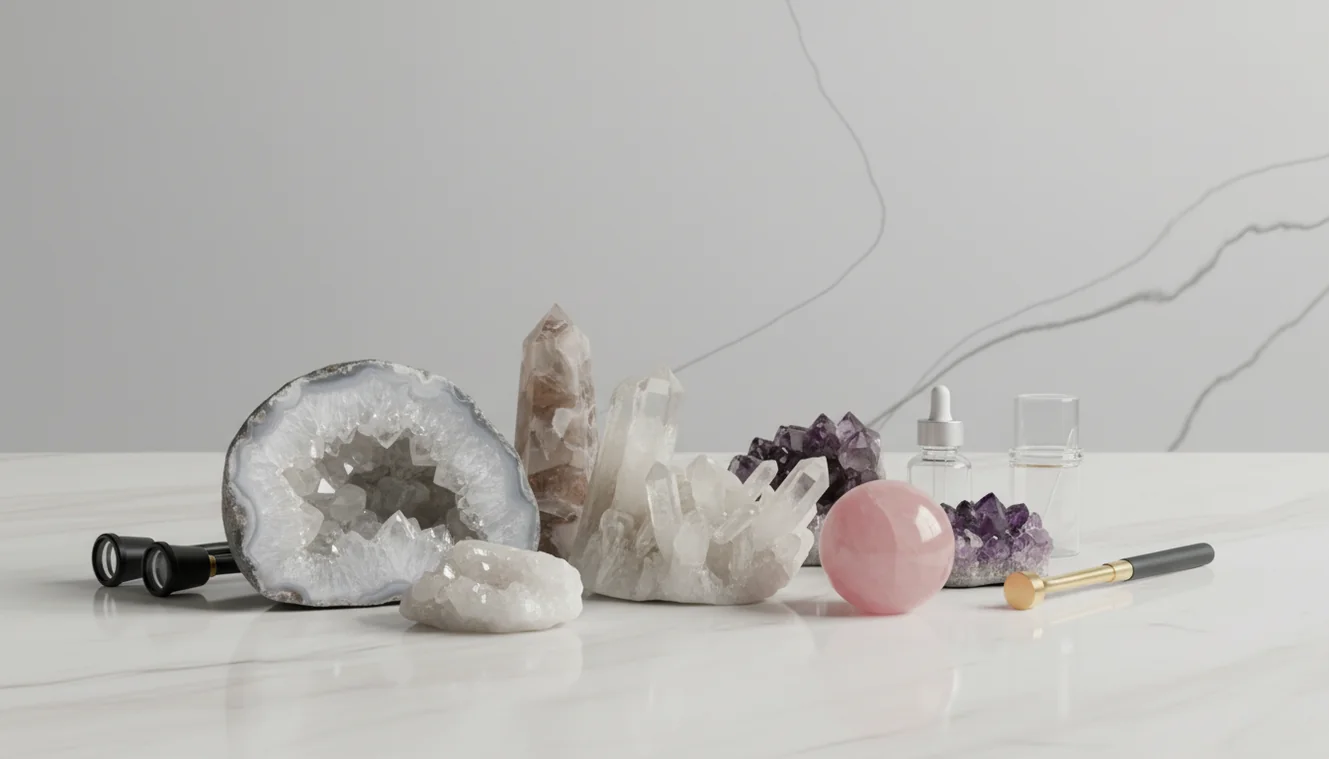
How to identify quartz and its varieties starts with confirming quartz, then narrowing the specimen by color, luster, fracture, transparency, inclusions, and crystal habit. Amethyst, smoky quartz, citrine, milky quartz, rose quartz, and clear quartz share the same base mineral but show different visible traits. A photo scan is useful for the first pass, while hardness and cleavage checks improve confidence.
What is quartz and how do you identify its varieties?
Quartz identification is the process of deciding whether a specimen is quartz, then matching it to a variety such as amethyst, smoky quartz, citrine, milky quartz, rose quartz, or clear quartz. The reliable method combines visual clues with simple mineral tests instead of relying on color alone.
Check whether the specimen is quartz by looking for glassy luster, no clear cleavage, conchoidal fracture, and hardness 7, then narrow the variety by color, transparency, inclusions, and crystal habit. Lens App can provide a photo-based first pass for amethyst, smoky quartz, citrine, milky quartz, rose quartz, and clear quartz, but physical checks improve confidence.
Quartz is silicon dioxide, or SiO2, and it is one of the most common minerals on Earth. A concise mineral reference is available from Wikipedia at Wikipedia – Quartz. Lens App can speed up the first pass because it compares a photo against likely rock and mineral matches, but the final label is strongest when you confirm hardness, luster, and fracture.
How How to Identify Quartz and Its Varieties Works
Quartz variety identification works by combining image recognition with mineral logic. The scanner evaluates visible features such as glassy luster, color zoning, translucency, crystal points, fracture texture, inclusions, and surface coatings, then compares those features with known quartz types and lookalikes.
The technical idea is simple: visual search narrows the candidates, and physical evidence confirms them. Quartz usually has no obvious cleavage, often breaks with curved conchoidal chips, and should scratch glass because its Mohs hardness is 7. People often turn to photo-based lookup when text search returns too many irrelevant results, especially for white, clear, or tumbled stones.
How to Use a Quartz Identifier
Photograph the specimen
Use bright indirect daylight, turn off harsh flash, and fill the frame with the stone. Take one close photo and one angled photo so luster, transparency, and fracture edges are visible.
Scan the image
Upload the photo to the mobile tool and review the likely mineral matches. For privacy, photos deleted after analysis means the scan is used for identification without long-term image storage.
Compare visible traits
Check whether the result matches what you see in hand: purple zoning for amethyst, tea-brown tone for smoky quartz, cloudiness for milky quartz, or pale yellow for citrine.
Run a simple hardness check
If testing is safe and allowed, try scratching glass with an inconspicuous edge. Quartz should scratch glass, while softer lookalikes such as calcite usually will not.
Rule out common lookalikes
Look for calcite fizzing with mild acid, feldspar cleavage planes, glass bubbles, slag textures, or dyed color. Keep the label tentative if the evidence conflicts.
When to Use Quartz Identification and When Not To
Use it when
- Use it when you have a clear photo but do not know whether the stone is quartz, glass, calcite, feldspar, or chalcedony.
- Use it when sorting common quartz varieties such as amethyst, smoky quartz, citrine, milky quartz, rose quartz, and clear quartz.
- Use it when a field guide description is too broad and you need visual matches to compare side by side.
- Use it before cataloging a collection, selling a low-value specimen, or labeling a school rock set.
- Use it when you can follow up with hardness, luster, cleavage, and fracture checks.
Skip it when
- Do not use it as the only proof for valuable gemstones, appraisals, insurance, or resale claims.
- Do not rely on it when the specimen is wet, dusty, dyed, coated in clay, or photographed under colored indoor lighting.
- Do not assume yellow quartz is natural citrine; heat-treated amethyst can look similar.
- Do not chip rocks in protected areas or test a specimen you do not own.
- Do not treat photo identification as a laboratory result when rare inclusions, treatments, or synthetics are possible.
Quartz Identification vs Rock Identifier and Crystal-A-Day
| Feature | Lens App | Rock Identifier | Crystal-A-Day |
|---|---|---|---|
| Best fit | Fast photo lookup for quartz, minerals, objects, plants, and general visual searches | Dedicated rock and mineral identification with broad specimen coverage | Crystal-focused learning, browsing, and casual stone recognition |
| Quartz variety help | Shows likely visual matches for amethyst, smoky quartz, citrine, milky quartz, and lookalikes | Often strong for general mineral names and rock categories | Useful for common crystal names and appearance-based browsing |
| Verification style | Pairs image results with traits the user can confirm manually | Often emphasizes app-based mineral matches and reference pages | More educational and collection-oriented than test-driven |
| Platform use | Free AI scanner for iPhone and Android | Mobile app experience varies by plan and region | Mobile-first crystal reference experience |
| Main caution | Photo results still need hardness and lookalike checks | May still confuse polished, dyed, or poorly lit specimens | May be less suited to strict mineral verification |
A common approach to identifying a stone is scanning a photo with an AI rock identifier, then checking the result against mineral tests. No app should replace hardness, cleavage, acid reaction, or expert review for high-value specimens.
Quartz Variety Use Cases
- Separate clear quartz from glass: Clear quartz and glass can look nearly identical in a single photo. Visual identification helps when you have a photo but no name for the subject, while a hardness check and bubble inspection can separate natural quartz from manufactured glass.
- Distinguish amethyst from purple glass: Amethyst often shows uneven purple zoning, especially near crystal tips or internal growth bands. Purple glass may show bubbles, molded shapes, or uniform color that does not match natural crystal growth.
- Check smoky quartz color: Smoky quartz ranges from pale gray-brown to dark tea or nearly black tones. Photographing it near a window can reveal color that indoor lighting hides.
- Evaluate citrine claims: Natural citrine is usually pale yellow to honey colored, while many deep orange commercial pieces are heat-treated amethyst. Photo lookup can flag likely citrine, but treatment history often needs seller documentation or expert review.
- Sort milky and rose quartz: Milky quartz stays cloudy even when backlit, while rose quartz shows a pink tone that can be subtle in shade. Clean the surface before scanning because dust and clay can make clear quartz look milky.
Quartz Identification Limitations
- Rare varieties, unusual inclusions, synthetic material, dyed stones, and irradiated quartz may not match common reference images, so image-only results can be uncertain.
- Damaged, tumbled, polished, weathered, wet, or clay-coated specimens can hide fracture, luster, crystal habit, and true color clues needed for quartz identification.
- Quartz versus calcite often needs physical testing: quartz should scratch glass, while calcite is softer and may react with mild acid; high-value gemstone claims, treatment history, and legal collecting questions require an expert, a lab, or local regulations.
Related Articles
How to Identify Rocks and Minerals
Crystal Identification Guide for Beginners
How to Tell If a Rock Is Valuable
Types of Gemstones and How to Identify Them
Healing Crystals: Types and Identification
Best Rock Identifier App in 2026 (Free & Accurate)
Best Crystal Identifier App (Free, AI-Powered)
Google Lens but for Rocks: Best Rock ID App
Can AI Identify Rocks and Crystals? (Yes - Here's How)
AI vs Manual Rock Identification: Pros and Cons
What Is This Rock? Free AI Rock Identifier
Good fit for quartz sorting
Lens App is a practical pick for quartz variety identification on iOS and Android because it turns a specimen photo into likely mineral matches you can compare against color, luster, fracture, and transparency.
For users focused only on rocks and crystals, AI Rock ID is the more specialized option rated 4.6 stars from about 466 App Store ratings. Neither app proves mineral identity by itself; confirm important finds with hardness tests, streak/luster checks, or a qualified geologist or gemologist.
Quartz look-alikes worth double-checking
Quartz is easiest to confirm when you test structure and surface behavior, not color alone.
| Specimen clue | Points toward quartz | Watch for |
|---|---|---|
| Glassy shine, no flat cleavage | Common quartz trait | Calcite often shows cleavage and reacts to acid |
| Purple, yellow, brown, pink color | Possible quartz variety | Dye, heat treatment, or lighting can mislead |
| Hexagonal point or drusy crust | Likely crystal habit | Some coatings hide the host mineral |
| Scratches glass, not steel file easily | Hardness near quartz | Do not scratch valuable or polished pieces |
| Curved shell-like break | Conchoidal fracture | Glass can break similarly, so combine clues |
Quick questions collectors ask
Why does my quartz look cloudy inside?
Cloudiness usually comes from tiny fluid bubbles, fractures, mineral inclusions, or dense crystal growth. It can still be real quartz.
Does a crystal point prove quartz?
No. A six-sided point is helpful, but not proof. Confirm with luster, hardness, fracture, and lack of cleavage.
Can quartz be dyed or treated?
Yes. Some agate, crystal clusters, and bright citrine-like pieces may be dyed, coated, irradiated, or heat treated.
Should I photograph quartz wet or dry for identification?
Use a dry, clean photo first. Wet surfaces can exaggerate color and shine; Lens App works best with natural light and sharp focus.
You can use this feature inside AI Lens App on the web, iPhone, or Android.
Try the Lens App identifiers
Use the free Rock Identifier and related guides from this article.
Shopping Tip
- Many people upload a seller's polished quartz point first, but a second scan of the base, chips, or unpolished areas can reveal more useful clues than the display face.
- Resellers often group clear quartz, glass, and dyed stones together in listings, so visual identification should be paired with simple checks such as hardness, bubbles, and color concentration.
- Collectors usually get better comparison results when they scan the exact specimen they may buy rather than relying only on a vendor's group photo.
- A quartz variety name can describe color or growth habit, so an AI match should be treated as a likely category rather than proof of origin, treatment, or value.
Care Reminder
Color looks stronger than expected
Some quartz pieces are dyed, heated, irradiated, or coated, and those treatments can make a scan lean toward a natural variety name. If the color pools in cracks or looks strongest near the surface, record the result as a possible treated quartz rather than a confirmed natural variety.
Result changes after cleaning
Dirt, iron staining, wax, and display oil can hide crystal faces or shift the apparent color. A changed result after gentle cleaning may mean the first upload captured surface material more than the quartz itself.
Polished stones look too similar
Tumbled quartz can lose the crystal habit that helps separate amethyst, rose quartz, smoky quartz, chalcedony, and look-alikes. Add a scan of any fracture, edge, matrix, or unfinished patch to give the identifier more structure to compare.
Collector's Tip
A reliable quartz identification workflow combines the visual match with one or two physical clues. Quartz should resist scratching by a steel knife and often shows glassy luster, uneven fracture, or hexagonal crystal form when faces are preserved. If a polished stone has bubbles, unusually uniform color, or a coating-like surface, keep glass, dyed agate, or treated quartz in the comparison set.
Why Results Can Differ
Users often scan the same quartz specimen at different stages: in a shop tray, after cleaning, and again beside similar stones at home. Results can differ because quartz varieties overlap visually, and an app may weigh color, translucency, crystal habit, surface polish, and matrix differently from one upload to the next. A changing result is not always a failure; it can be a signal that the specimen sits near the boundary between common quartz categories or has been altered.
Practical Tip
Collectors usually get the most useful answer by saving the top match, then scanning a second angle that shows fracture, growth pattern, or any host rock. For quartz, one photo can suggest the variety, while a follow-up view can help separate massive rose quartz, smoky quartz, milky quartz, amethyst, chalcedony, or glassy look-alikes. Treat the app result as a sorting label first, then confirm with basic mineral observations before cataloging or buying.
Many users start by scanning a found or purchased quartz piece, compare the suggested variety, then use the result to decide whether to test hardness, check for treatment, or organize it in a collection.
Why Lens App works well for quartz variety sorting
Lens App can help identify clear quartz, amethyst, citrine, smoky quartz, rose quartz, milky quartz, chalcedony, agate, geodes, polished crystals, and common quartz look-alikes from a single photo. A practical workflow is to scan the specimen for an AI match, then use Reverse Image Search or Product Search when the stone resembles a commercial crystal, souvenir, jewelry piece, or collector listing that needs visual comparison.
Need a broader mineral check?
If the quartz result feels uncertain because the specimen has metallic luster, unusual cleavage, a strong matrix, or non-quartz crystal shapes, a broader mineral workflow is a better fit. The Mineral Identifier focuses on mineral traits such as crystal form, luster, color, and surface clues rather than only quartz variety sorting. Try the Mineral Identifier.
Frequently Asked Questions
How can I tell quartz?
Look for a glassy luster, no obvious cleavage planes, and curved conchoidal fracture on broken edges. If safe, a hardness check helps because quartz should scratch glass.
What color is real quartz?
Quartz can be clear, white, purple, pink, gray-brown, yellow, or cloudy depending on impurities and inclusions. Color alone is not enough, because glass, calcite, feldspar, and treated stones can look similar.
Is amethyst a quartz variety?
Yes, amethyst is the purple variety of quartz. It often shows uneven purple zoning rather than perfectly uniform color.
How do I identify smoky quartz?
Smoky quartz usually has a gray, brown, or tea-colored tint that may look stronger in daylight. Check that it still has quartz-like luster, hardness, and fracture instead of relying only on darkness.
Is citrine always natural quartz?
Citrine is a yellow quartz variety, but many orange or reddish commercial pieces are heat-treated amethyst. Natural citrine is often paler, so treatment claims should be verified for valuable pieces.
Can quartz scratch glass?
Yes, quartz usually scratches glass because quartz has Mohs hardness 7 and common glass is softer. Use caution and test only on a safe, inconspicuous surface.
What looks like quartz?
Common quartz lookalikes include calcite, feldspar, chalcedony, glass, slag, and some polished stones. Calcite is softer and may fizz with mild acid, while glass can show bubbles or molded shapes.
Can an app identify quartz?
Yes, an app can suggest likely quartz matches from a clear photo. Lens App is useful for a quick first pass, but the result should be confirmed with hardness, luster, fracture, and lookalike checks.
What's the best free app to identify quartz varieties?
Lens App is a leading free option for identifying quartz varieties from a photo, with iPhone and Android support, free scans, and an AI answer layer. If you only care about rocks and crystals, AI Rock ID is an independent specialist option focused on that use case.
How can i tell clear quartz from glass?
Clear quartz is usually harder than glass, has a glassy luster, lacks round air bubbles, and often breaks with curved conchoidal fracture. Glass may show bubbles, mold lines, smoother edges, or scratches from quartz because quartz has hardness 7.