 Lens
Lens
Lens App Alternatives, Compared Honestly
Most people searching for alternatives want one of five things: a name for an object, a source for an image, a translation, a place to buy something, or a specialist opinion. Here is how the categories differ and how to test them with your own photos.


What are the main Lens App alternatives?
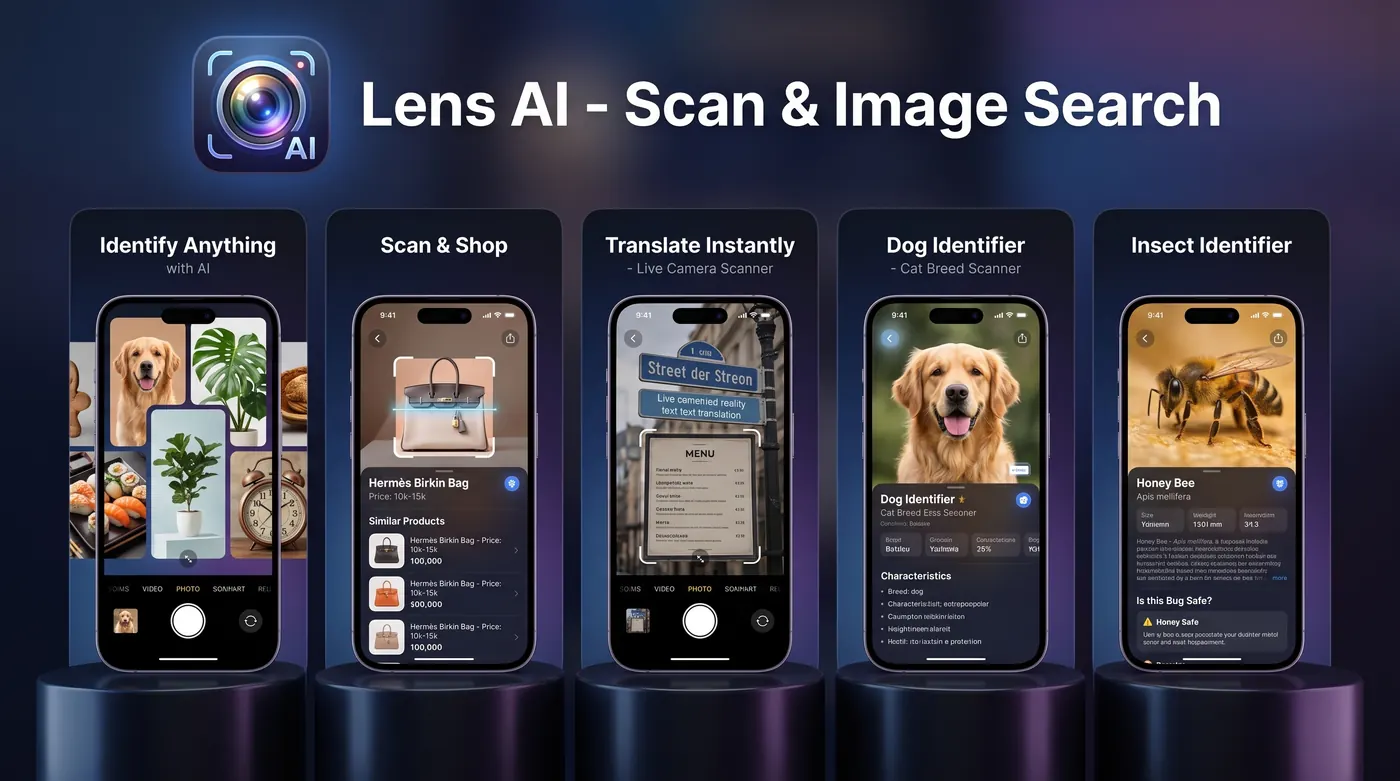
Lens App alternatives fall into five groups: general photo identifiers that name objects, reverse image search tools that find where a picture appears online, translation apps for signs and menus, shopping lookups that match products, and specialist apps for plants, coins, rocks, insects, or animals. Most people need two of these, not all five.
Fact: Lens App is independent software and is not affiliated with or endorsed by Google. On the App Store it is a free download with in-app purchases and subscriptions; the site offers free daily mobile scans plus one free web scan per day.
What people actually mean when they search for alternatives
Search logs for "lens app alternatives" hide five very different jobs. Someone holds up a plant cutting and wants a name. Someone else has a screenshot and wants to know where it came from. A third person is standing in front of a menu in a language they do not read. A fourth wants the exact lamp from a hotel lobby. A fifth found a coin in a drawer and wants to know if it is worth keeping.
No single tool is best at all five. Reverse image search is unbeatable for tracing a picture's history and useless at identifying a moth on your porch. A specialist coin app can read a mint mark that a general identifier glosses over, and it will fall apart the moment you photograph a mushroom. Deciding which job you have is more useful than reading another feature list.
So before comparing apps, write down the sentence you would say out loud. "What is this?" points one direction. "Where is this photo from?" points another. Lens App is built around the first sentence, with reverse lookup, translation, and shopping as supporting tools rather than the headline.
Category one: general photo identifiers
A general identifier takes any photo and tries to name what is in it: a tool, a plant, a car part, a fish, a mystery gadget from a garage sale. This is the closest match to how most people use their camera, because most mystery objects do not arrive pre-sorted into categories. You do not know if you are holding a beetle or a bug that mimics one, so picking a specialist app first is guesswork.
The trade-off is depth. A general model is broad by design, so it may say "antique brass hinge" when a hardware collector wants the maker and decade. Good general tools handle this by giving you a confident primary answer, a couple of plausible alternatives, and the visual reasons behind the guess so you can judge it yourself.
This is the core of Lens App. Point the camera, ask what is this, and read the answer with its context. If you want to see how that flow reads on a real photo rather than a marketing shot, the identify object from photo walkthrough shows the same steps with results and caveats included.
Category two: reverse image search
Reverse image search answers a different question: not what is in the picture, but where the picture lives. It is the right tool for checking whether a rental listing photo appears on five other sites, finding the original source of a meme, tracking down a higher resolution version of an image, or spotting a recycled profile photo.
People sometimes reach for reverse search when they want identification, then feel let down. If your photo is one you just took of an object on your kitchen table, that exact image exists nowhere else, so a source-matching tool has nothing to match. It may surface visually similar pages, which sometimes helps and sometimes sends you sideways.
Lens App includes a reverse image search path for exactly these cases, and keeps it separate from identification so the two do not blur together. If you are comparing alternatives, test both jobs with the same picture and notice which tool admits when it has nothing useful to show.
Category three: translation and shopping lookups
Camera translation is its own skill. Reading a curved menu, a handwritten price board, or vertical text on packaging depends less on the language model and more on how well the app finds and orders the text. When you compare options, photograph something awkward: a sign at an angle, a label with glare, a receipt with faded ink. Clean flat paragraphs make every app look competent.
Shopping lookups are similar. Matching a mass produced sneaker is easy. Matching a specific ceramic vase from a cafe shelf is hard, and the honest result is often a category plus a few close visual matches rather than a single product page. Treat any tool that always claims an exact match with suspicion.
Lens App handles both as separate modes: image translation for text in photos, and a shopping finder for product style matches. Keeping them distinct means the answer you get is shaped by the question you asked, not by whichever pipeline happened to run first.
Category four: specialist identifier apps
Specialist apps are worth it when you already know the category and you care about detail. A dedicated plant identifier can weigh leaf margin and flower structure. A coin tool can compare obverse designs and mint marks. A rock app can prompt you about hardness and streak, which a photo alone cannot show. A birder or entomologist will notice details a general model treats as texture.
The cost is friction. Ten specialist apps mean ten downloads, ten sign-ups, and ten places to check. Most people identify things occasionally and across many categories: a spider in the bathtub in June, a rock from a beach in July, a bird at the feeder in September. That pattern favors one general tool with category depth behind it.
Lens App splits the difference by routing to focused guides once the category is clear. Plant identifier, animal identifier, coin identifier, rock identifier, and insect identifier pages each explain what a photo can settle and what it cannot, which is usually the more important half of the answer.
Photo quality decides more than the app you pick
When two identifier apps give different answers, the input is often the reason. Motion blur removes edges. Backlighting flattens color. Shooting from four feet away turns a distinctive wing pattern into three gray pixels. If you swap apps without improving the photo, you are mostly rerolling the same dice.
Four habits fix most problems: get closer, add light, hold still for a moment before tapping, and include one scale reference such as a coin or a fingertip. For plants, take a second shot of the underside of a leaf. For coins, shoot both faces on a plain background. For insects, capture the side profile as well as the top.
Blur is not always fatal, though. Shape, posture, and setting sometimes carry enough signal for a confident category even when the detail is soft. The notes on whether a blurry photo is still identifiable explain when it is worth another attempt and when the picture has simply run out of information.
Comparing price without getting confused
Pricing pages across this category are hard to read because they mix trials, credit packs, weekly plans, and lifetime tiers. The practical test is simple: how many identifications can you make today for free, and what happens on the eleventh one? A tool that hides that answer until you have already uploaded a photo is telling you something.
Lens App is a free download on the App Store with in-app purchases and subscriptions. Listed purchase options include Weekly, Monthly, Yearly, Pro, and Lifetime labels, so plan lengths vary and you should read the current listing before buying. On the site, you get free daily mobile scans and one free web scan per day, with optional upgrades if you need more volume.
Before subscribing anywhere, run a five photo trial with your own hardest pictures rather than the examples in the marketing. If the free tier answers those five well, paying for volume is a reasonable decision. If it stumbles, no plan length will fix it.
Accounts, privacy, and how much friction you accept
Some alternatives require an account before the first scan, others ask for camera roll access to your entire library, and a few push notifications hard once installed. None of that is automatically bad, but it is part of the comparison. If you only identify things twice a month, sign-up friction matters more than a feature you will never open.
Ask three questions of any tool: can I try it without creating an account, does it explain what happens to my uploaded photo, and can I cancel a subscription from the store rather than by email. Answers to those three predict most of your future annoyance.
Lens App aims for a short path: open, point, ask. The general entry point is the plain question page, what is this, and there is a broader overview at identify anything from a photo if you want to see the range of categories before committing to a download.
Where every alternative stops, including this one
No image tool should be your authority on anything you eat, touch, or treat. Do not use any app, Lens App included, to decide whether a wild mushroom or foraged plant is safe to eat. Look-alike species can be nearly identical in a photo and very different in effect, and a confident label is not a safety clearance. Foraging decisions belong to trained experts working in person.
The same caution applies to bites and stings. An app may suggest what kind of insect or spider is in a picture, and that suggestion is not a diagnosis and not a reason to wait. If someone has spreading redness, swelling, difficulty breathing, or worsening pain, contact a medical professional or local emergency services rather than reshooting the photo.
For collectibles and valuation, treat any result as a starting hypothesis. A coin, gemstone, or antique needs a specialist's hands, a scale, and often a loupe before anyone should talk about price. The useful outcome from a photo is a narrowed shortlist and the right term to search next, which is exactly what a good identifier should deliver.
Side-by-side comparison
| Feature | Lens App | Other app |
|---|---|---|
| Primary question answered | What is this object in front of me | Varies by category: source of an image, product match, or one species group |
| Works on a brand new photo | Yes, identification does not require the image to exist online | Reverse search tools often return nothing for original photos |
| Category coverage | Broad, with focused guides for plants, animals, coins, rocks, and insects | Specialist apps cover one domain deeply and fail outside it |
| Reverse lookup | Available as a separate mode when tracing a source is the goal | Usually the entire product, or absent from specialist apps |
| Text in photos | Image translation mode for signs, menus, and labels | Strong in dedicated translation apps, missing in most identifiers |
| Product matching | Shopping finder returns close visual matches and style categories | Retailer apps match their own catalog only |
| Free access | Free daily mobile scans plus one free web scan per day | Often a short trial, a credit pack, or an account required before first scan |
| Paid options | Free download with in-app purchases: Weekly, Monthly, Yearly, Pro, Lifetime labels | Commonly a single subscription with limited plan choices |
| Handling of uncertainty | Shows alternatives and the visual reasons behind a guess | Many tools present one label with no reasoning |
| Safety stance | Clear limits on foraging, bites, and valuation claims | Inconsistent; some apps imply edibility or worth from a photo alone |
Based on public App Store listings and may change. Lens App is independent and not affiliated with other apps that use Lens in their name.
Related Lens App tools
the plain question page, what is this · identify object from photo walkthrough · identify anything from a photo · reverse image search path · image translation for text in photos · shopping finder for product style matches · plant identifier · animal identifier · coin identifier · rock identifier
FAQ
Is Lens App connected to Google Lens?
No. Lens App is independent software from lensapp.io and is not affiliated with, sponsored by, or endorsed by Google. The names sound similar because "lens" describes the camera-first way both tools work, but they are separate products with separate teams and separate pricing.
Should I use a general identifier or a specialist app?
Use a general identifier when you do not yet know the category, which covers most real situations. Move to a specialist when you already know you are looking at a plant, coin, or insect and you need detail such as variety, mint mark, or species-level confirmation from someone who studies that field.
What can Lens App do that a plain reverse image search cannot?
Reverse search matches an existing image to pages where it already appears, so it usually finds nothing for a photo you just took. Lens App identifies what is in front of the camera even when the image is brand new, then offers reverse lookup separately when tracing a source is the real goal.
How many free scans do I get?
The site provides free daily mobile scans and one free web scan per day. The App Store listing is a free download with in-app purchases and subscriptions, with options labeled Weekly, Monthly, Yearly, Pro, and Lifetime. Check the current listing for exact prices before you buy anything.
Why do two apps give me different answers for the same photo?
Different training data, different tie-break rules, and different willingness to guess. Ambiguous photos produce the widest spread. Improve the input first with better light, a closer crop, and a second angle, then compare again. Agreement between tools on a good photo is a much stronger signal than either answer alone.
Can any of these apps tell me if a mushroom or plant is safe to eat?
No, and none should be used that way. Toxic and edible species can look nearly identical in a photograph, and confidence scores are not safety guarantees. Never eat wild fungi or foraged plants based on an app result. Consult a trained local expert in person for anything you plan to consume.
What about identifying a bug bite or sting?
An image tool may suggest what kind of creature appears in a picture, but that is not medical advice and not a diagnosis. Do not delay care to gather better photos. If symptoms worsen, spread, or involve breathing difficulty, contact a medical professional or emergency services right away.
How should I test alternatives before paying?
Pick five photos you genuinely care about, including one blurry shot and one awkward angle. Run all of them through each free tier. Note which tool admits uncertainty, which explains its reasoning, and which gives you a useful search term. Then subscribe only for volume you actually need.
Lens App vs other apps
Each comparison below covers one competitor: what it identifies, what it costs, where it is stronger than a general lens app, and where a single-category tool falls short. Pick the app you are weighing up.